
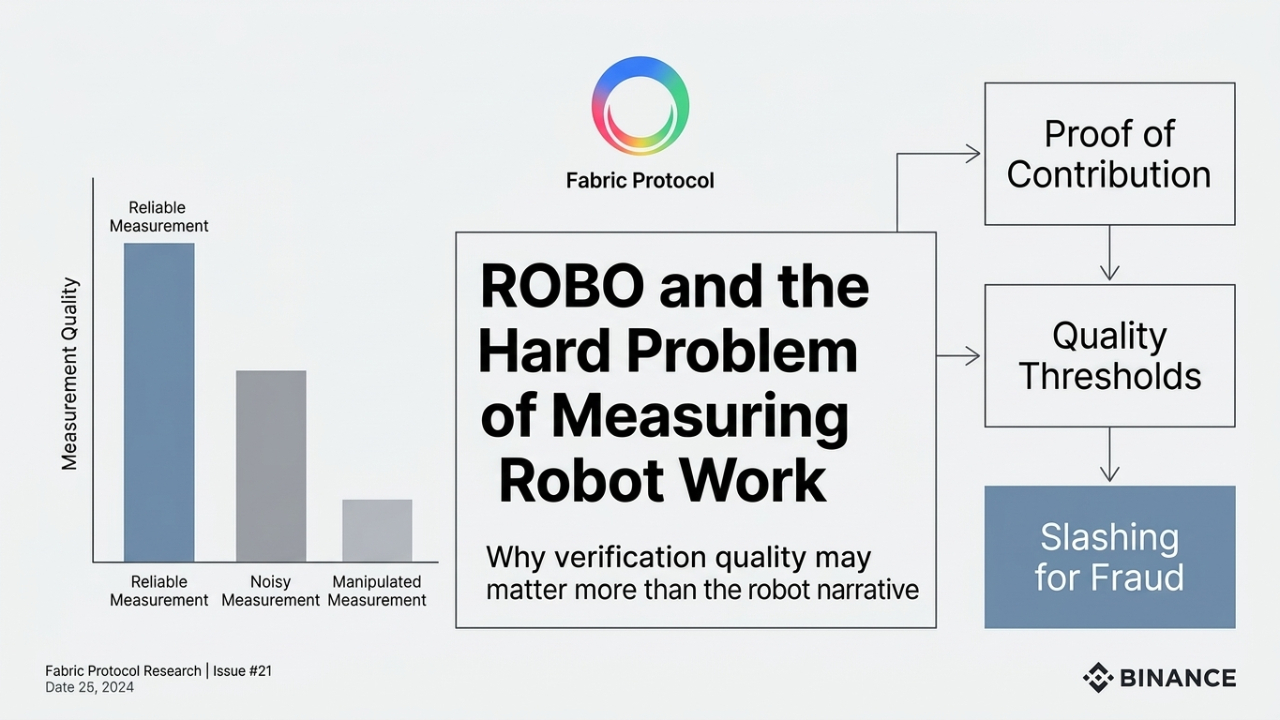

I like the ambition here. I do not automatically trust the leap.
I went back through the ROBO whitepaper and this time I kept my hype brain switched off. No easy “robot economy is coming” lines. No automatic respect just because the paper is long and uses equations. I wanted to see where the idea gets uncomfortable. Honestly that is where it got more interesting for me.
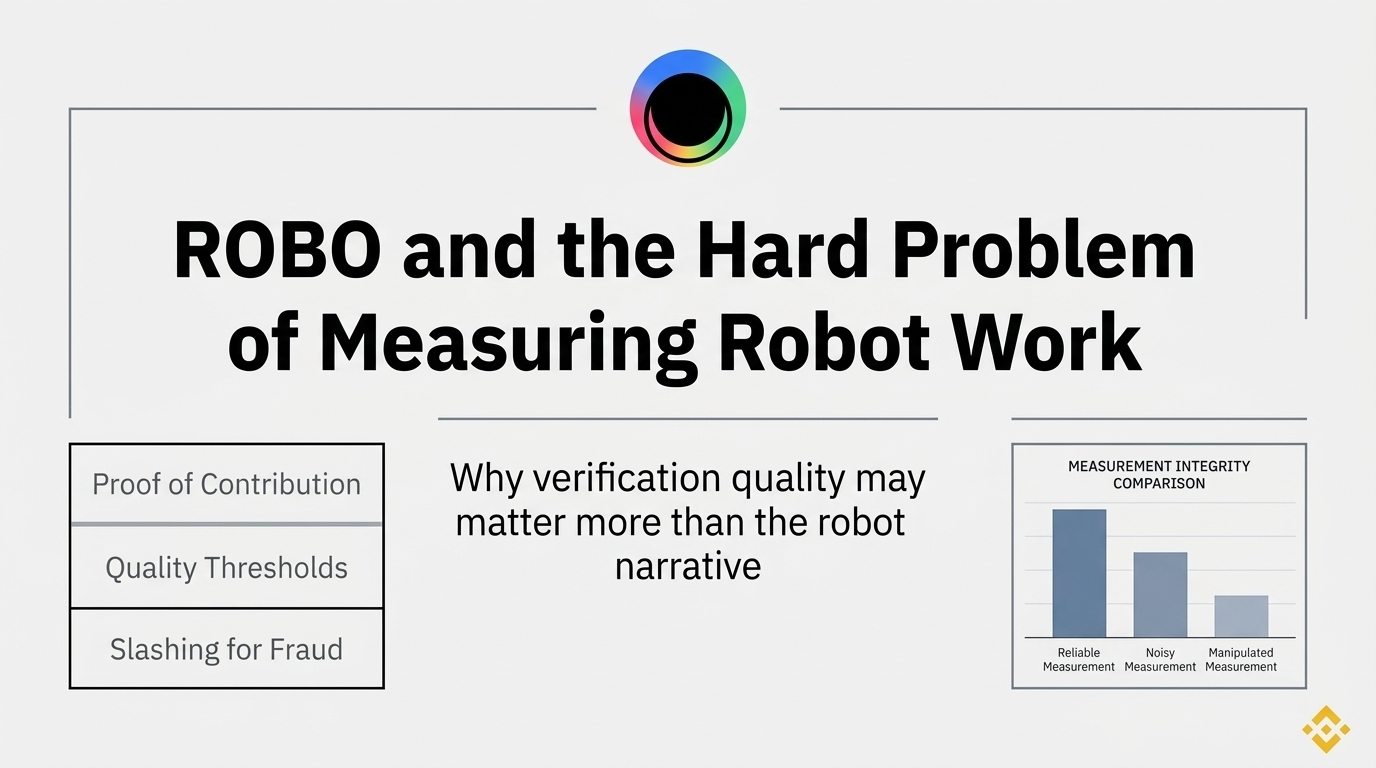
The angle that stands out now is not identity or open robotics or skill chips. It is the whitepaper’s attempt to turn robot contribution into a measurable economy before that economy really exists at scale. That is bold. It is also risky as hell 😅
Fabric is not just proposing a token for robotics. It is trying to pre-build the accounting system for a future labor market where robots complete tasks humans validate outcomes developers add skills compute providers contribute resources and everyone gets scored and paid through the protocol. On paper that sounds smart. In practice it means the project is making a huge bet that machine work can be measured cleanly enough to support rewards penalties governance and market structure. That is the real bet here. Not robots. Not AI. Measurement.
That is where I got more critical.
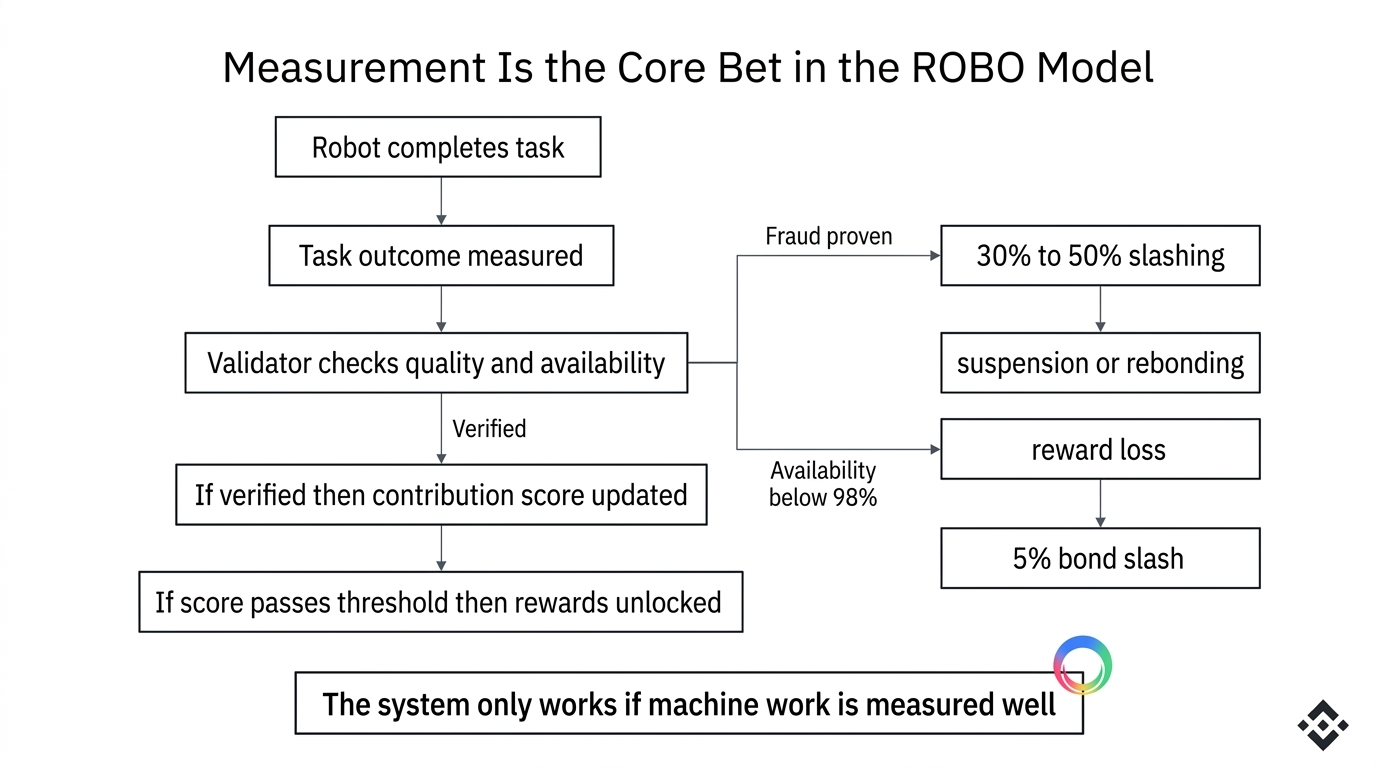
The whitepaper is full of mechanisms that depend on measurement quality. The adaptive emission engine responds to utilization and service quality. Proof of contribution depends on verified work. Rewards depend on contribution scores. Penalties depend on fraud detection uptime and quality thresholds. The evolutionary layer depends on graph values and revenue signals. All of that sounds elegant until you ask a very annoying question. What if the measurement layer is noisy manipulated incomplete or just plain wrong. Then a lot of the economic beauty starts wobbling.
And this is not some small detail. It is the core pressure point.
The paper itself gives away how central this is. It sets a target quality threshold of 0.95 in the emission controller and proposes a maximum 5 percent per epoch adjustment as a circuit breaker. Later it uses hard operating standards like 98 percent availability over a 30 day epoch and a quality floor of 85 percent before reward eligibility gets suspended. Those are serious numbers. I actually respect that. They are not hiding behind vague words like reliability or trust. They are trying to pin the system down. But strict thresholds only help if the underlying data is credible. Otherwise the protocol risks becoming a machine that confidently optimizes around imperfect signals.
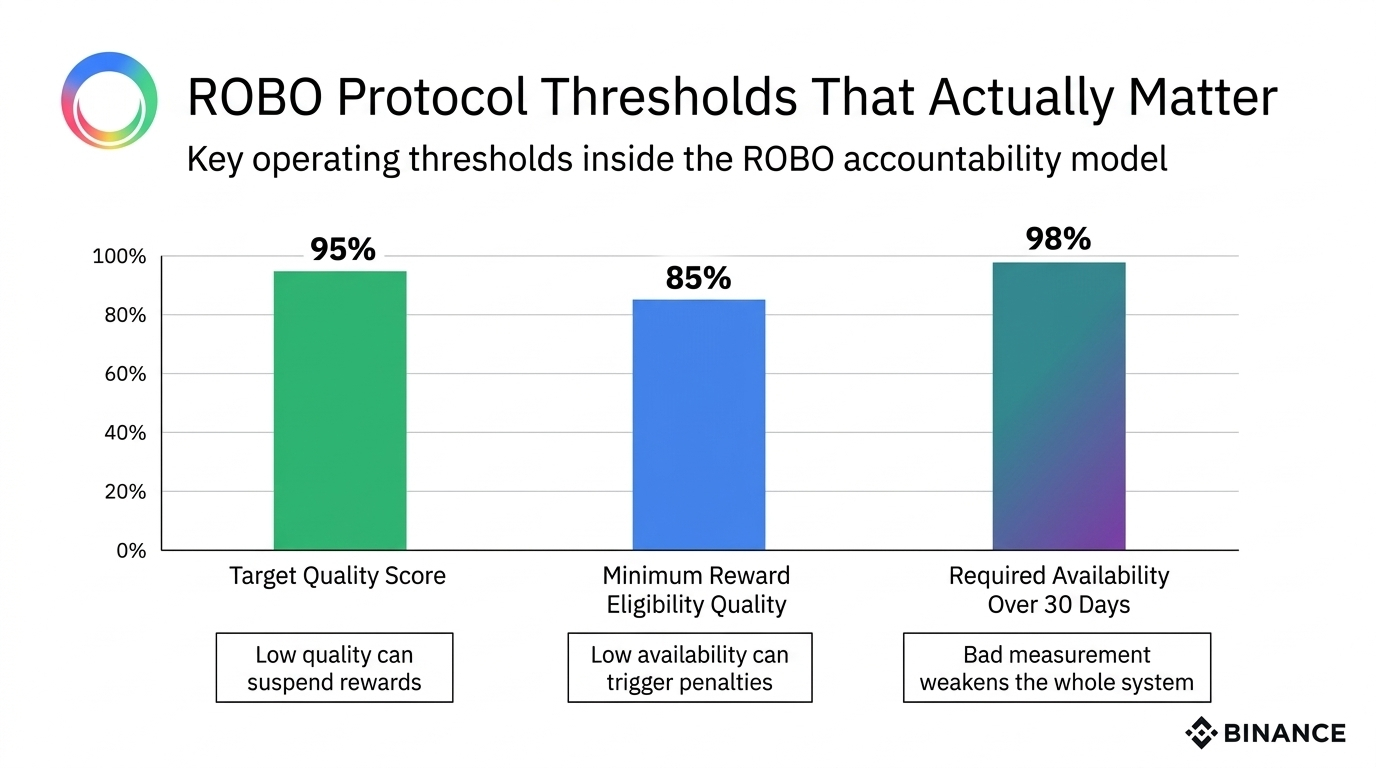
That is the part I think most people will glide past. I am not gliding past it.
Because once you think about real robot deployments this gets messy fast. A robot can complete a task badly. A user can rate a good outcome poorly. A validator can miss context. An operator can optimize for the metric instead of the actual service. We have seen this movie before in every system built around performance scoring. Humans game KPIs. Of course machines and operators around machines will game them too. So the real challenge for Fabric is not writing formulas for accountability. It is surviving contact with adversarial reality.
That said I do think the paper earns points for at least facing the problem head on. It does not pretend every task can be perfectly proven onchain. It leans into challenge based verification and tries to make fraud economically irrational instead of technically impossible. That is a mature choice. The slashing system is also sharper than I expected. Proven fraud can trigger 30 to 50 percent slashing of earmarked task stake. Availability failure can cost rewards and burn 5 percent of the bond. That is not decorative tokenomics. That is a protocol trying to create consequences.😳
This is where the whitepaper stopped reading like a robot fantasy and started reading like a machine bureaucracy with teeth.
And weirdly I mean that as a compliment.
Because the crypto market is full of projects that want the upside of automation without touching the ugly part which is enforcement. Fabric is at least trying to design enforcement. The problem is that enforcement systems can become brittle if the measurement layer is weak. A badly tuned protocol can punish honest participants and still miss sophisticated abuse. That is the nightmare scenario. Clean equations. Dirty reality.😵
Another thing I keep thinking about is how early this all is. The paper says total supply is fixed at 10 billion tokens and sketches a full token economy with bonds buybacks governance locks and contribution rewards. Fine. But structural demand only becomes convincing when there is real sustained throughput from robots doing valuable work. Until then the market is mostly front running a theory. I do not say that as a cheap criticism. It is just true. The whitepaper is effectively saying trust us now because the machine labor market later could be huge. Maybe. But that later has not arrived yet.
This is why my current take on ROBO is harsher than a normal bullish thread. I think the project is most compelling when it is treated as an experiment in economic coordination under uncertainty. Not as a guaranteed winner in AI robotics. Not as some magic bridge between machines and crypto. It is a design attempt. A serious one. But still an attempt.
The strongest thing in the paper is not that it predicts a robot economy. A lot of people can predict that. The strongest thing is that it tries to answer a nastier question. If robots become economically useful who decides what counts as real work and who gets paid for it. That is a much harder problem and Fabric is at least brave enough to wrestle with it.
Do I think that means ROBO is easy money? Nope 😂
Do I think it is more thoughtful than the average AI narrative token? Yes definitely.👍
Do I think the market may still overrate the vision before the verification layer proves itself in the wild? Also yes.🤖
That tension is exactly why I find it interesting.
A lot of crypto projects try to look inevitable. ROBO does not feel inevitable to me. It feels fragile smart early and very dependent on whether its measurement and verification systems can survive real world usage. That is not a weakness in the story. That is the actual story.
My biggest takeaway is simple. The future robot economy will not be won by the loudest vision. It will be won by whoever measures machine work without getting fooled by it.🚀✨🤖
@Fabric Foundation #ROBO $ROBO
