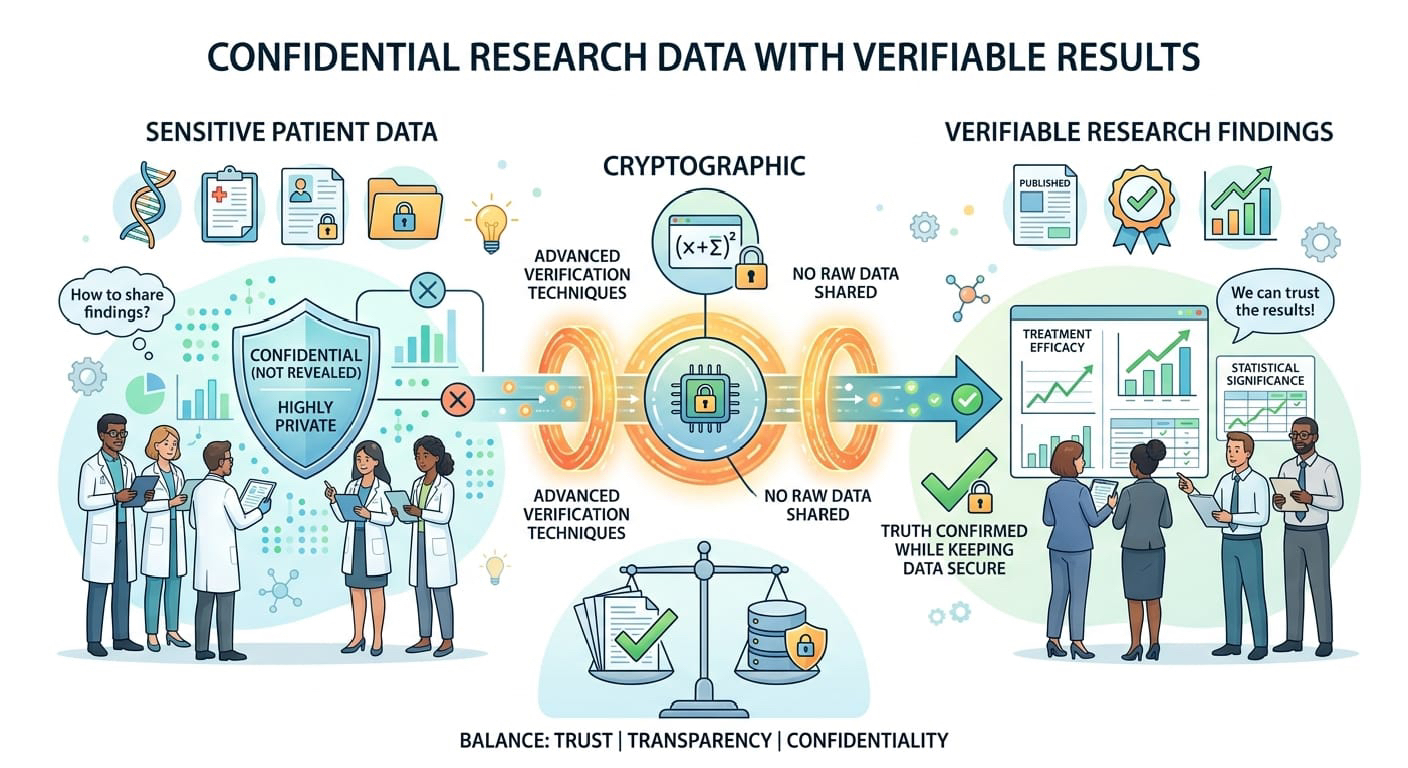
Imagine a medical research team working on a new treatment for a serious disease. They collect sensitive patient data — medical history, genetic information, test results, and personal health records. This information is extremely valuable for research, but it is also highly private.
Now suppose the researchers want to publish their findings. They need to prove that their results are accurate and based on real data. However, sharing the raw dataset publicly could expose patient identities and violate privacy regulations.
This creates a serious dilemma: how can science remain transparent while protecting confidentiality?
In a traditional system, researchers might have to choose between full disclosure or limited trust. But modern cryptographic methods change this approach. Using advanced verification techniques, it becomes possible to confirm that calculations, experiments, or statistical outcomes are correct — without revealing the underlying sensitive data.
This means auditors, regulators, or peer reviewers can validate the integrity of the research without accessing private details. The result is accountability without exposure.
Confidential data stays protected, yet the outcome remains fully verifiable. This balance strengthens trust, encourages collaboration, and supports innovation — especially in fields where privacy is essential.
In a privacy-first digital world, verification should not require sacrifice. It should confirm truth while keeping sensitive information secure.
#night @MidnightNetwork $NIGHT