
The Truth Most Traders Discover Too Late
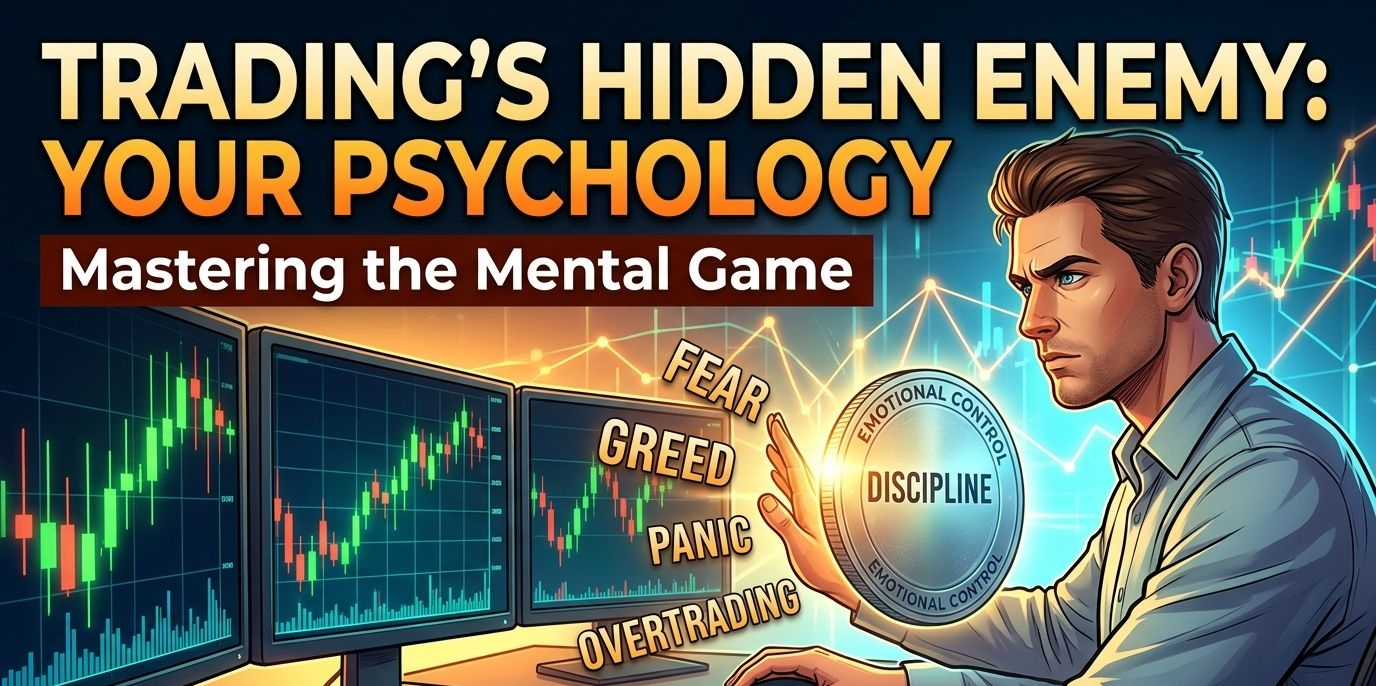
Every trader enters the market believing success depends on indicators, strategies, and charts. They study patterns, memorize setups, and analyze endless candlesticks.
But sooner or later, a powerful realization hits:
The market is not just a financial battlefield — it is a psychological one.
✔ Two traders can use the same strategy
✔ Look at the same chart
✔ Enter the same trade
Yet one profits while the other panics, exits early, or overtrades.
Why?
Because trading success is not controlled only by technical analysis. It is controlled by how well a trader controls their mind.
This is the moment every serious trader experiences — the moment they realize:
> The biggest competition in trading is not the market… it's your own psychology.
◆ Why Psychology Controls Trading More Than Strategy
Many beginners think success comes from finding a “perfect strategy.”
But experienced traders understand something deeper.
➜ Markets are driven by human emotion.
Fear, greed, impatience, and overconfidence move prices just as much as liquidity and news.
And if traders cannot control these emotions, even the best strategy becomes useless.
Here are the three psychological forces that separate professional traders from the rest.
① Fear: The Silent Profit Killer
Fear appears when the market moves against your position.
A trader suddenly thinks:
• “What if I lose everything?”
• “Maybe I should close this trade early.”
• “The market might crash.”
As a result, traders often:
✖ Close winning trades too early
✖ Avoid good setups
✖ Break their trading plan
Professional traders understand one rule:
✔ Losses are part of the game.
They trust their system instead of reacting emotionally.
② Greed: The Reason Traders Blow Accounts
Greed appears after a few winning trades.
A trader suddenly believes:
• “This trade will go much higher.”
• “Let me increase my position size.”
• “I can double my profit.”
Instead of following risk management, they overexpose themselves.
Then one market reversal erases weeks of profit.
Experienced traders know:
✔ Consistency beats big wins.
They focus on small, repeatable profits rather than chasing huge gains.
③ Impatience: The Hidden Destroyer
Markets reward patience.
But many traders struggle to wait for high-probability setups.
Instead, they:
✖ Enter random trades
✖ Chase the market
✖ Trade out of boredom
This behavior slowly drains capital.
Professional traders understand a simple truth:
➜ Sometimes the best trade is no trade.
Waiting is a skill.
◆ The Turning Point in Every Trader's Journey
Every successful trader eventually reaches a moment of clarity.
They realize:
✔ The market cannot be controlled
✔ Price movement is unpredictable
✔ Emotional decisions lead to losses
But one thing can be controlled:
Their mindset.
At this stage, traders stop searching for the perfect indicator and start building discipline, patience, and emotional control.
That is when trading begins to transform from gambling into a professional skill.
◆ The Real Edge in Trading
Many traders believe the edge is found in:
• Indicators
• Secret strategies
• Expensive signals
But the real edge is much simpler.
✔ Risk management
✔ Discipline
✔ Emotional control
When traders master these three elements, the market stops feeling chaotic.
Instead, it becomes a game of probabilities and patience.
The Market Tests More Than Your Strategy
Every trader eventually learns this lesson.
Charts reveal price movement, but they also reveal your mindset.
The market exposes fear, challenges patience, and tests discipline.
And the traders who succeed are not the ones with the most indicators.
They are the ones who master their psychology.
➜ Because in the end…
The greatest battle in trading is not against the market — it is against yourself.
◆ What do you think is the hardest psychological challenge in trading?
➤ Share your experience in the comments and help other traders learn from it.
➤ If you found this insight valuable, like and share it with the trading community.


#MetaPlansLayoffs #BTCReclaims70k #PCEMarketWatch #AaveSwapIncident #BinanceTGEUP