

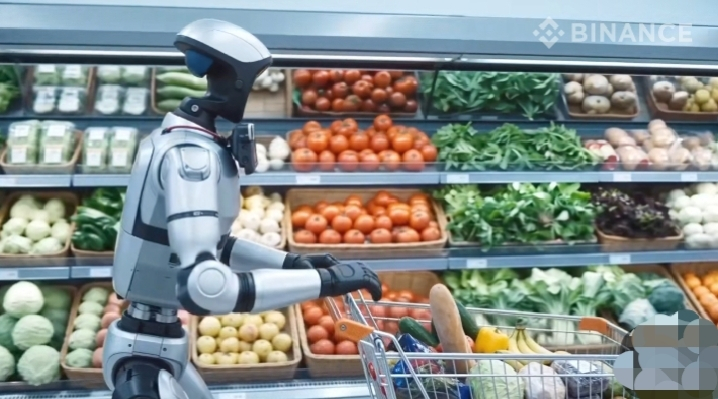
When we talk about robotics or AI, our imagination is usually stuck in the flashy scenes of science fiction movies. But the picture that @Fabric Foundation shows us is not a movie but a solid economic and technological evolution. At the root of this evolution is a deep question - when machines pay their own bills, buy goods and provide services, what will be the backbone of those transactions?
1. From science fiction to science fact:
Suppose a humanoid robot is knocking on doors, shopping in supermarkets and completing transactions at payment terminals. It is not just a robot, it is an Autonomous Economic Agent (AEA). Traditional robotics was originally limited to "automation" or repetitive tasks. But the thesis that ROBO is working on is "Autonomous Agency". Here the robot is not just following a program, it is navigating the physical world and making transactions from its own digital wallet.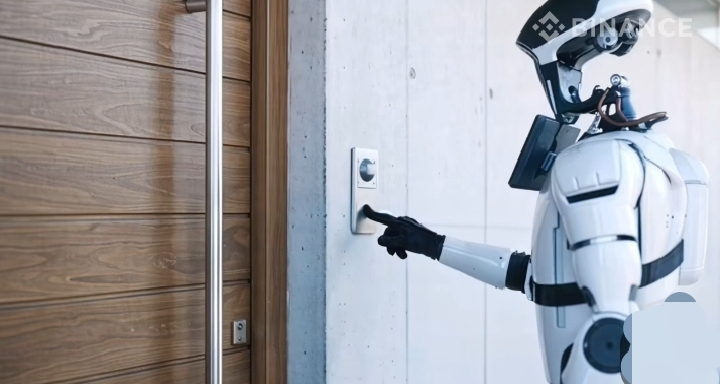
2. Infrastructure thesis:
The most powerful aspect of this system is its Backend Infrastructure. Terms like "Governance node sync" and "Smart contract settlement" mean:
Trustless Settlement : When a robot makes a 3.04 ROBO payment, there is no human intermediary. The smart contract automatically verifies whether the service or product has been received or not, and immediately releases the payment.
Identity Verification : The device has its own digital identity (DID). It is not just a machine, it is acting like a legal entity on-chain.
Edge Computing & 5G : When the robot is sitting in the car and syncing data, it is essentially acting as part of a distributed network. It is able to make decisions through local nodes instead of relying on a central server.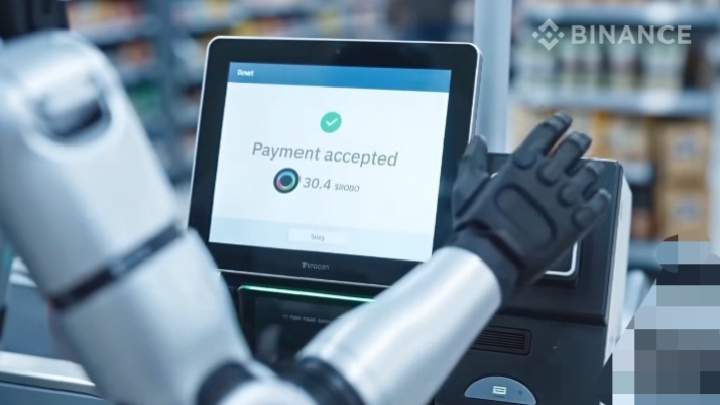
3. Distribution Model: Why is this not hype but a dilution-proof strategy?
Most projects in the cryptocurrency world are just busy selling tokens. But ROBO's distribution thesis is basically Utility-First.
Service-as-a-Service (SaaS to RaaS) : The project is shifting from 'Software' to 'Robotics as a Service' (RaaS) model. Here, the ROBO token is not just a currency, it is acting as a Gas Fee or fuel for the entire ecosystem.
Incentivized Nodes : Governance node sync indicates that those who are providing the infrastructure or compute power of this network are partners in this ecosystem. It is a decentralized physical infrastructure network (DePIN).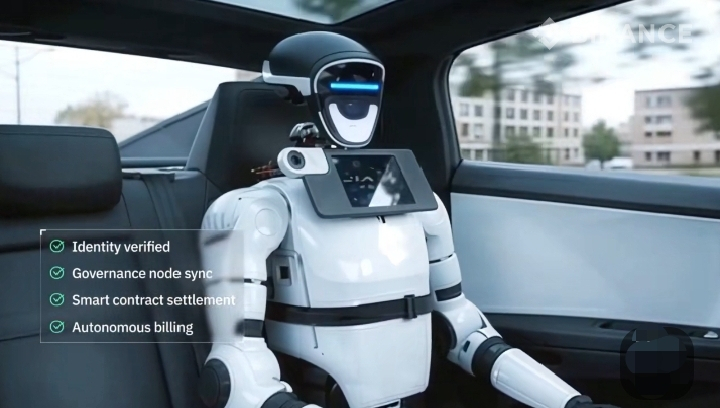
4. Adoption Thesis :
The deepest analysis is hidden in the adoption area. We usually think of technology adoption as people buying phones or laptops. But in the case of ROBO, adoption will be B2B (Business to Business) and M2M (Machine to Machine).
As a regular user, you may never know that your delivery was delivered by a robot and that robot used ROBO tokens in the backend to pay the road toll or electricity bill. This is called Invisible Infrastructure.
Efficiency Gains : The logistical errors or delays that occur in human-operated delivery systems are reduced to zero by smart contract-driven robotics. The 12-minute delivery time is not a coincidence, it is the result of optimized algorithms.
Economic Velocity : When machines transact, the speed of money increases manifold. Because machines do not get tired, they can continue economic activity 24/7.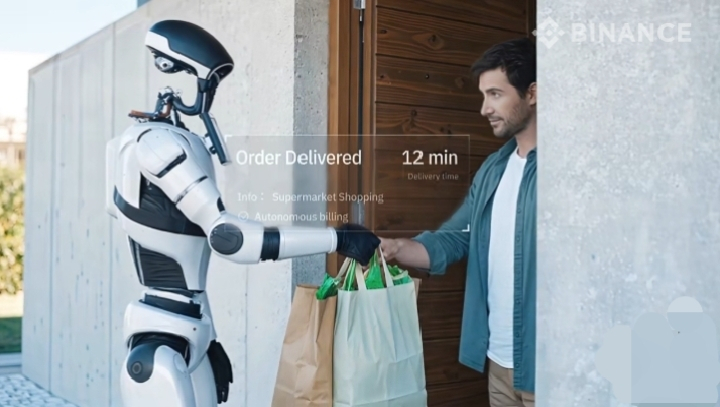
5. Message for Builders: Why is this a paradigm shift?
ROBO is a new playground for those who are not just traders but also future builders. It is not just a token graph, it is a full-stack integration.
Hardware Layer : Humanoids and Drones.
Network Layer : Decentralized Nodes and Connectivity.
Economic Laye r: ROBO Tokens and Smart Contracts.
Autonomous Society of the Future,
These visuals from Fabric Foundation give us a clear message - the economy of the future will be for people but it will be run by machines. $ROBO is not just a payment method here, it is the level of trust that recognizes a solid metal robot as an economic member of society. If we look deeper into this technological evolution, we will see that we are not just seeing a new crypto project but we are seeing the ultimate convergence of the Internet of Things (IoT) and the Internet of Value (IoV).
This is not hype. This is an integrated future of mathematics, coding and physical engineering. Those who can understand this 'Infrastructural Narrative' will be the ones who will be the real changemakers of the coming decade.