
I watched a friend quit crypto last month. Not because he lost money—he'd survived bear markets before. Not because of a hack or a rug or a liquidation event. He quit because he tried to move $200 and couldn't figure out why $63 disappeared before the transaction even landed.
"I signed one thing," he said. "The network did another. And no one can tell me where the gap went."
He wasn't angry about the money. He was angry about the fog. The sense that somewhere between his intent and execution, value bled out in ways no interface would explain and no support ticket would recover. He didn't feel like a user. He felt like prey moving through terrain where the predators were invisible and the rules changed with every block.
That fog is crypto's real killer. Not volatility. Not regulation. Not even security failures. The slow erosion of confidence that comes from never quite knowing what you'll pay until after you've already committed.
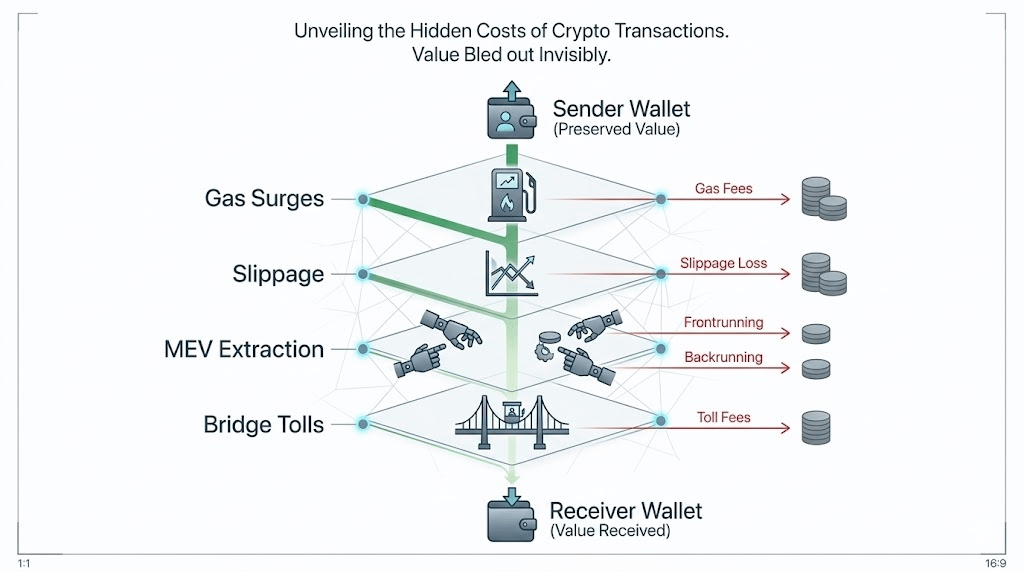
The Information Asymmetry Problem
Every market has friction. Every financial system has costs. The difference between traditional finance and crypto isn't the existence of fees—it's the predictability of them.
When you wire money internationally, you know the fee before you click send. When you buy a stock, the commission is disclosed. When you sign a loan, the APR is printed in bold. The costs may be high, but they're knowable. You consent to what you can see.
Crypto inverts this. The costs are disclosed after commitment, not before. You estimate gas, but gas changes. You set slippage, but slippage widens. You approve a swap, but MEV extracts. You sign blind and hope the number that returns looks something like the number you left.
This isn't a technical limitation. It's a design choice embedded in how interfaces prioritize conversion over consent. "Cheap at sign" converts better than "honest at sign." So the industry optimizes for the gap, and users absorb the difference transaction by transaction until one day they realize they can't remember the last time they trusted a number on a screen.
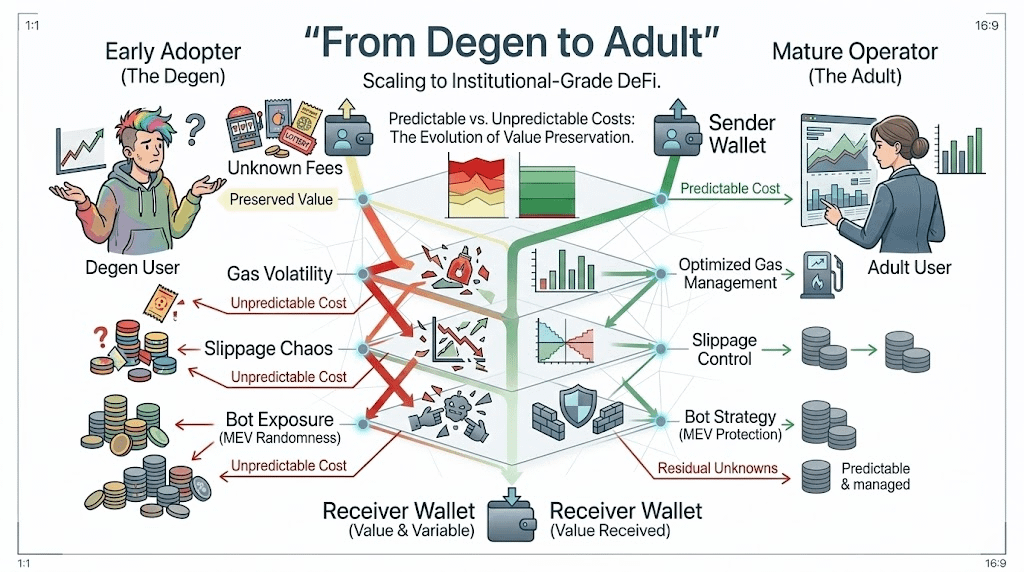
The Degen-to-Adult Transition
Here's what founders rarely admit: their user base changes over time.
Early adopters are degens. They're chasing 100x. They'll pay any fee, endure any friction, forgive any surprise because they're not here for efficiency—they're here for lottery tickets. Gas estimates can be off by 50% and they'll shrug. MEV can extract 10% and they'll call it tuition.
But degens don't build sustainable economies. They rotate through narratives and leave when the next shiny thing appears. The users who stay—the ones who bring real volume, real business, real economic activity—are adults. They're running operations. They're managing P&Ls. They're accountable to someone other than themselves.
Adults don't tolerate fog. They need to know what things cost before they commit, because their ability to operate depends on predictability. When the gap between consent and cost becomes a recurring surprise, they don't complain on Twitter. They quietly migrate back to systems where costs are knowable, even if those systems are slower, more expensive, or more centralized.
The degens are loud. The adults are quiet. And when the adults leave, the economy leaves with them.
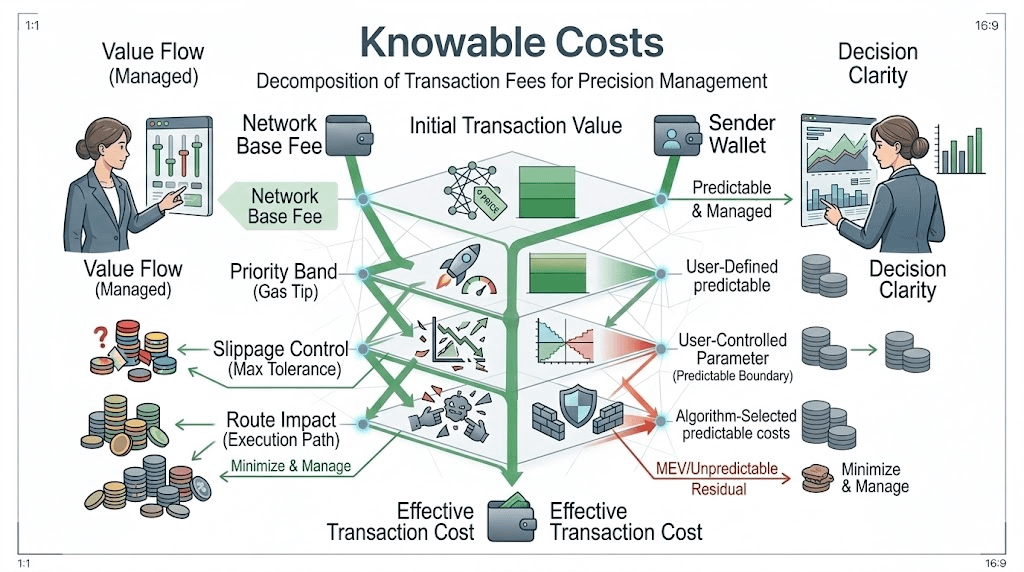
What "Knowable Costs" Actually Require
Most interfaces treat fee transparency as a UI problem. Show a number. Call it an estimate. Move on.
Knowable costs require something harder: a model of reality that accounts for what actually happens between signature and settlement.
Gas doesn't stay static. It surges when blocks fill. Priority fees multiply when you're competing with demand. Slippage expands when liquidity shifts. Routes fragment when pools rebalance. MEV extracts when your transaction is visible. Bridge tolls change with congestion on the other side. Sequencer fees vary by L2 activity. Price impact only reveals itself after execution reveals the true depth of the market.
A knowable cost isn't a single number. It's a range with components. It's base fee plus priority band plus slippage model plus route analysis plus MEV exposure estimate plus explicit error bound that widens when conditions are uncertain.
When I can see the decomposition, I can decide. Reduce size. Change timing. Switch routes. Wait. Walk away. The decision becomes mine instead of the network's.
That's the difference between being a user and being prey.
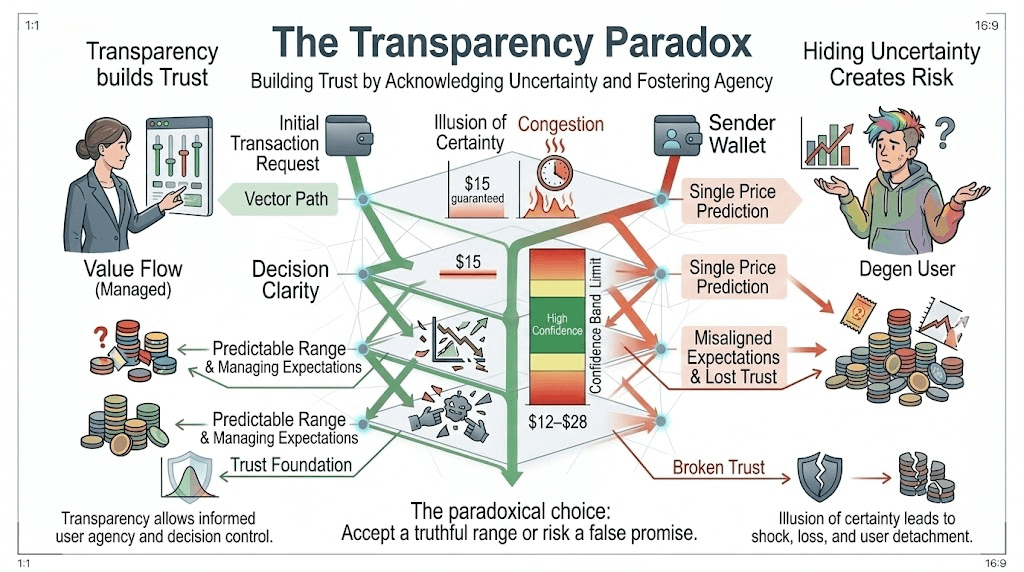
The Transparency Paradox
Here's the uncomfortable truth: perfect transparency is impossible.
No one can predict the exact block your transaction will land in. No one can forecast the exact priority fee competition at that moment. No one can model every MEV opportunity that might extract from your flow. The future is uncertain, and settlement happens in the future.
But impossible doesn't mean useless. The goal isn't perfect prediction—it's honest communication of the limits of prediction.
A forecast that says "between $12 and $28, with 90% confidence, widening to $45 under extreme congestion" is infinitely more valuable than an estimate that says "$14" and delivers $63. The first gives me agency. The second gives me a surprise I'll remember the next time I consider using this ecosystem.
The paradox is that admitting uncertainty builds more trust than pretending certainty. Users don't need guarantees. They need maps. They need to know the terrain they're entering and the range of outcomes they might experience. When interfaces hide the uncertainty, they hide the truth. And when the truth eventually emerges—as it always does—the trust disappears with it.
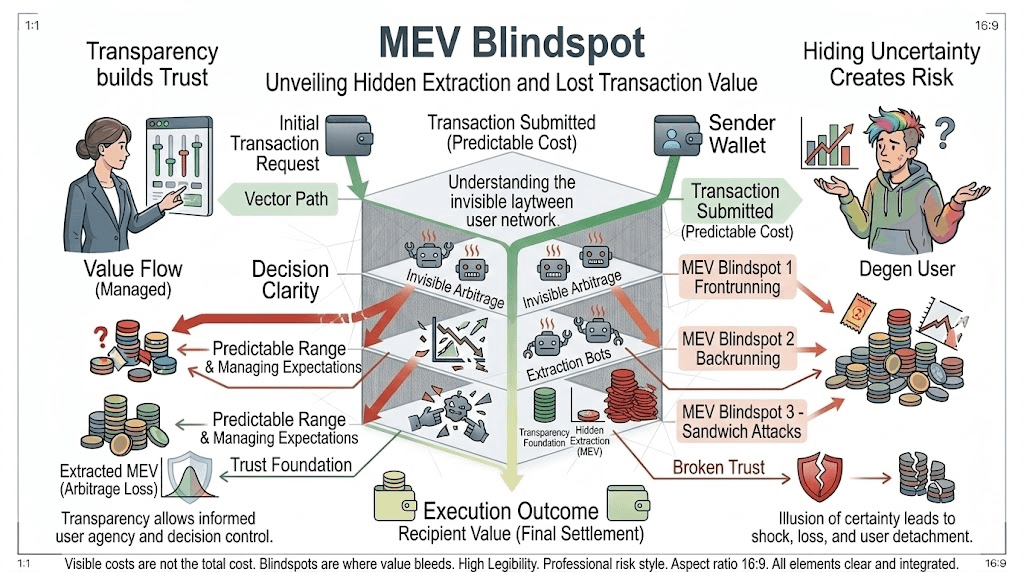
The MEV Blindspot
Most fee conversations stop at gas and slippage. That's where transparency ends and extraction begins.
MEV is the invisible layer. The tax you don't see because it's not in any interface, not disclosed by any protocol, not visible in any transaction preview. Your swap gets sandwiched. Your liquidation gets frontrun. Your order gets reordered. Value transfers from you to bots who did nothing but watch you coming and position themselves between you and your execution.
If transparency only covers what's easy to measure—gas, slippage, routing—and ignores execution risk, it's not transparency. It's selective disclosure. It's showing you the visible costs while hiding the invisible ones.
The next frontier isn't better estimates of gas. It's protection from extraction. Private mempools. Order flow auctions that compensate you for your data. Mechanisms that shield your intent until execution, so the bots can't see you coming until it's too late to extract.
Forecasting without protection is just a clearer view of the loss ahead.
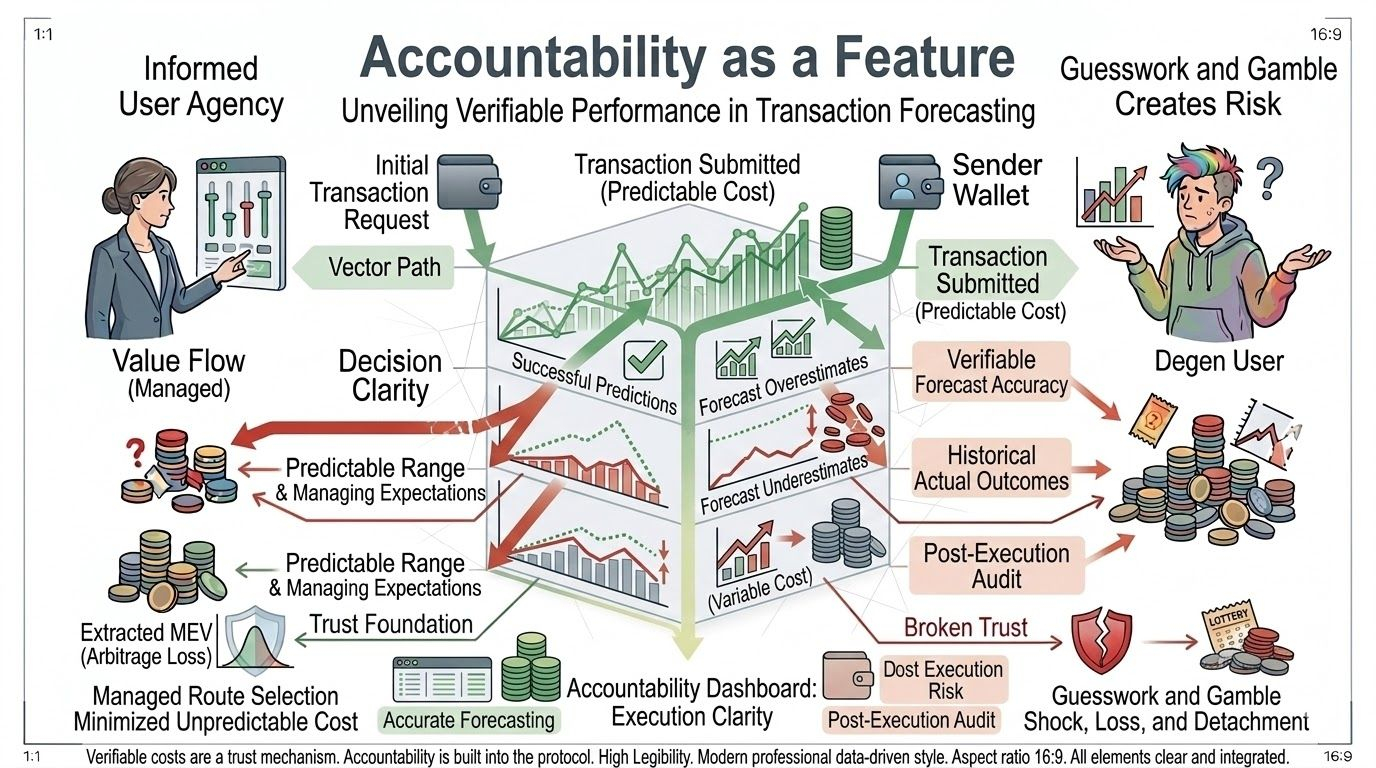
The Accountability Standard
No one expects the hardest part to be accountability.
Every team can publish a fee estimator. Very few will publish the accuracy of that estimator over time. The percentage of transactions that landed within forecast range. Segmented by network conditions. Segmented by transaction type. Segmented by market volatility. The misses alongside the hits. The overestimates and underestimates and the reasons for both.
If Fabric dares to publish those stats, they do something almost no protocol does: they make their performance verifiable. They put themselves under a microscope where every user can see not just what they claim, but how well their claims match reality.
Accountability as a feature. Trust as a metric you can audit. A reputation built on data rather than marketing language.
That's not just transparency. That's a standard.
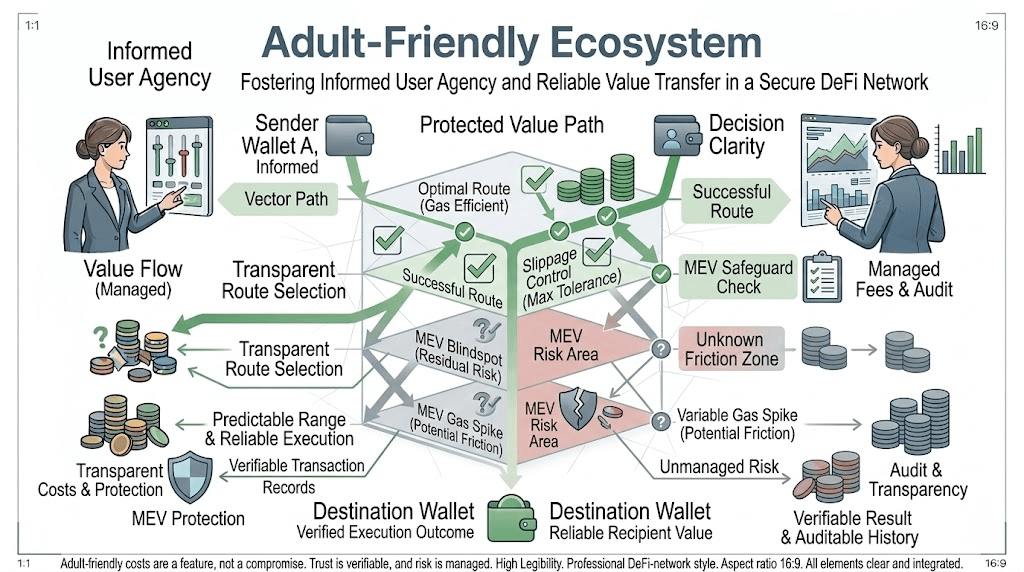
The Question That Matters
Mature users aren't afraid to pay. They're afraid to be surprised.
Cost transparency. Honest forecasting. Protection from invisible extraction. These aren't features. They're the foundation of an ecosystem where adults can operate without feeling like they're moving through fog, hoping the number that returns looks something like the number they left.
The question that keeps me watching isn't technical. It's whether the ecosystem will reward products that tell the truth about what things cost, or whether we'll keep optimizing for "cheap at sign" and quietly absorb the difference, transaction by transaction, until one day we realize we've built an economy that only degens can survive.
I know which future I'm watching for.