


There’s a common misconception: if you want to become more productive, you need better time management.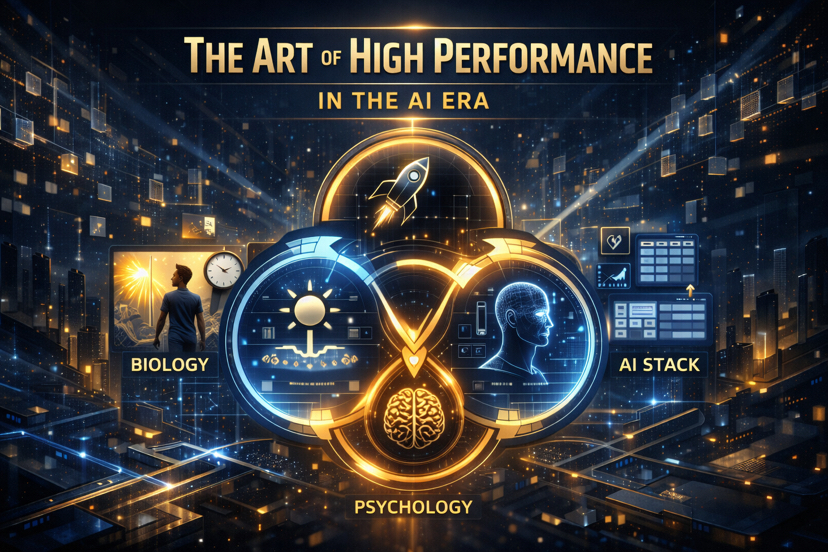
But after years of observing founders, traders, and builders in crypto, one insight becomes clear:
Performance doesn’t start with your calendar.
It starts with your biological operating system.
If we had to compress everything into one framework for 2026, it would be this:
The 3-Engine Model: Biology – Psychology – AI Stack.
Most people optimize only one.
High performers align all three.
Engine 1: Your Biological Operating System
Morning — The Most Important Sequence of the Day
Your morning sets the neurological tone for everything that follows.
Step outside within minutes of waking and expose yourself to natural sunlight for at least 10 minutes. Morning light synchronizes your circadian rhythm and activates alertness pathways in the brain.
Delay caffeine for about 90 minutes after waking. Your body needs time to naturally clear adenosine — the compound responsible for sleep pressure. Drinking coffee too early often leads to the classic mid-afternoon crash.
Move before you work. A 20-minute walk, run, or strength session increases dopamine and norepinephrine — your brain’s natural focus chemicals.
You’re not “warming up.”
You’re calibrating your system.
During the Day — Protect Your Most Valuable Asset: Attention
Attention is finite.
Every open loop — unread email, vague task, unfinished idea — consumes cognitive bandwidth.
The solution is specificity.
Instead of “work on article,” define the task as:
“Write 800 words of the introduction within 60 minutes.”
Work in 90-minute deep-focus blocks. Turn off notifications. Flip your phone face down. When the 90 minutes end, stop intentionally — even if you’re mid-sentence. Leaving something slightly unfinished increases the brain’s desire to return and complete it.
Evening — So Tomorrow Doesn’t Start in Fatigue
After 8 p.m., reduce bright light exposure.
Eat complex carbohydrates like rice, potatoes, or whole grains to help lower cortisol levels.
Sleep 7–8 consistent hours.
Sleep isn’t rest.
It’s biochemical maintenance. Your brain literally clears accumulated waste during deep sleep.
Without this reset, no productivity system survives.
Engine 2: The Psychology of Focus
Distraction isn’t laziness.
It usually happens because:
The task is too vague → the brain doesn’t know where to start.
The task is too large → anxiety triggers avoidance.
The only reliable solution:
Break it down before you begin.
Define the first concrete action.
Shrink the scope until it feels executable.
Key psychological principles:
Work 90 minutes uninterrupted.
Leave a small portion unfinished to maintain momentum.
Switch your phone to grayscale to reduce visual stimulation.
Write down distracting thoughts instead of fighting them.
Do the hardest task first to remove silent mental pressure.
Clarity reduces resistance.
Specificity reduces fear.
Engine 3: System Leverage with AI
Once biology is stable and psychology is aligned, tools finally amplify performance.
The common mistake is using AI like a smarter search engine.
The more powerful approach is using AI as a collaborative operator inside your workflow.
Design Your Schedule for Depth
There are two types of calendars:
Fragmented calendars filled with constant meetings.
Protected calendars with long blocks for deep work.
If you’re doing creative work and insert even one short meeting mid-session, you don’t just lose the meeting time. You lose the cognitive state of the entire block.
Cluster communication later in the day.
Protect mornings for your most important work.
The Rule of 100
Spend 100 hours per year on a single skill — roughly 18 minutes per day — and you’ll outperform 95% of people in that area.
Consistency compounds faster than intensity.
100 outreach messages daily.
100 minutes of content creation daily.
100 units of sales effort daily.
Sustained repetition beats short bursts of motivation.
AI Is No Longer About Prompts — It’s About Systems
The advantage no longer comes from writing clever prompts.
It comes from:
Defining AI’s role clearly.
Assigning structured tasks.
Providing real data from your own workflows.
Maintaining long-term context so the system understands your goals and style.
AI does not replace your thinking.
It multiplies the system you’ve already built.
When All Three Engines Align
When your biology is optimized,
Your psychology is structured,
And your AI stack is leveraged correctly —
Performance stops being something you chase.
It becomes your default state.