We’ve all experienced it. An AI gives you a confident, polished answer — and somewhere in the back of your mind you wonder: But can I really rely on this?
That’s where @Mira - Trust Layer of AI changes the game.
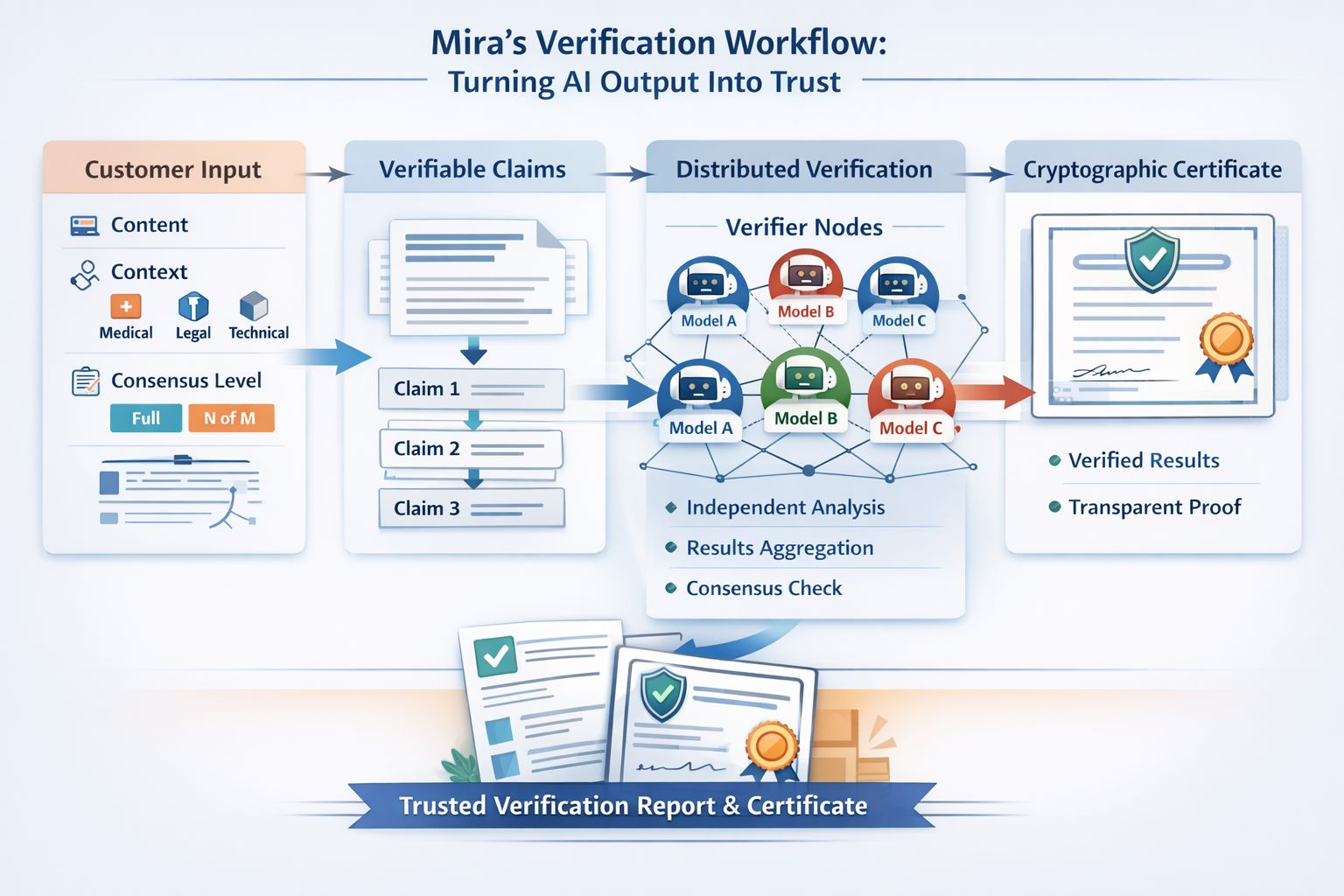
What stands out immediately about Mira’s verification workflow is how intentionally structured it is. This isn’t just AI generating content and hoping for the best. It’s a step-by-step system designed to transform raw output into something far more valuable: verifiable trust.
It Starts With Clarity — Not Guesswork
The process begins with the customer.
Instead of simply submitting content and asking, “Is this right?”, customers define the rules of engagement upfront. They provide:
The content that needs verification
The domain context (medical, legal, technical, etc.)
The required level of agreement — whether that’s full consensus or something like an N-of-M model agreement
This is powerful because it sets expectations from the start. A medical claim might demand stricter consensus than a general technical explanation. Mira doesn’t treat every verification the same — it adapts to the level of reliability you require.
Right away, the question shifts from “Is this accurate?” to “How certain do we need to be?”
Breaking Content Into Verifiable Claims
Here’s where things get smart.
Instead of checking an entire paragraph as one opaque block, Mira deconstructs the content into individual, logical claims — while preserving the relationships between them.
Why does that matter?
Because truth lives at the statement level. A paragraph can be mostly correct but contain one flawed assertion. By isolating claims, Mira enables:
Granular verification
Traceability of each statement
Clear visibility into what passed and what didn’t
It’s the difference between reviewing a whole contract at once versus examining every clause line by line.
Independent Verification — No Echo Chambers
Once claims are defined, they’re distributed across a network of verifier nodes.
Multiple models independently evaluate each claim. No shared bias. No groupthink. Just parallel, independent analysis.
This independence is critical. Trust doesn’t come from a single model saying, “Looks good.” It comes from agreement across diverse evaluators.
Their outputs are then aggregated according to the predefined threshold. If you requested full agreement, every required model must align. If you requested N-of-M, Mira calculates whether the consensus bar has been met.
It’s structured disagreement management — by design.
From Evaluation to Proof: The Cryptographic Certificate
And this is where Mira moves beyond traditional AI systems.
Instead of simply returning a “verified” label, Mira generates a cryptographic certificate. This certificate records:
Which claims reached consensus
Which models agreed
The verification parameters used
This isn’t just an internal checkmark. It’s transparent, traceable proof.
The customer receives both:
The verification result
The certificate documenting how that result was achieved
In other words, you don’t just get an answer — you get evidence.
More Than AI Output — It’s Engineered Trust
What makes this workflow so compelling is that Mira doesn’t treat trust as an afterthought.
It engineers it.
From structured input requirements, to claim-level analysis, to distributed independent verification, to cryptographic proof — every step is intentional.
Mira isn’t simply producing answers.
It’s producing confidence around those answers.
And in a world where AI-generated content is everywhere, that difference matters more than ever.