

When I first came across $ROBO and the Fabric Protocol, I assumed it was another ambitious crypto narrative — decentralization, robots, token incentives, the usual futuristic pitch. But the more I read, the more I realized this isn’t just about launching a token or building another blockchain ecosystem. It’s about redefining who — or what — gets to participate in the economy.

Fabric is attempting something far more radical than it sounds at first glance: giving robots blockchain identities and wallets so they can transact autonomously. Not as tools. Not as property. But as economic agents.
And once I understood that, I stopped thinking about price charts and started thinking about labour, ownership, and power.
Because if robots can earn, hold, and spend value then the question isn’t whether automation will increase. The question is who captures the wealth it produces.
Right now, robots are treated as capital equipment. They belong to corporations. They generate output. Humans collect the profit. Fabric introduces a different architecture: a robot with an on-chain identity, capable of receiving payments directly, paying for maintenance, buying energy, or executing smart contracts without a centralized intermediary.
This is an example: imagine a fleet of autonomous delivery robots operating in a city. Instead of all payments flowing to one logistics company, each robot has its own wallet. When it completes a task, the payment is credited to its on-chain identity. That wallet then automatically pays for electricity, allocates funds for maintenance, and distributes a portion to token holders who co-own that robot. The robot becomes a micro-enterprise.
On paper, this sounds efficient. Even elegant.
But then I asked myself — who owns the robots?
If robots become productive economic actors but ownership remains concentrated, we haven’t democratized wealth. We’ve automated inequality.
Research from Brookings suggests that each industrial robot introduced into the workforce can displace between 3 to 6 workers. Historically, new industries eventually create new jobs. But transitions are never smooth. During the Industrial Revolution, technological gains took decades before wages stabilized. In the meantime, inequality widened.
Fabric’s answer seems to be shared ownership. Tokenized participation. Community-based robot fleets. There’s even the concept of something like a “robot birthplace,” where communities could collectively fund and co-own robotic infrastructure.
This is an example: imagine a town where 1,000 residents pool capital to purchase agricultural robots. Those robots operate farms autonomously and sell produce. Revenue flows into smart contracts and is distributed proportionally among participants. In theory, automation wealth becomes communal wealth.
I find that idea powerful.
But here’s where I remain cautious.
Token distribution matters more than narrative.
If early investors hold large portions of $ROBO, governance and economic flows can become concentrated before the network fully decentralizes. In many blockchain ecosystems, governance power correlates directly with token holdings. Without mechanisms like quadratic voting or strict anti-concentration rules, wealth compounds toward early capital.
And when robots are the productive layer beneath that governance system, the stakes are no longer digital speculation — they become physical-world logistics, healthcare, agriculture.
Another dimension people underestimate is data.
Robots don’t just perform tasks. They generate enormous amounts of sensor data. Movement logs. Environmental readings. Interaction patterns. In many cases, that data is more valuable than the task itself.
This is an example: a cleaning robot operating in commercial buildings collects spatial mapping data across thousands of properties. That dataset can be sold to urban planning firms, AI training labs, or security companies. Who owns that data? The building owner? The robot operator? The token holders? The protocol?
In traditional markets, data ownership is already contentious. On a blockchain, immutability complicates it further. Once logged, it cannot easily be erased. European GDPR regulations emphasize the right to withdraw consent. Blockchains do not forget.
Fabric sits directly in that tension between transparency and privacy.
Then there’s labour itself.
Automation doesn’t just replace income. It replaces structure. Meaning. Routine. Studies across European labor markets have shown that increased robot adoption correlates with reduced feelings of autonomy and purpose among lower-skilled workers — even when wages are stable.
If robots take over repetitive work, humans may shift toward creative or strategic roles. That’s the optimistic view. But optimism doesn’t create retraining programs. Protocols don’t automatically fund upskilling unless explicitly designed to do so.
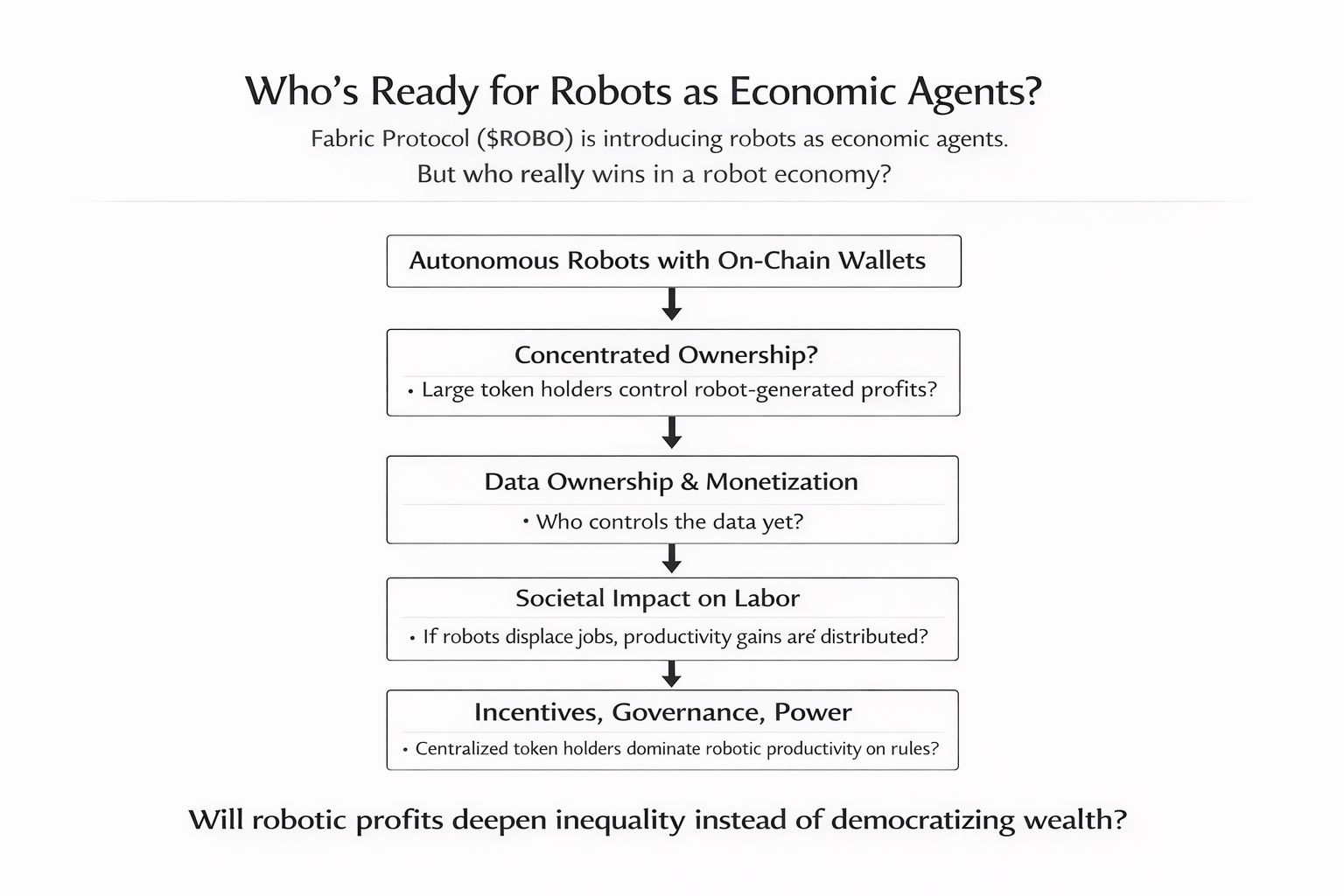
If a robot economy generates massive productivity gains but doesn’t structurally redistribute them, we risk creating a two-tier society: capital owners and service dependents.
That’s why I keep returning to the idea of a robot dividend.
This is an example: similar to Alaska’s Permanent Fund, where oil revenues are distributed annually to residents, a percentage of robot-generated revenue could be automatically allocated into a social pool. That pool funds education, healthcare, or universal income. If robots replace labor, their productivity should replenish the system that labor once sustained.
Without something like that, the free market will likely optimize toward concentration.
Another overlooked risk is incentive distortion.
If robots are programmed to maximize profit under tokenized reward systems, they may cut corners.
This is an example: imagine delivery robots rewarded purely based on speed and volume. Without quality weighting, they might skip safety checks or degrade service quality to optimize throughput. In blockchain mining, selfish mining exploits incentive design. In robotics, selfish cleaning or selfish delivery could emerge.
Reward structures must align long-term quality with short-term performance. Otherwise, automation optimizes for metrics, not wellbeing.
What fascinates me most about Fabric isn’t the token. It’s the governance experiment.
Moving coordination on-chain forces rule transparency. But transparency doesn’t equal fairness. Governance models can drift toward oligarchy if large token holders dominate proposals. We’ve seen this in multiple proof-of-stake systems where validator concentration becomes inevitable.
If robots generate revenue and that revenue increases token value, governance influence may compound toward those already holding power.
The promise of decentralization has to be engineered — not assumed.
There’s also the geopolitical dimension. Advanced robotics and blockchain infrastructure are capital-intensive. Wealthier nations and corporations are positioned to deploy them first. Without cross-border economic frameworks, robot-generated wealth could widen global inequality.
Imagine autonomous port logistics in one region dramatically increasing efficiency while emerging markets lack access to comparable infrastructure. The productivity gap expands.
That’s not science fiction. That’s path dependency.
Still, I don’t see Fabric as dystopian. I see it as infrastructural. It formalizes something that’s already happening — machines making decisions and executing tasks autonomously. The difference is whether we design governance before scale arrives.
If robots are going to transact, let them transact in systems we can audit.
If automation is going to replace labor, let’s decide how wealth circulates before it concentrates.
If data is going to be monetized, let’s define ownership before it defaults to whoever controls the server.
The real revolution isn’t robots earning tokens.
It’s whether humans shape the distribution logic behind them.
I don’t see Fabric as just a cryptocurrency. I see it as an early blueprint for how machine economies might function. It forces uncomfortable questions about labour, ownership, taxation, governance, and meaning.
And the answers won’t come from code alone.
They’ll come from how communities choose to structure that code.
So here’s what I’m genuinely thinking about:
If robots become borderless economic actors, who sets the borders for value?
And more importantly who benefits when those borders disappear?
I’d really like to hear different perspectives on this. Do you see $ROBO as a step toward shared automation wealth or as infrastructure that could accidentally entrench inequality?
Let’s discuss.