
Introduction: When Stability Meets Spectacle
The crypto industry has witnessed countless experiments, but the story surrounding $USD1, launched by World Liberty Financial, feels less like financial innovation and more like political theater entering blockchain markets. Marketed as an “upgraded dollar,” $USD1 promised reliability, institutional confidence, and a new era of digital finance. However, on February 23, 2026, the stablecoin briefly lost its $1 peg, falling to $0.994 — a small numerical move but a massive psychological shock. For a project heavily associated with Donald Trump and his family, even a minor depeg instantly turned into a global controversy, raising doubts about whether the stability narrative was ever as strong as advertised.
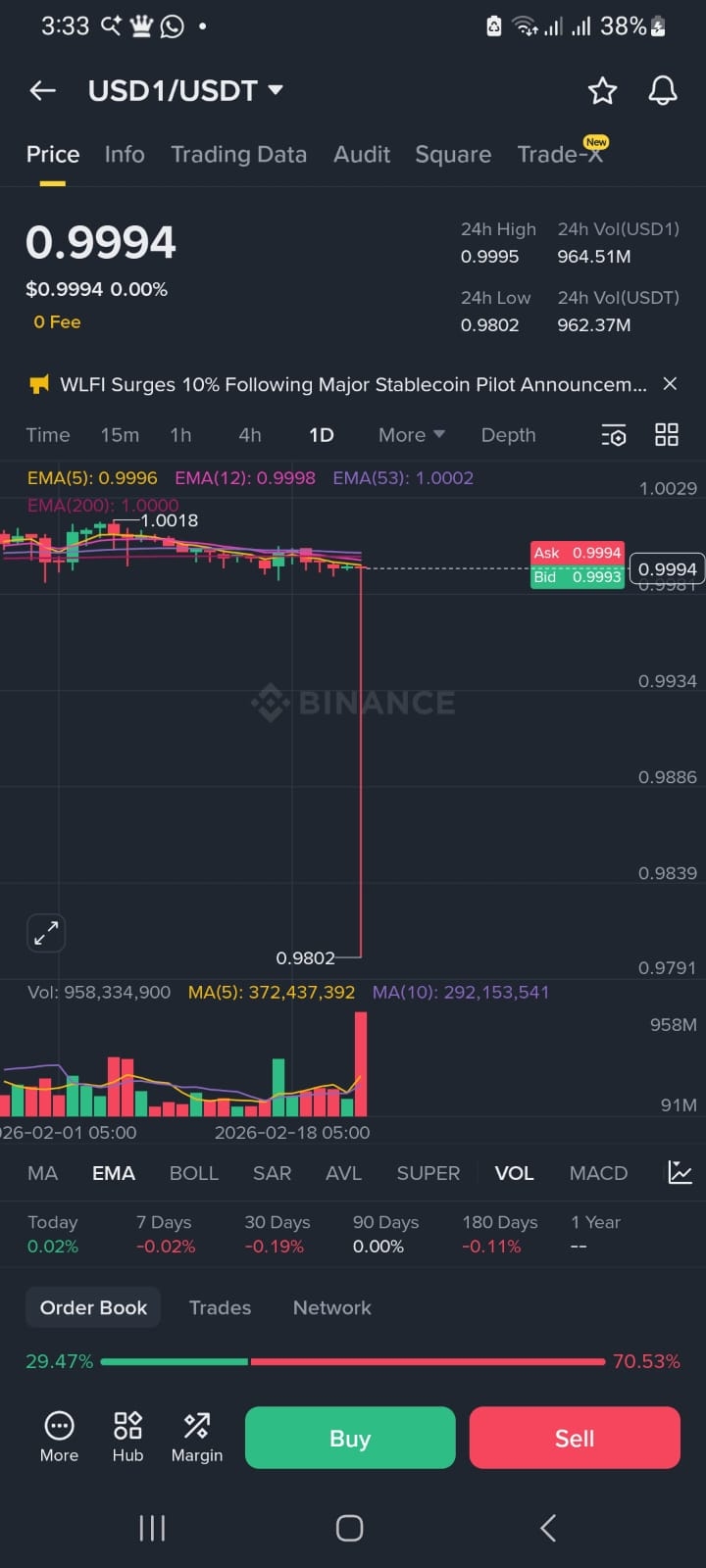
The Depeg Drama: More Than Just Market Noise
WLFI quickly blamed the incident on a so-called coordinated attack involving hacked accounts, influencer-driven fear campaigns, and aggressive short selling. While the peg eventually recovered, the episode exposed a deeper issue: a system overly sensitive to social media narratives. Deleted posts and sudden messaging changes triggered sharp price reactions, suggesting that confidence in USD1 depends heavily on perception rather than purely on technological resilience. In crypto, where trust is everything, a stablecoin reacting to online drama signals fragility rather than strength.
Follow the Money: Innovation or Political Finance?
Critics argue that USD1’s structure raises uncomfortable questions about incentives. Large ownership stakes tied to Trump-linked entities, revenue flowing from token sales, and reserve investments generating traditional financial yields create the impression of a centralized profit engine dressed in decentralized branding. Rather than disrupting finance, the model appears to replicate it — only with political branding attached. International investment ties and controversial partnerships have further intensified scrutiny, turning USD1 into not just a crypto asset but a geopolitical talking point.
Security, Trust, and the Illusion of Smoothness
Although USD1 claims full 1:1 backing with dollars and U.S. Treasuries, the incident showed that technical backing alone does not guarantee market confidence. Stability is truly tested during moments of fear, not calm conditions. If social engineering and online panic can push the peg off balance, a larger crisis — regulatory pressure, exchange instability, or geopolitical tension — could create far greater stress. The event demonstrated that stability depends as much on user trust as on reserve assets.
Terra Comparisons: Similar Fear, Different Risk
Naturally, comparisons emerged with the collapse of Terra and Luna in 2022. Unlike Terra’s algorithmic design, USD1 is asset-backed, meaning a rapid death spiral is unlikely under normal conditions. Liquidity held during the crisis, and redemption mechanisms functioned. However, the risks are different rather than nonexistent — centralization, political exposure, and concentrated exchange reliance introduce vulnerabilities that algorithmic models never had. Terra failed because math broke; USD1 could struggle if confidence erodes.
Politics Enters Crypto: A Volatility Multiplies
Trump’s expanding involvement in crypto has turned USD1 into more than a financial product — it has become a political symbol. Supporters see innovation and financial independence, while critics view it as influence-driven monetization leveraging political power. When a stablecoin’s credibility moves alongside political headlines, tweets, or policy debates, volatility becomes inevitable. Money tied to political narratives inherits political instability.
Conclusion: Stability or a Long-Term Risk?
USD1’s brief depeg may not signal immediate collapse, but it serves as a clear warning. The project survived technically, yet the episode revealed how fragile confidence can be when hype, politics, and finance intersect. Stablecoins are meant to remove uncertainty from crypto markets, not introduce new forms of it. Whether USD1 evolves into a legitimate financial instrument or remains a high-profile experiment depends on its ability to build trust beyond branding and political influence. For now, the peg may be restored — but the questions raised by this incident are unlikely to disappear anytime soon.
#TrumpCrypto #scam #TrumpNewTariffs
