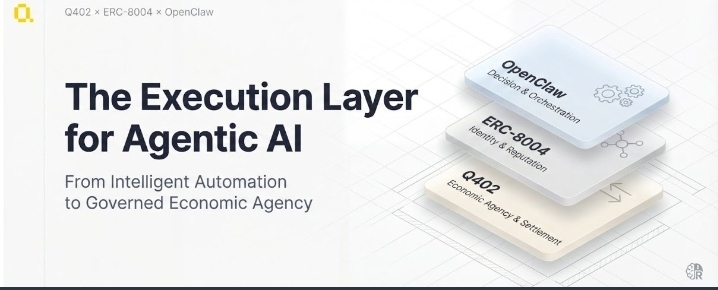
Yesterday, @QuackAI published an X Article:
“The Execution Layer for Agentic AI.”
Here's what I took away 👇
1/
Agents can reason and orchestrate workflows but reasoning alone doesn’t create economic agency. Execution must be governed.
2/
Once real capital is involved, four questions define the system:
• Who executed the action?
• Was it authorized under policy?
• How was capital moved?
• Can it be audited?
Without identity, policy enforcement, settlement, and records, agents remain tools not economic actors.
3/
The paper outlines a practical stack:
OpenClaw → off-chain orchestration
ERC-8004 → on-chain identity & reputation
Q402 → policy-bound execution, settlement, verifiable receipts
The bottleneck isn’t intelligence.
It’s governed execution.
4/
The scenarios make it concrete:
• DAO treasury agent with caps and vendor whitelists
• DeFi rebalancing agent with slippage and protocol limits
• Compliance agent blocking sanctioned addresses
Policy is enforced at execution time not after.
5/
Adoption follows a risk-first path:
Phase 1: Controlled execution (identity × policy bounds)
Phase 2: Measured trust (performance-indexed reputation)
Phase 3: Orchestrated autonomy at scale
Constrain authority → measure behavior → expand autonomy.
6/
The future of agentic AI won’t be defined by reasoning alone but by governed execution.
If you want to see how Quack AI structures this execution layer, read the full article below 👇
https://x.com/i/status/2024537303188984227