 When I first try to understand Plasma, I stop thinking about blockchains for a moment and think about how people actually use money today.
Most people using crypto are not trying to speculate all day. They are trying to send money, protect savings, pay someone far away, or move value without friction. In many parts of the world, stablecoins already do this job better than banks. People trust them not because of ideology, but because they work when nothing else does.
The strange part is that stablecoins became essential without having a home built for them. They live on blockchains that were created for other reasons. Trading, experimentation, governance, memes. Stablecoins are everywhere, but they are always guests, never the priority.
Plasma feels like it comes from noticing this gap and taking it seriously.
At its heart, Plasma is a Layer 1 blockchain built around stablecoin settlement. Not as a feature, not as a side use case, but as the main reason the chain exists. Everything else is shaped around that decision.
This sounds obvious, but it is actually rare. Most blockchains start broad and hope real use appears later. Plasma starts with a real use and builds narrowly around it.
Technically, Plasma stays close to Ethereum on purpose. It uses full EVM compatibility so developers do not have to relearn how to build. Wallets do not need strange integrations. This is not about being clever, it is about reducing friction wherever possible.
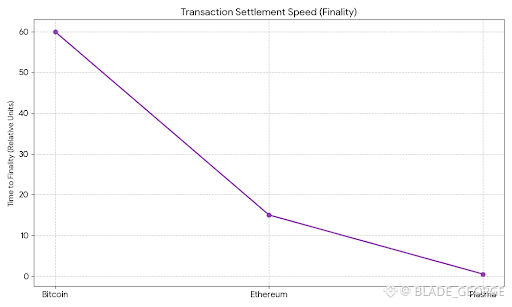
Where Plasma really changes the feeling is finality. Transactions settle almost instantly. You send value, and it feels done. This matters more than people admit. When finality is slow, users hesitate. They refresh screens, they worry, they double check. Plasma treats that anxiety as a design failure and tries to remove it.
Gas is another quiet but important shift. Most blockchains force users to care about a native token they never asked for. Plasma does the opposite. Stablecoins sit in the center. You can pay fees in stablecoins, and in some cases not think about gas at all. This is how real systems scale. They hide complexity instead of pushing it onto users.
None of this is flashy. And that is kind of the point.
One design choice that stands out is Bitcoin anchoring. Plasma does not pretend it can magically become the most neutral system overnight. Instead, it acknowledges that Bitcoin already holds a unique position as a neutral, hard to change settlement layer. By anchoring to Bitcoin, Plasma borrows credibility and censorship resistance rather than trying to invent it.
This tells you something about the mindset behind the project. It is not trying to win arguments. It is trying to last.
When you look at Plasma this way, it feels less like a typical crypto network and more like infrastructure. Something closer to rails than a destination. The goal is not to be loved, but to be relied on.
This also explains the role of the native token. It exists to secure the network and align validators, not to dominate user experience. Users mostly interact with stablecoins. The token works in the background. This makes value growth slower, but also more honest. The network earns relevance by being used, not by being talked about.
The ecosystem that forms around Plasma is likely to reflect this. Instead of hype driven experiments, you expect wallets, payment tools, settlement services, and financial apps that care about uptime and reliability. These are not the loudest parts of crypto, but they are the most durable.
Plasma’s target users make sense in this context. Retail users in places where stablecoins already matter, and institutions that care about predictable settlement. Both groups value stability over novelty. Both groups leave quickly when systems feel fragile.
The roadmap feels aligned with this philosophy. First, make the base layer strong and boring. Fast, cheap, and difficult to break. Then integrate slowly with real services. Adoption here comes from habit, not incentives. People keep using systems that do not surprise them.
Of course, Plasma is not without risk. Liquidity is sticky and users are lazy. Regulation around stablecoins can shift suddenly. Keeping validators secure when fees are low is a real challenge. And in a market driven by attention, being quiet can look like weakness.
But when you zoom out, Plasma is not trying to win a cycle. It is trying to fix a coordination problem. Stablecoins became the most used product in crypto before the ecosystem built proper settlement infrastructure for them.
Plasma is an attempt to correct that mismatch.
If it works, most users will never talk about Plasma. They will just send value, receive it quickly, and move on with their lives. And strangely enough, that might be the strongest signal of success a blockchain can have.
If you want, I can make this even more casual, or tighten it specifically for Binance Square flow, or add a section that explains why this approach might fail.