
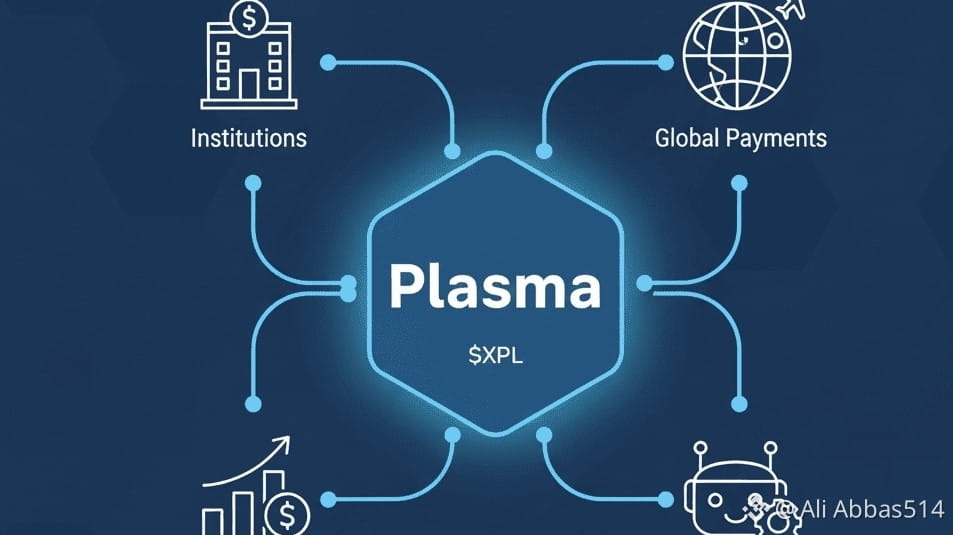
I’m standing at the edge of a world where money moves faster than ever yet still faces friction that most people never see. They’re the hidden delays, the fees that make sending a simple payment feel complicated, the moments when trust wavers because the system was not built for real human needs. If blockchain is to become a reliable backbone for commerce, for families, for institutions, it must be designed around the people using it. Plasma was created in response to that friction, to provide a network where stablecoins are no longer secondary but central, and where payments are fast, secure, and predictable.
Plasma exists because the world outgrew old systems. Stablecoins like USDT have become digital cash for millions of people, used for remittances, everyday payments, and institutional settlements. But most blockchain networks were designed for experimentation, not for large-scale movement of money. Transactions can be slow, expensive, and unpredictable, leaving users frustrated and businesses cautious. It becomes clear that a new foundation was needed, one focused on reliability and real-world usability. Plasma answers that call by building a network where speed, security, and simplicity are not optional—they are the core of the experience.
At its heart Plasma is a Layer 1 blockchain built for stablecoin settlement. PlasmaBFT, its consensus mechanism, finalizes transactions in sub-seconds, giving users the certainty that money has moved. Every validator in the network participates in a carefully orchestrated process, agreeing on transactions almost instantaneously while resisting manipulation. We’re seeing a system that functions with the grace of an orchestra, every node in harmony, producing efficiency that feels effortless. The network does not just process transactions; it creates confidence and trust in each interaction.
The execution layer of Plasma is built for familiarity. It runs a Rust-based Ethereum Virtual Machine called Reth, meaning developers can bring their existing smart contracts and tools without rewriting anything. Wallets, development frameworks, and scripts continue to work as they did on Ethereum, but now with dramatically faster finality and native stablecoin capabilities. Adoption grows when innovation meets familiarity, and Plasma understands that technology must empower rather than confuse. If developers can feel at home, the ecosystem can flourish naturally.
One of Plasma’s most human-centered innovations is its approach to gas fees. Transfers of stablecoins such as USDT can be sent without paying gas fees, removing a friction point that has frustrated users for years. Even more, the system allows users to pay network fees directly in stablecoins or BTC rather than requiring a native token. It becomes intuitive to send value anywhere in the world without juggling multiple assets or worrying about unexpected costs. These design choices reflect empathy built into the code and show a deep understanding of the human side of digital money.
Security is another cornerstone of Plasma. The network anchors its state to Bitcoin, tying every transaction to the most secure and decentralized ledger in existence. This is not a superficial choice. It’s a foundation for trust, a guarantee that if anyone questions the history of transactions, there is an unchangeable record to refer to. I’m reminded that at its core, blockchain is not just technology—it’s confidence. Plasma gives users the ability to trust that money will move as promised, whether they are sending a small payment to a family member or settling millions in institutional transfers.
When evaluating a network like Plasma, surface-level metrics such as transactions per second can be misleading. Peak numbers may look impressive but do not reflect reliability, cost predictability, or real-world performance under load. What truly matters is predictable finality, liquidity, and smooth user experience. We’re seeing that merchants and institutions value these qualities far more than raw throughput. Deep liquidity and ease of moving funds on and off the network are indicators of real adoption, trust, and usability. Metrics are only meaningful when they reflect human experience.
Yet, Plasma is not without risks. Hidden failure points exist if validators become centralized or if the Bitcoin bridge experiences issues. Regulatory uncertainty could also constrain usage in some markets or for certain users. These are not abstract concerns; they are the kind of failures that could truly damage trust in a network built on reliability. Governance plays a key role in mitigating these risks. Plasma is evolving mechanisms to decentralize control and allow the community to participate in decision-making. If executed with care, governance can ensure resilience and continuity. If neglected, even the strongest technology cannot maintain user confidence.
In the end, Plasma is more than a blockchain. It is a response to the real-world pain points of digital payments. It is about sending money without fear, settling transactions instantly, and creating a network that feels fair and reliable. We’re seeing the future of payments not in abstract theory but in moments that matter: a family receiving remittances, a business closing a deal instantly, a merchant accepting stablecoins without hesitation. Plasma reminds us that technology works best when it serves people. It becomes trust, connection, and possibility all in one. Its vision is grounded, honest, and achievable, and it inspires a future where money flows freely across borders with certainty and care.
