
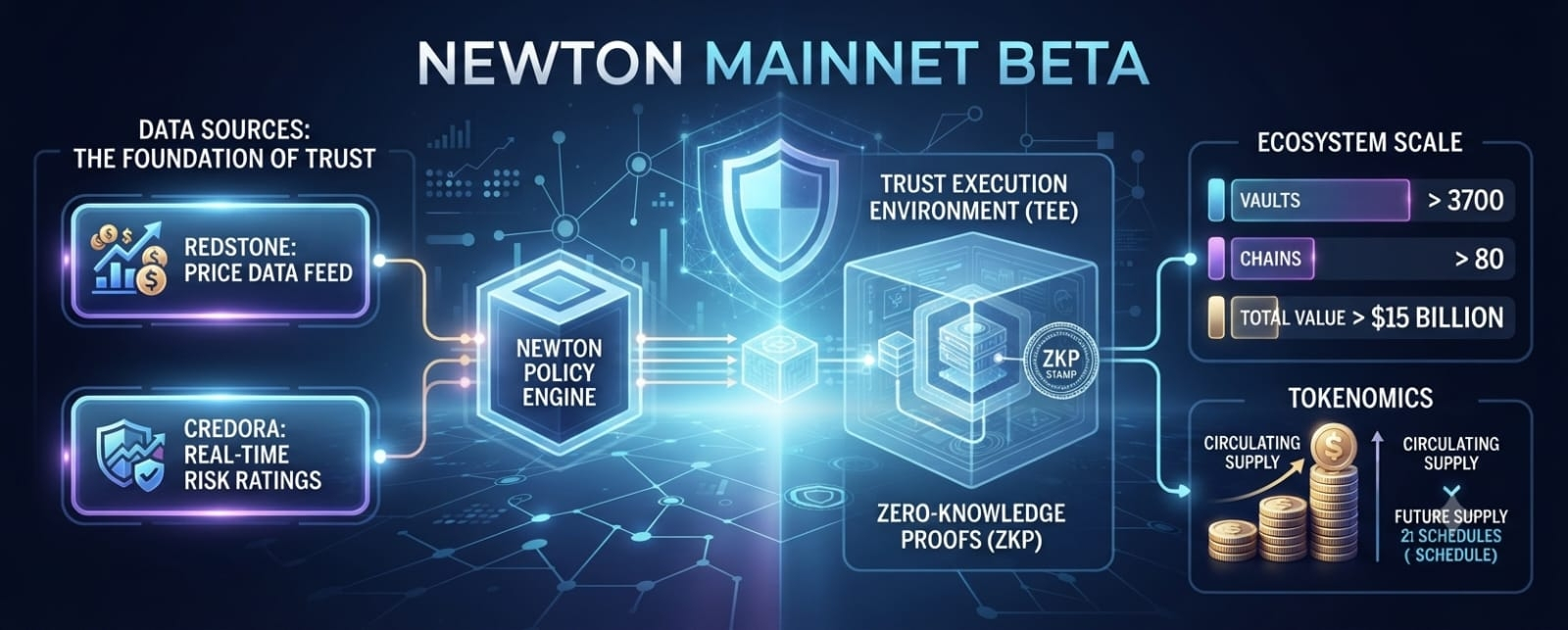
When I read the Newton Mainnet Beta announcement, one thing immediately caught my attention: the first data partners are RedStone and Credora—not an auditing firm. It may seem like a small detail, but the more I thought about it, the more it revealed how this system is actually designed to work.
Newton is building an authorization layer for on-chain transactions. In simple terms, it acts as a policy engine that checks certain conditions before a transaction is settled. Only transactions that satisfy those rules are allowed to go through. It's an interesting approach, but it also creates a clear dependency: the system is only as reliable as the data it receives.
This is the first layer of trust. Even if the policy engine is built well, it still has to make decisions based on external inputs. If market prices are manipulated or a credit model carries bias or inaccurate assumptions, then even the best-written rules can lead to poor decisions. A strong policy engine simply can't fix bad input data.
That's why the choice of RedStone and Credora matters. RedStone provides price data, while Credora delivers real-time risk ratings. On paper, both are important pieces of infrastructure. If the price feeds remain accurate and the risk models stay reliable, the policy engine can do its job as intended. But if either source becomes compromised or starts producing flawed data, the entire decision-making layer becomes much less dependable.
The second layer of trust is the technical execution. Newton is built on EigenLayer AVS, giving it access to Ethereum-level security for verifying off-chain computation. It also runs AI-related workloads inside a Trusted Execution Environment (TEE) and generates zero-knowledge proofs (ZKPs) to verify those computations back on-chain. From a technical standpoint, that's a solid architecture because it helps prove that the computation itself hasn't been tampered with.
However, there's an important distinction here. Proving that a computation was executed correctly is not the same as proving that the input data was correct in the first place. ZKPs can verify the integrity of the computation, but they can't guarantee that the underlying data was accurate, unbiased, or free from manipulation. That's a separate trust challenge, and it's one that's easy to overlook.
That's why Newton Mainnet Beta feels both promising and unfinished at the same time. The scale is already significant. According to the project's figures, the Vault ecosystem has grown beyond $15 billion, spanning more than 3,700 Vaults across 80+ chains. Growth at that pace naturally creates pressure to move quickly. But when infrastructure expands before every trust assumption is fully tested, the risks don't disappear—they simply shift to another layer.
Token economics is another factor worth paying attention to. On June 24, around 139 million NEWT tokens were unlocked, representing 37.22% of the circulating supply, with an estimated value of roughly $7.6 million. At the same time, the project's market cap remains relatively modest at around $12 million, while approximately 264 million tokens are in circulation out of a maximum supply of 1 billion. That means a considerable amount of supply is still scheduled to enter the market.
So the real question isn't just whether the technology is impressive. The bigger question is whether the protocol can generate enough genuine usage to absorb that future supply over time. Infrastructure narratives can attract attention, but long-term value usually comes from sustained protocol activity rather than the excitement of a launch.
For now, Newton appears to have a thoughtful technical direction and a meaningful use case. At the same time, the trust model still has areas that need to prove themselves, and the token economics deserve close attention. The Mainnet Beta isn't the conclusion of the story—it's where the real test begins.
