
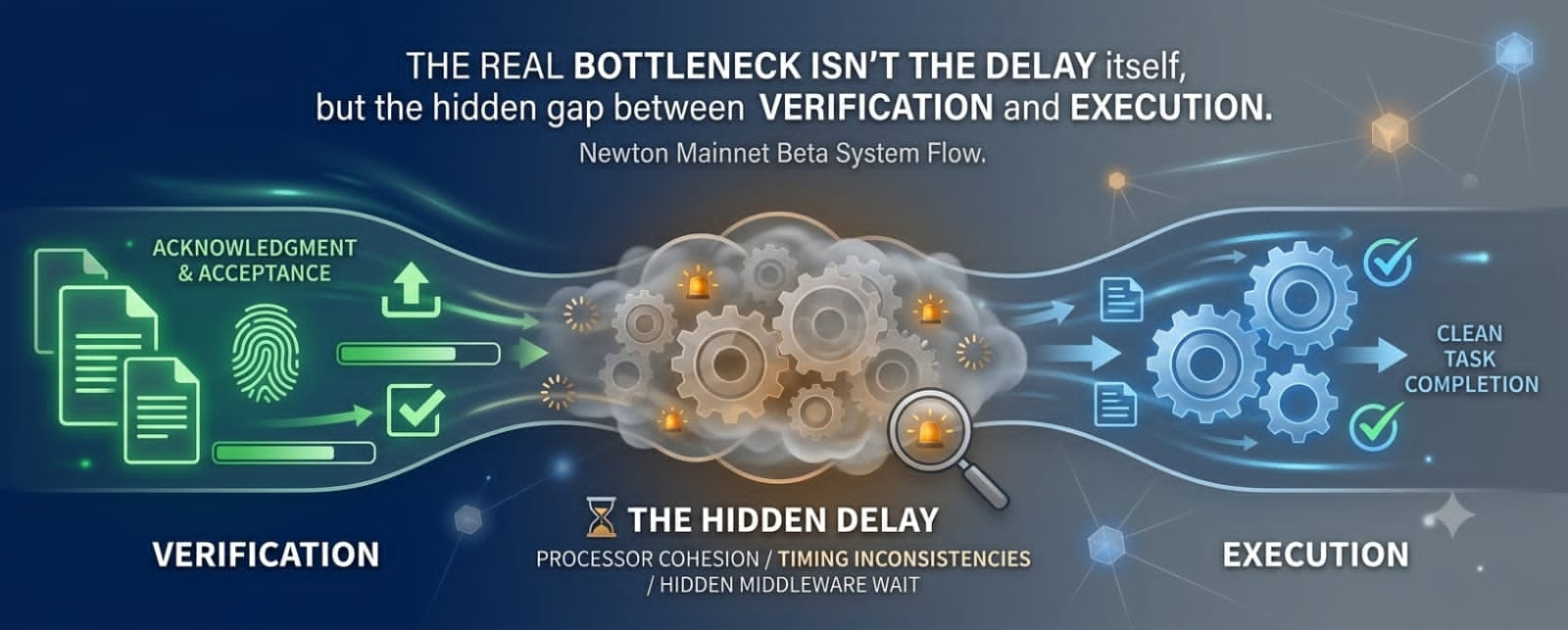
The first thing I saw was a request that didn't move the way I expected. It didn't fail. It didn't crash. It just took a little longer than I thought it would, and the retry completed cleanly on the second attempt.
At first, I blamed the usual things. Load. Temporary congestion. A busy node. It felt like the most reasonable explanation because it's the first place most of us look when a system behaves a little differently.
But the flow didn't really support that assumption.
The upload was accepted. The storage layer responded. Registration appeared as expected. Then the process slowed before the task became available for execution. In a system like Newton Mainnet Beta, that kind of delay doesn't automatically mean something is broken. Sometimes the visible pause happens between steps that are all working exactly as they're supposed to.
That was the part that made me stop and look again.
I keep noticing how easy it is to mistake confirmation for completion. A request can be acknowledged, a record can be written, and the system can still be waiting on something less visible in the middle. From the outside, everything looks fine, but the timing underneath isn't always as smooth as it appears.
What stood out to me wasn't bandwidth or hardware. It was the gap between verification and execution. If different operators are processing work in slightly different windows, the overall system can feel inconsistent even though every individual component is behaving normally. Nothing actually breaks. It just... pauses.
That kind of hesitation is easy to overlook during normal usage. It becomes much more interesting when demand starts to grow. If more agents, users, or automated processes arrive at the same time, that small delay might stop looking like a timing quirk and start becoming the real bottleneck.
That's the part I'm paying attention to now. Not the retry itself, but what the retry might be hiding.
