

One section of Newton's whitepaper kept pulling me back.
It wasn't the cryptography.
It wasn't the privacy model.
It wasn't even the discussion around AI agents.
It was the part about reusable policy modules.
At first, it didn't seem like the most exciting idea in the document. But the more I thought about it, the more I felt it might end up being one of the most important.
Most crypto applications solve the same problems again and again.
One team builds KYC checks.
Another builds sanctions screening.
Someone else creates transfer limits or jurisdiction rules.
A different protocol writes almost the same logic from scratch because their requirements are slightly different.
It works, but it's hardly efficient.
After a while, you realize developers aren't just building products. They're rebuilding the same compliance layer over and over again.
That's the problem Newton seems to recognize.
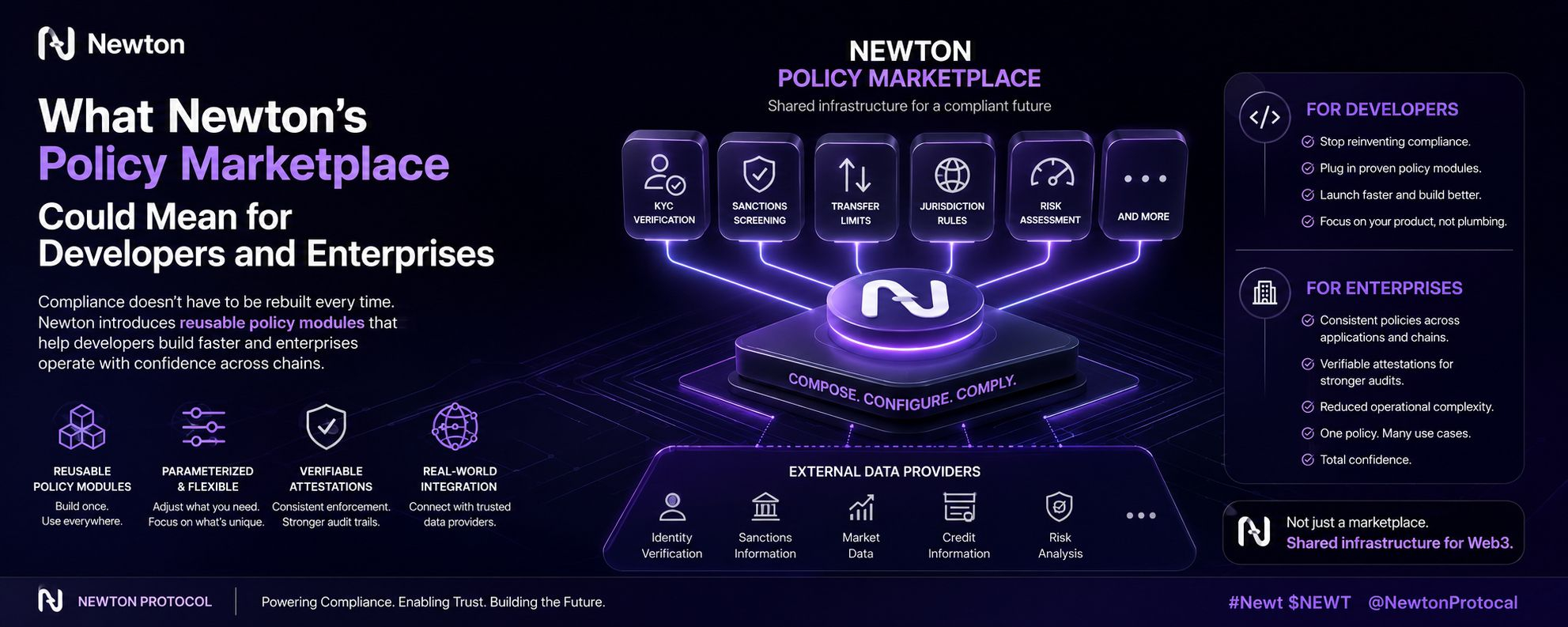
Instead of expecting every project to create its own policy system, Newton introduces the idea of reusable policy modules. Developers can combine existing building blocks, adjust the parameters they need, and focus their time on what actually makes their application unique.
Honestly, that feels like a much more practical direction.
Infrastructure becomes valuable when people stop noticing it.
Nobody gets excited about authentication libraries anymore because they're simply expected to exist. Cloud storage works the same way. Developers don't reinvent it every time they launch something new.
Reading this part of the whitepaper made me wonder whether compliance could eventually follow the same path.
Instead of treating policy as custom code written for every application, what if it became something reusable?
Something developers could simply plug in.
For enterprises, I think the value is even easier to understand.
Large organizations rarely want to maintain a different compliance framework for every blockchain they interact with. They usually want consistency.
If one policy can be reused across multiple applications and different chains while producing verifiable attestations, that removes a surprising amount of operational complexity. It also creates a clearer audit trail because the same policy is being applied everywhere instead of being rewritten by different teams.
Another detail I appreciated is that Newton isn't trying to lock everything inside its own ecosystem.
Policies can use external data providers for identity verification, sanctions information, market data, credit information, and risk analysis. That makes the system feel much more connected to the real world instead of pretending everything important already exists onchain.
The more I read, the less I thought about this as a marketplace.
I started thinking about it as shared infrastructure.
That's a small difference in wording, but a big difference in mindset.
A marketplace sounds like somewhere people exchange products.
Shared infrastructure sounds like something the entire ecosystem quietly relies on.
Of course, none of this happens automatically.
Developers still have to publish useful policy modules.
Applications have to trust them enough to integrate them.
Enterprises need to see that using shared policies is actually easier than maintaining everything internally.
Those things take time, and they certainly don't happen because a whitepaper says they will.
But I do think Newton is looking at a real problem.
Web3 has become incredibly good at building new protocols.
It hasn't been nearly as good at reusing the operational pieces that almost every protocol needs.
If Newton Protocol can help change that, its biggest contribution may not be another feature or another product.
It could simply make building compliant applications a lot less repetitive than it is today.
To me, that's the kind of infrastructure that usually has the longest lifespan.
People rarely remember who built it first.
They just end up wondering how they ever worked without it.