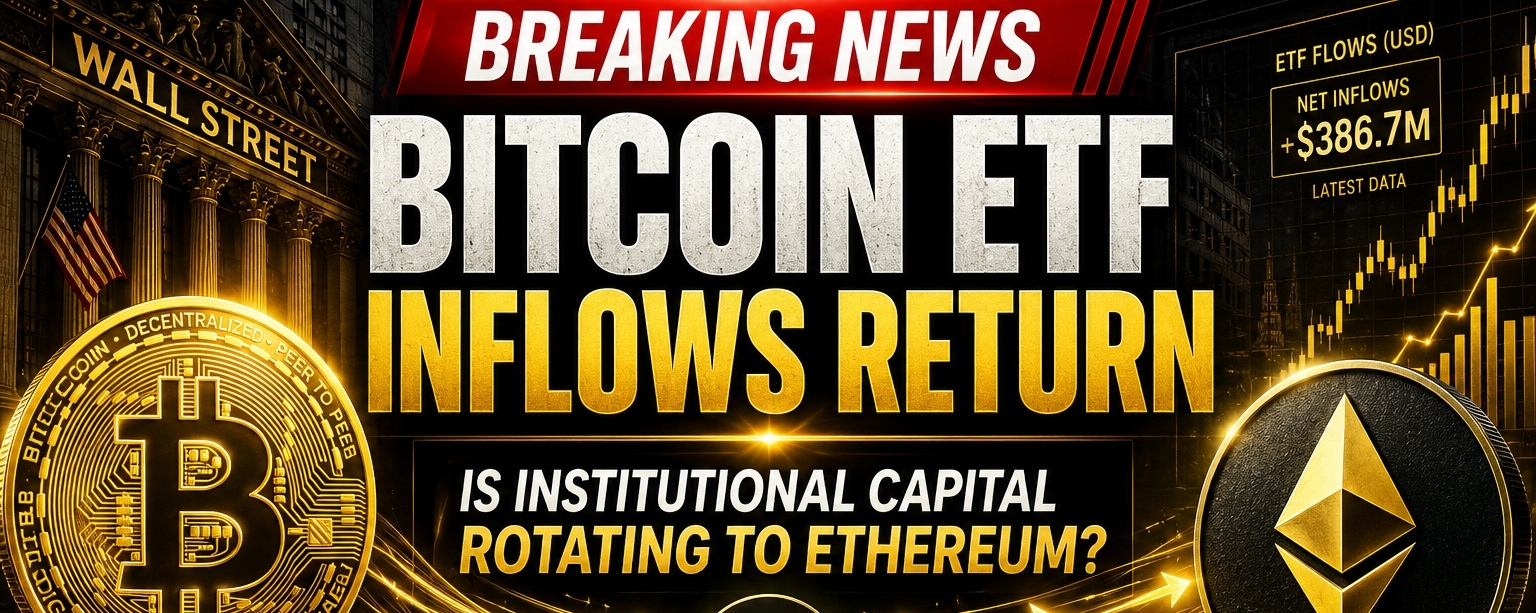
The biggest story in crypto today isn't just Bitcoin's price—it's where institutional money appears to be moving.
Every market cycle has a signal that most traders notice too late.
This time, it may not be a dramatic price breakout or a viral headline. Instead, the real story could be unfolding through ETF capital flows.
After weeks of mixed sentiment, Bitcoin spot ETFs have started seeing renewed inflows, while Ethereum ETFs continue to attract consistent institutional interest. At first glance, these developments may seem like ordinary market statistics. But for long-term investors, they raise an important question:
Is institutional capital leaving Bitcoin—or simply becoming more diversified?
The answer matters because institutional investors rarely make decisions based on emotion. Their capital allocation often reflects broader expectations about the future of digital assets.
Bitcoin Remains the Market Leader—But the Strategy Is Changing
Bitcoin continues to hold its position as the world's largest cryptocurrency and the primary gateway for institutional exposure to digital assets.
Recent ETF inflows suggest that confidence hasn't disappeared. Instead, large investors appear to be returning selectively after periods of market uncertainty.
Rather than aggressively buying every dip, institutions are taking a measured approach. Factors such as interest-rate expectations, macroeconomic conditions, and overall market liquidity continue to influence their decisions.
This is a reminder that professional investors often prioritize patience over speed.
Why Ethereum Is Attracting Fresh Institutional Interest
While Bitcoin remains the benchmark asset, Ethereum is strengthening its appeal for a different reason.
Ethereum is no longer viewed solely as a cryptocurrency. It powers decentralized finance (DeFi), tokenized real-world assets, enterprise blockchain solutions, and a growing ecosystem of smart contracts.
For many institutions, Ethereum represents exposure to the infrastructure of the future digital economy.
The continued demand for Ethereum ETFs reflects that broader investment thesis.
Rather than choosing between Bitcoin and Ethereum, many professional investors may now see value in holding both—each serving a different role within a diversified portfolio.
Is This a Capital Rotation—or Just Smarter Portfolio Management?
The phrase "capital rotation" has become popular across crypto discussions, but it's important not to jump to conclusions.
A few days of ETF inflows or outflows don't prove that institutions are permanently shifting away from Bitcoin. Daily ETF data can change quickly in response to economic news, monetary policy expectations, and investor sentiment.
What's more likely is that institutions are becoming increasingly sophisticated in how they allocate capital.
Instead of asking, "Which coin will win?" they may be asking, "How should we balance exposure across multiple high-quality digital assets?"
That's a sign of a maturing market—not a weakening one.
What Retail Investors Can Learn
Retail traders often react to headlines.
Institutional investors usually react to long-term trends.
That's why ETF flows should never be viewed as standalone buy or sell signals. They are one piece of a much larger puzzle that includes technical analysis, on-chain activity, macroeconomic developments, and risk management.
Following capital flows can provide useful context—but successful investing still requires patience, discipline, and a clear strategy.
AltcoinWolF Perspective 🐺
One of the biggest mistakes in crypto is assuming that every market move has only one explanation.
Bitcoin attracting fresh ETF inflows while Ethereum continues to see institutional demand doesn't necessarily mean one asset is replacing the other.
It may simply reflect a more balanced approach from professional investors who understand that the digital asset market is evolving beyond a single narrative.
For retail investors, the real lesson isn't to chase every headline.
It's to understand why capital is moving—and to make decisions based on evidence rather than emotion.
In the long run, knowledge will always outperform hype.
Key Takeaways
Bitcoin ETFs are showing renewed investor interest after earlier periods of weaker flows.
Ethereum continues attracting institutional capital because of its expanding role in blockchain infrastructure.
Current ETF trends suggest diversification, not necessarily a permanent shift away from Bitcoin.
ETF flows should be combined with technical analysis and macroeconomic context before making investment decisions.
Long-term discipline remains more valuable than reacting to daily headlines.
Data Note
ETF flow trends discussed in this article reflect publicly available market information available at the time of writing. Because institutional fund flows are updated regularly, they should be viewed as one indicator among many—not as standalone buy or sell signals.
Final Thoughts
Institutional participation is becoming one of the strongest forces shaping the future of crypto markets.
Whether Bitcoin leads the next rally or Ethereum continues building momentum, one thing is becoming increasingly clear:
Smart money isn't leaving crypto.
It's becoming more selective.
For investors willing to look beyond daily price movements, ETF flows offer valuable insight into how professional capital is positioning for the next phase of the market.
If you found this analysis valuable, follow AltcoinWolF for clear, data-driven crypto insights focused on market structure, institutional trends, and risk-aware trading.
The market rewards patience, not emotions. Wait for confirmation, protect your capital, and let the charts lead the way. — AltcoinWolF
#etf #bitcoin #ETHETFsApproved #Binance $BTC