


the defining advantage of autonomous ai agents is their ability to observe markets, evaluate opportunities, and execute transactions faster than any human operator. that same advantage exposes a weakness in today's defi infrastructure. financial systems have traditionally relied on the time between decision and execution as an opportunity for oversight. a treasury manager approves an exceptional payment. a compliance officer reviews a flagged transfer. a trading desk requires multiple signatures before moving significant capital. ai compresses that decision window to milliseconds. once an autonomous agent decides to act, there is effectively no opportunity for human intervention.
this challenge is becoming increasingly significant as onchain finance continues to scale. stablecoins now represent more than $313 billion in circulating value and facilitate over $4 trillion in monthly transfer volume, while the tokenized real world asset market has expanded beyond $25 billion. financial activity is becoming increasingly programmable, but governance has not evolved at the same pace. systems capable of executing value in milliseconds still often depend on authorization models designed for human review.
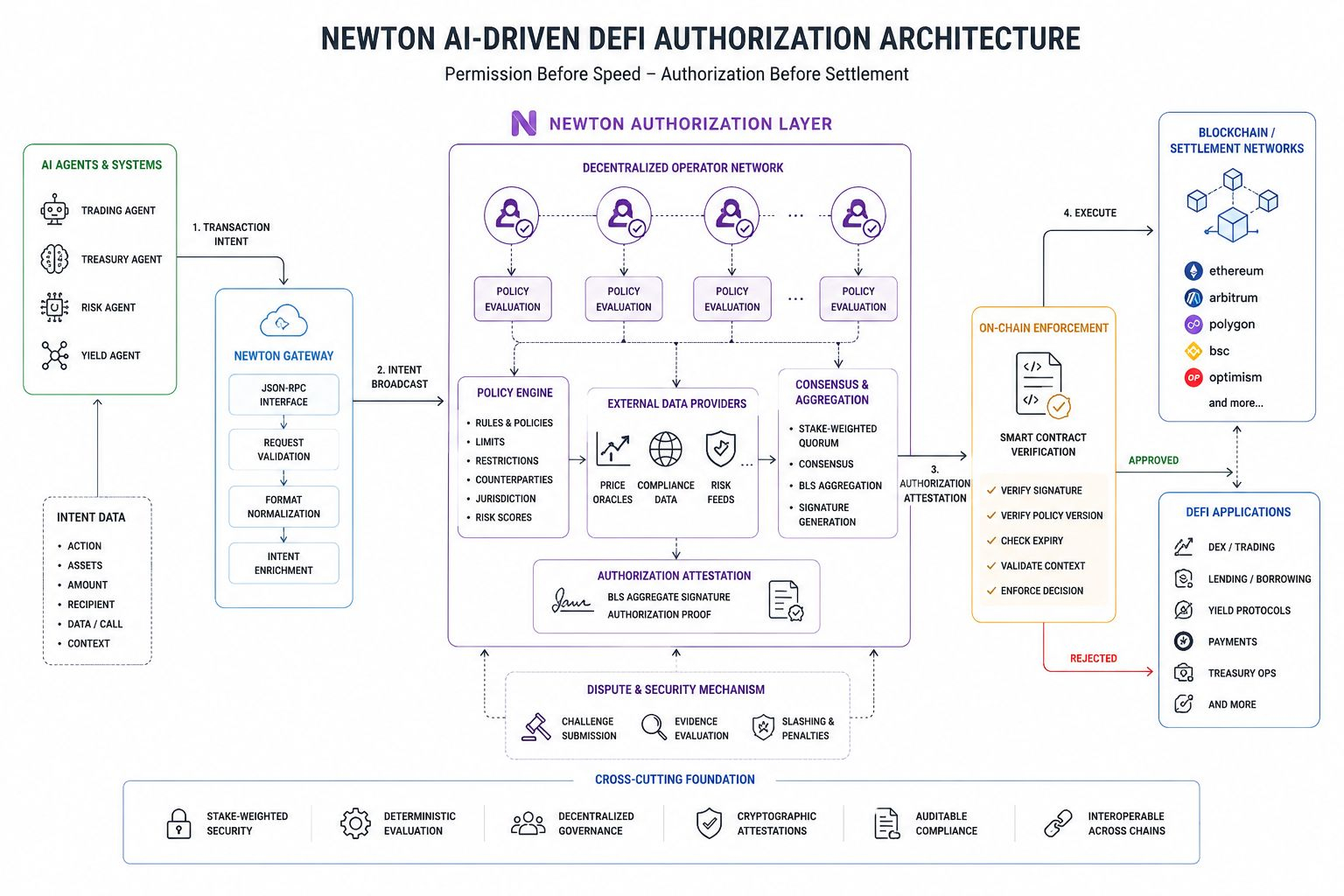
ai doesn't simply increase transaction speed, it changes where trust has to be established. traditional blockchains assume that a valid signature and successful smart contract execution are sufficient conditions for settlement. autonomous finance introduces a different requirement: every transaction must also satisfy organizational policy before value moves. settlement proves a transaction can execute. authorization proves it was permitted to execute. ai collapses those decisions into the same moment, making pre settlement authorization part of the execution path rather than an external review process.
@NewtonProtocol is designed around this architectural shift. instead of evaluating compliance after settlement, it evaluates transaction intent before execution. an ai agent submits an intent through newton's gateway using a standard json rpc interface. newton's decentralized operator network evaluates that intent against predefined policies and approved external data sources. once the required stake weighted quorum reaches consensus, the network produces a bls aggregate signature that serves as cryptographic proof of authorization. smart contracts that integrate newton can require that proof before allowing a transaction to settle. within those systems, authorization becomes a cryptographic prerequisite for execution rather than a review performed after value has already moved.
this distinction matters because autonomous systems cannot pause for manual approval without losing the speed that makes them valuable. newton's streaming consensus architecture allows operators to evaluate policies and required data providers in parallel while the aggregator finalizes authorization as soon as the required stake weighted threshold is reached. instead of forcing ai systems to choose between governance and execution speed, the protocol makes authorization compatible with the latency requirements of machine driven finance. #newt
speed alone, however, is not enough. an authorization layer must also be economically trustworthy. newton achieves this through stake weighted security. operators back their evaluations with economic stake and collectively authorize results through bls signature aggregation. incorrect evaluations can be challenged through the protocol's dispute mechanism, while dishonest behavior carries financial consequences through slashing. every authorization therefore represents more than distributed agreement. it represents economically accountable consensus. operators do not merely express an opinion about policy compliance they place capital behind the correctness of that decision. trust shifts from institutional reputation to measurable economic incentives.#Newt
equally important is determinism. every honest operator evaluates the same transaction intent against the same policy and external inputs, independently reaching the same result. consensus emerges because identical computation produces identical outcomes rather than because participants negotiate or interpret policy differently. authorization becomes reproducible instead of discretionary, allowing decentralized policy enforcement without introducing inconsistent compliance decisions. for institutional systems, predictable authorization is just as important as decentralized authorization.$BEE
the policy layer is where this architecture becomes operational. organizations can define spending limits within rolling time windows, restrict interactions to approved counterparties, confine activity to specific protocols, or require elevated authorization for transactions exceeding predefined thresholds. crucially, these controls exist outside the ai system itself. an autonomous agent may refine its reasoning, adapt its strategies, or discover more efficient execution paths, but it cannot optimize around an authorization requirement enforced independently by a decentralized network. governance becomes infrastructure rather than guidance. $THE
the economic incentive to automate these controls is substantial. organizations worldwide spend an estimated $206 billion annually on compliance. as autonomous systems assume greater responsibility for treasury management, liquidity allocation, and cross-chain capital deployment, replacing manual review with cryptographically verifiable authorization becomes more than a security improvement it becomes an operational requirement for scaling financial activity safely.
cross-chain activity makes consistent authorization even more important. autonomous agents naturally move capital toward whichever blockchain offers the most attractive combination of liquidity, execution costs, or yield. without a unified authorization layer, differences between chains become potential compliance gaps. newton addresses this through a source chain and destination chain architecture where operators registered on ethereum extend the same security guarantees and policy enforcement across supported networks. authorization becomes independent of execution venue, allowing organizations to enforce one policy framework regardless of where transactions ultimately settle.
every authorization decision also produces independently verifiable evidence. each evaluation generates a compliance receipt binding together the transaction intent, the policy version, operator responses, and the resulting aggregate signature. rather than reconstructing events from application logs or relying on records maintained by an ai operator, institutions can verify exactly which policy was enforced before settlement occurred. the authorization record becomes part of the transaction's lifecycle itself rather than evidence assembled after execution has already taken place. compliance shifts from retrospective investigation to cryptographic proof.
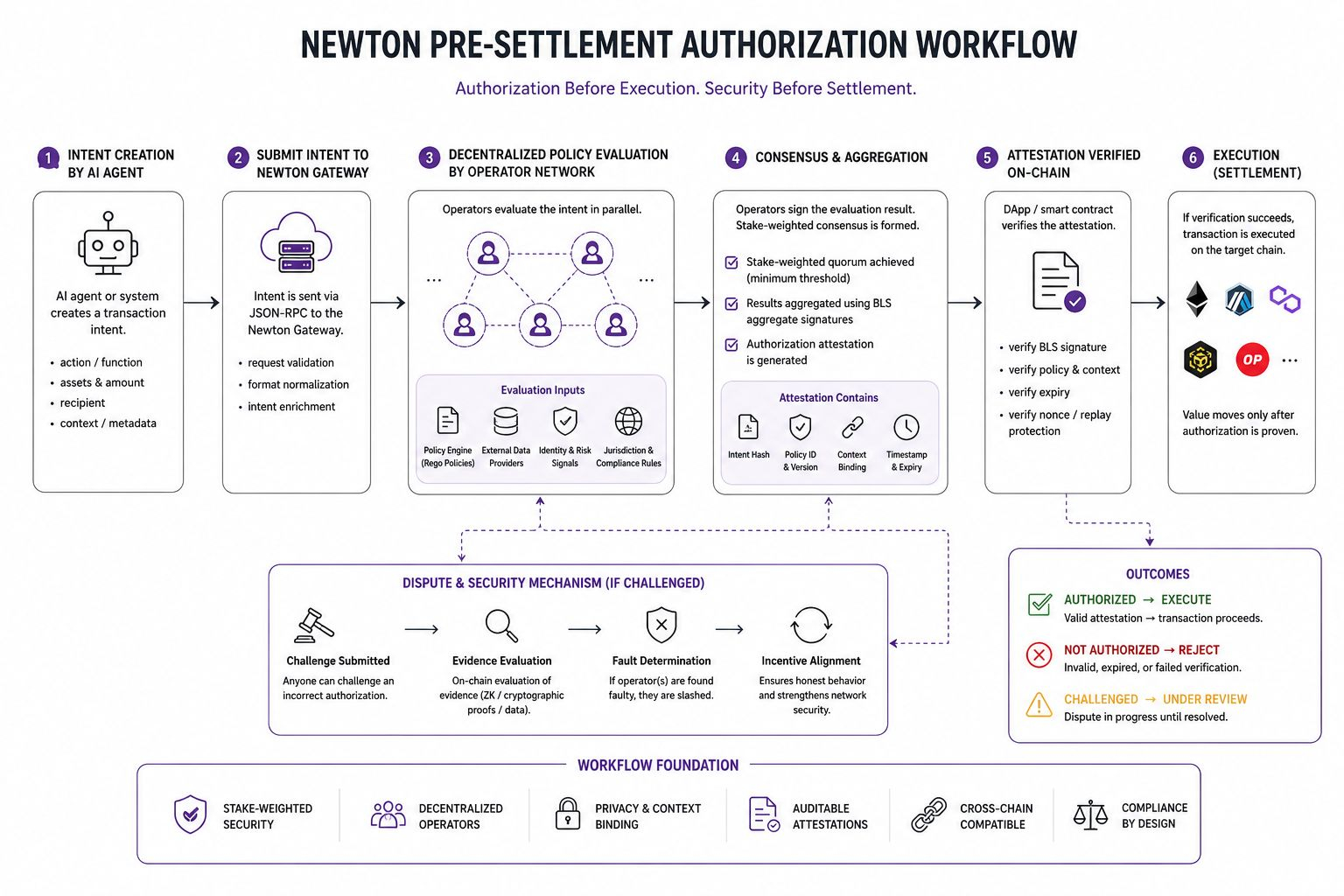
the broader significance of newton's architecture extends beyond compliance. traditional financial systems institutionalized trust through people, procedures, and organizational controls. autonomous finance cannot depend on those mechanisms because ai removes the time available for procedural oversight. trust must instead be embedded directly into infrastructure. by replacing manual approval with decentralized, cryptographically verifiable authorization, newton transforms governance from an organizational process into a programmable property of transaction execution itself. $NEWT
the long term challenge of ai driven finance is not teaching machines how to move capital. that capability already exists. the challenge is ensuring autonomous systems remain accountable without sacrificing the speed that makes automation valuable. with more than $4 trillion moving across stablecoin networks every month and tokenized real world assets continuing to expand, the scale of programmable finance is growing far faster than traditional compliance models were designed to support. newton addresses this by separating authorization from settlement and embedding governance directly into execution. permission is established before value moves, secured through stake weighted consensus, verified through cryptographic attestations, and enforced consistently across chains. as finance becomes increasingly autonomous, competitive advantage will belong not simply to the systems that execute transactions the fastest, but to the systems that can prove every transaction was authorized before execution ever began. in that sense, pre settlement authorization is not another layer of compliance,it is foundational infrastructure for autonomous finance.