I keep a mental list of details in crypto projects that get buried in the fine print of a tokenomics section but actually say more about the project than anything in the pitch deck. A few nights ago I was rereading Newton's staking mechanics for probably the third time, mostly skimming, and I landed on one line I'd glossed over before: staked NEWT is locked for a fourteen-day cooldown period before it can be withdrawn. My first reaction was that this is completely standard, every proof-of-stake style system has some unbonding period, nothing to see here. But then I put that detail next to the rest of what Newton is supposedly for, and it started bothering me in a way it hadn't the first two times I read it.
The initial assumption I had going in was that the staking and slashing model exists purely as a security backstop, the kind of thing you set up once and mostly forget about, similar to how validator slashing works on any proof-of-stake chain. Operators put up collateral, they behave, everyone's happy, and the cooldown period is just a standard anti-gaming measure to stop people from front-running slashing events by withdrawing right before getting caught. Fine. Boring. Move on.
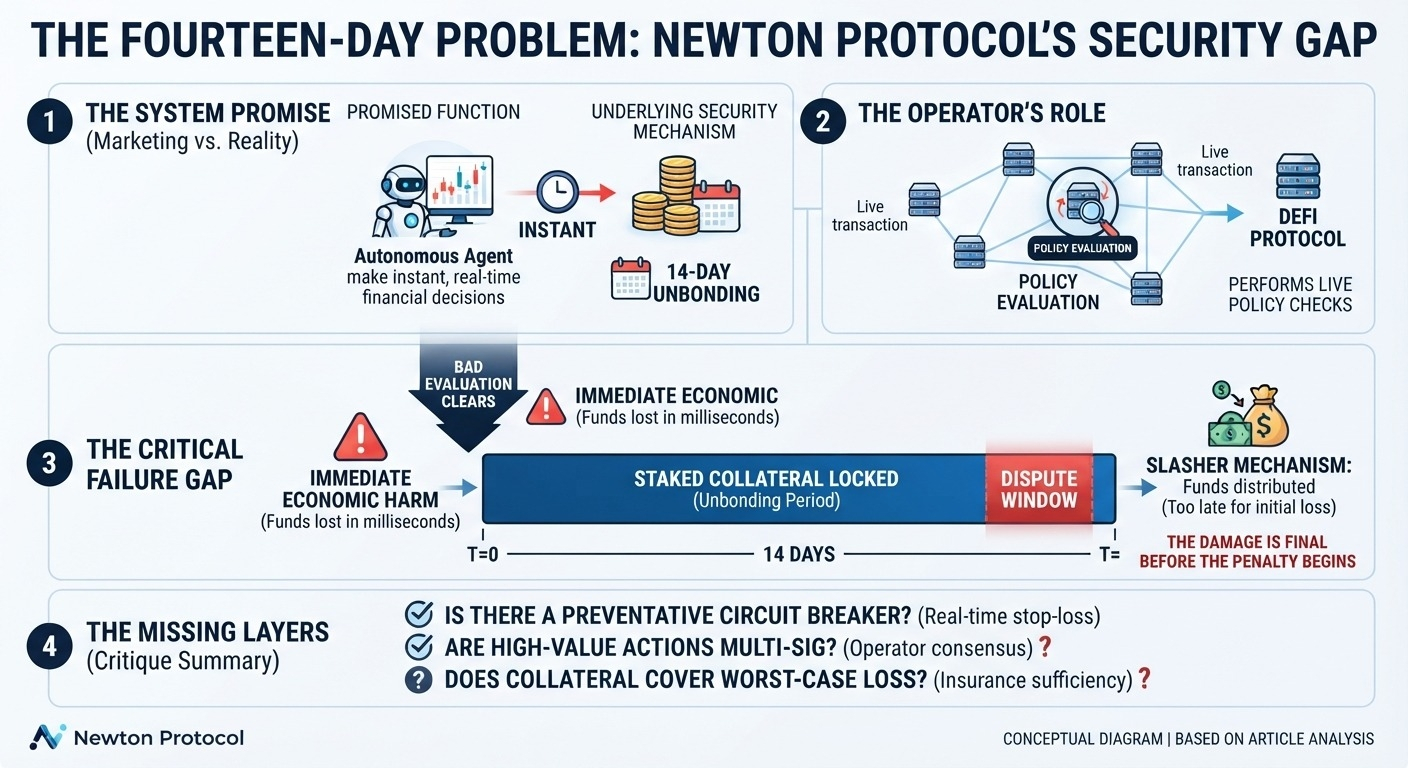
Then I thought more carefully about what these operators are actually securing, and the picture stopped feeling boring. Newton's operators aren't just validating blocks in the abstract sense. They're evaluating live policy checks on live transactions, in something close to real time, for use cases the project explicitly frames as autonomous agents doing things like rebalancing portfolios or executing recurring actions without a human in the loop for every step. The entire value proposition rests on speed and continuous trustworthiness, the system is supposed to be checking things constantly, as they happen, unattended.
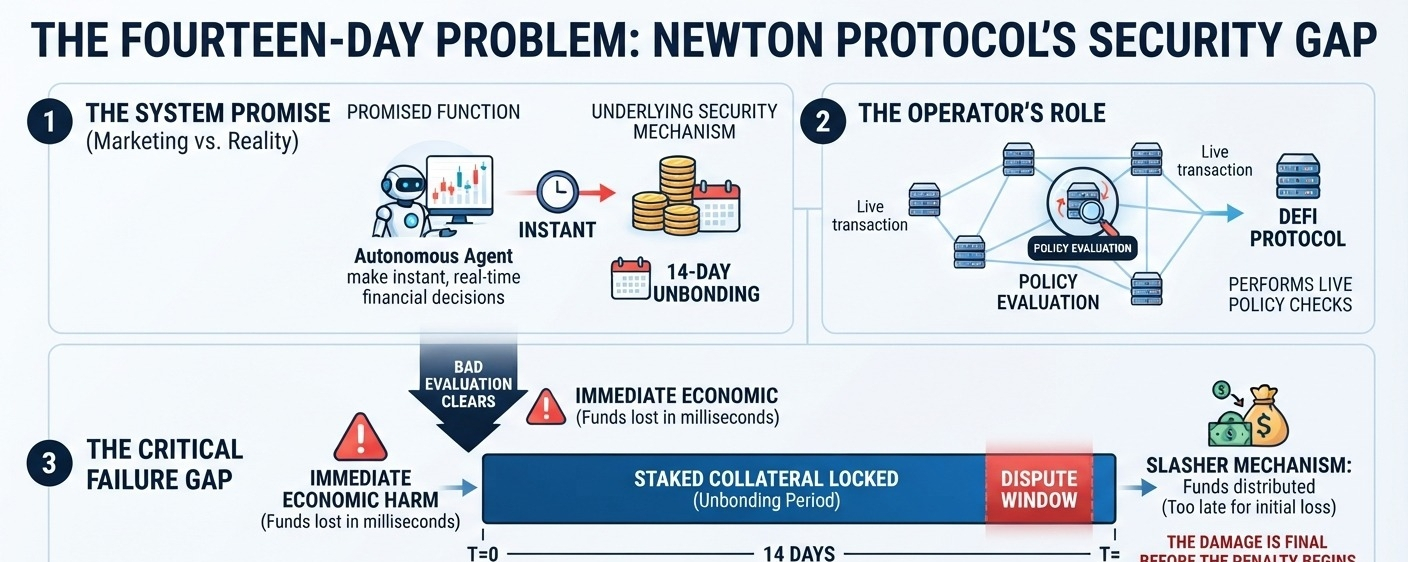
And the security model underneath that constant, live, unattended checking is economic collateral that takes two weeks to unwind if something goes wrong. That gap is the thing I think most people skim past. If an operator starts misbehaving, whether through actual malice, a bug, a compromised key, or just a badly configured policy evaluation, the slashing mechanism exists to punish it after the fact. It doesn't stop the bad evaluation from happening in the moment. It's a deterrent and a cleanup mechanism, not a circuit breaker. Meanwhile the thing it's supposed to be deterring is happening at the speed of blockchain transactions, which is to say, fast, continuous, and often irreversible the second it's confirmed.
Here's a way to think about it plainly. Imagine a bank that hires security guards to watch every single transaction happening at every teller window in real time. The guards are well trained, well paid, and if one of them lets a fraudulent withdrawal through, they lose their job and their pension two weeks later. That's a real consequence, and it probably does discourage a lot of bad behavior in expectation. But it does nothing for the customer whose money already left the building in the moment the guard looked away. The punishment is real. The protection, in the specific instant it mattered, isn't. Slashing works the same way here. It aligns incentives over time. It does not prevent a specific bad transaction from clearing before anyone can react to it.
To be fair, this isn't unique to Newton, every restaking or proof-of-stake security model has some version of this lag between misbehavior and consequence. What makes it feel sharper here is the specific framing of the product. A lot of proof-of-stake systems are securing things like block production or data availability, where the failure mode is usually detectable and reversible, or at least contained, before real economic damage compounds. Newton is explicitly positioning itself as the layer that authorizes autonomous financial actions, sometimes for institutions, sometimes for stablecoin issuers, sometimes for agents managing real money without a human checking each step. That's a category of action where a single bad approval, one operator letting something through that shouldn't have gone through, can be final the moment it happens. Applying a slow, deterrence-based security model to a use case that's marketed as fast and autonomous is a mismatch that I don't think gets discussed nearly enough relative to how central it is to whether the whole system actually protects anyone.
There's also a practical wrinkle in how slashing interacts with actual harm. Slashed funds are supposed to be redistributed to affected users, which sounds fair on paper, but it assumes the damage is quantifiable, attributable to a specific operator's fault rather than a flawed policy, and that the slashed collateral is actually sufficient to cover whatever went wrong. High value transactions, the kind institutions would actually route through something like this, could easily exceed whatever an individual operator has staked. At that point the "security" is really more like partial insurance with a payout cap, not a guarantee, and I haven't seen anything spelling out what happens once losses exceed available collateral.
None of this makes the design obviously bad, to be clear. Slashing-based security has worked reasonably well across a lot of proof-of-stake systems, and fourteen days is not an unusual cooldown window by industry standards. My skepticism isn't about whether the mechanism is competent engineering. It's about whether it's the right mechanism for the specific promise being sold. A system marketed around real-time autonomous financial decision-making probably needs something closer to preventative controls in the moment, tighter permission scoping, transaction limits, maybe multiple independent operator confirmations before high-value actions clear, rather than relying mainly on economic deterrence that settles its accounts two weeks after the fact.
If I had to reframe what this actually resembles, I'd say it's less like a security guard and more like an insurance policy with a long claims process bolted onto a system that's supposed to behave like a real-time trading desk. Insurance is a perfectly legitimate way to manage risk. Nobody expects their homeowner's policy to stop a fire from starting. But you'd think twice about a fire alarm company that pitched itself as preventing house fires when what it actually does is process the insurance claim afterward. The gap between "prevents bad outcomes" and "compensates for them after a delay" is exactly the gap I think Newton's marketing glosses over when it uses words like real-time and autonomous in the same breath as staking and slashing.
What I'd want to see, and haven't yet, is a clearer answer for what happens in the actual gap window, the seconds or minutes where a bad evaluation clears and the fourteen-day unwind hasn't even started yet. Is there any in-the-moment circuit breaker, any rate limiting, any requirement for multiple operators to agree before high-stakes actions execute? Or is the entire model resting on the assumption that the threat of eventual slashing is enough to keep operators honest in real time, the same way the threat of eventually going to prison is supposed to stop crime, imperfectly, after the fact, and never in the specific moment it would actually matter. That's the question I'd be watching for before I'd trust this with anything meaningful, and right now I don't think it's been answered publicly at all.