
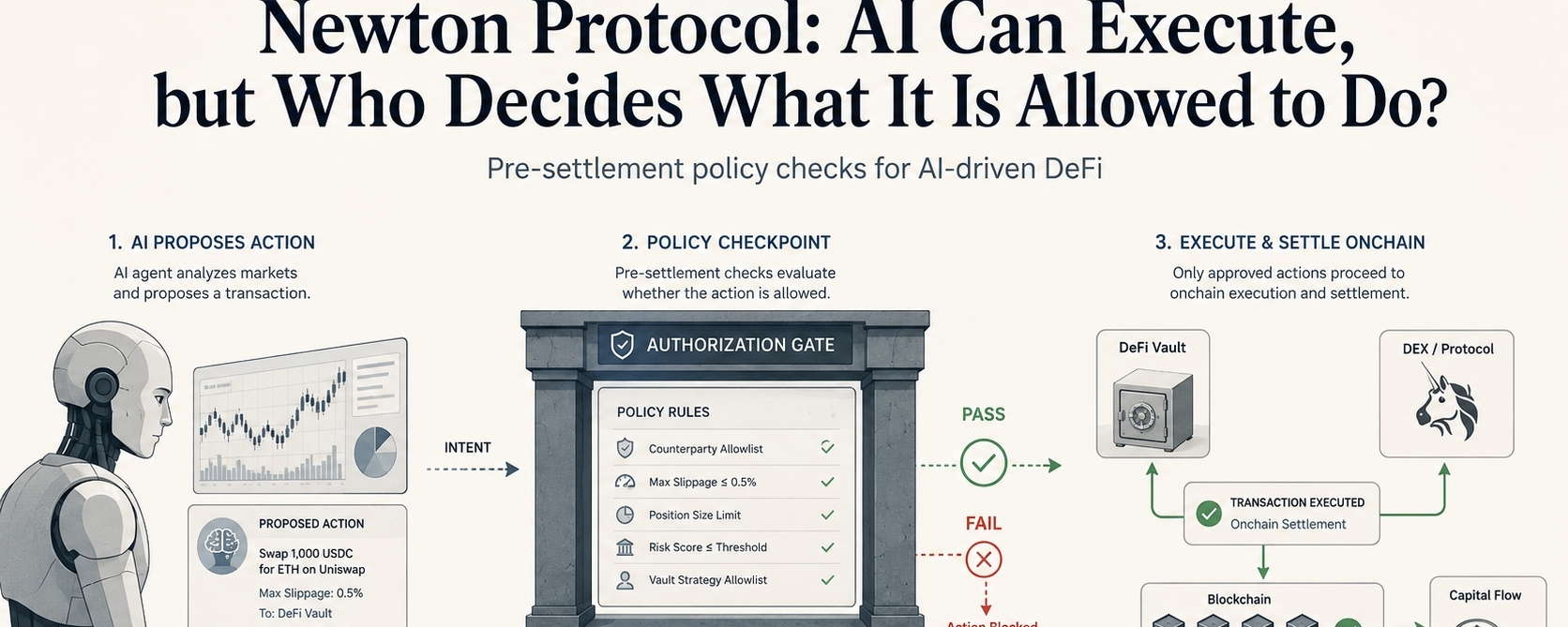

@NewtonProtocol i keep noticing the same uncomfortable thing whenever I look at automated strategies: the market can change faster than the rules around them. Nothing looks broken. Transactions clear. Yet that is the problem. An agent can act, but nobody has built a convincing way to ask, just before capital moves, whether the action is still acceptable. That is why I keep coming back to Newton Protocol.
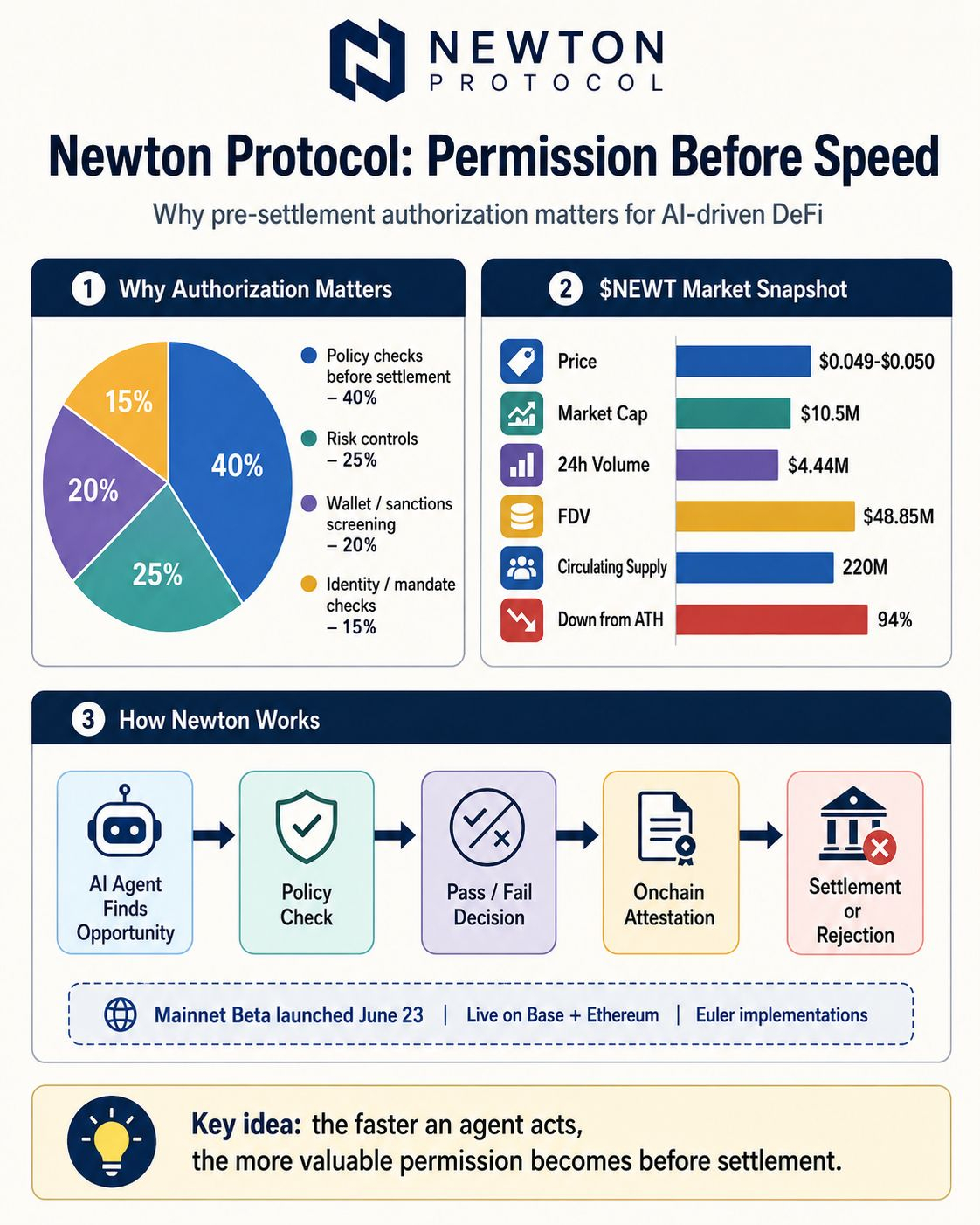
My thesis is simple: AI agents do not mainly create an execution problem. They create what I call the Permission to Speed Ratio. The faster an agent can act, the more valuable it becomes to verify permission before settlement. Intelligence can find a trade in milliseconds. Execution can route it. But if authorization still depends on an offchain dashboard, human reviewer, or static contract rule, speed becomes a liability.
Newton’s Mainnet Beta, launched on June 23, is interesting because it inserts a policy check between transaction initiation and settlement. A transaction can be evaluated against predefined conditions, return pass or fail, and leave a signed, timestamped record onchain. The protocol is live on Base and Ethereum, with Euler implementations, while operators use EigenLayer security and evaluation correctness can be supported by zero knowledge proofs. That differs from monitoring an agent afterward.
Think about a vault manager using an AI agent. The agent sees higher yield and wants to rebalance. Normally, you might trust the model, curator, and application checks. Newton’s approach is closer to putting a rules desk in front of the settlement engine. Is the target market allowed? Has concentration crossed a limit? Did a risk score deteriorate? Is a wallet flagged? The policy is checked before value moves, and the answer can be attested onchain. Newton is also positioning VaultKit around enforceable vault controls using external risk and data providers.
Now here’s the thing: good architecture and a good token trade are not the same thing.
As of today, NEWT trades $0.049 to $0.050. CoinGecko shows a market cap near $10.5 million, roughly 220 million tokens circulating, about $4.44 million in 24 hour volume, and an FDV near $48.85 million. The token remains about 94% below its June 2025 all time high of $0.8206. Over seven days it is up about 2.6% versus an 8.2% rise in CoinGecko’s market benchmark. A product story may improve while the market still refuses to pay for it.
The realistic bull case is not “AI narrative equals price goes up.” I reject that. The bull case is that authorization becomes required as more automated capital moves through vaults and agents. Newton says curated DeFi vault TVL has grown more than 350% over the past year, and its Mainnet Beta targets that environment. If policy checks become recurring infrastructure, then a $10.5 million circulating market cap deserves attention. But small does not mean cheap. Durable demand is not proven.
This is where the Retention Problem becomes central for me. Crypto projects can attract wallets, integrations, campaigns, and speculative volume. Keeping repeated economic activity is harder. For Newton, retention is not a repeat app visit. It is whether vault curators keep policies active, transactions keep being evaluated, developers keep integrating the authorization layer, and those checks create recurring demand that connects back to NEWT. Launches create attention. Repeated policy usage creates evidence.
I am skeptical here. Mainnet Beta is still beta. Policy systems are only as good as their inputs, thresholds, and operator assumptions. A bad oracle, stale risk score, overly strict rule, or poorly designed policy can block a legitimate action or approve a dangerous one. There is an uncomfortable tradeoff between stronger controls and complexity. Extra checks can create integration friction, latency, governance questions, and another dependency. I do not think “pre settlement” automatically means “safe.”
Then there is supply. CoinGecko’s tokenomics section lists a July 24 unlock of 17.84 million NEWT, worth roughly $871,000 at the displayed price, equal to about 1.8% of total supply. For a token with a market cap around $10.5 million, I cannot shrug at that. Unlocks do not guarantee selling, but they change the pressure map when price is already far below its peak.
So what am I watching? Not announcements. I want evidence that policies stay active after the first integration, evaluation volume grows, curators treat Newton as necessary infrastructure rather than optional compliance decoration, and token demand has a visible relationship with network usage. Bullishly, sustained transaction checks across multiple live vaults, recurring developer adoption, and clearer value capture would change my conviction fast. Bearishly, stagnant usage, shallow retention, repeated unlock pressure, or policy failures would make the low valuation look less like opportunity and more like warning.
Look past whether AI can trade. Watch who gets to say yes before it does. That is the market signal I would track now.
