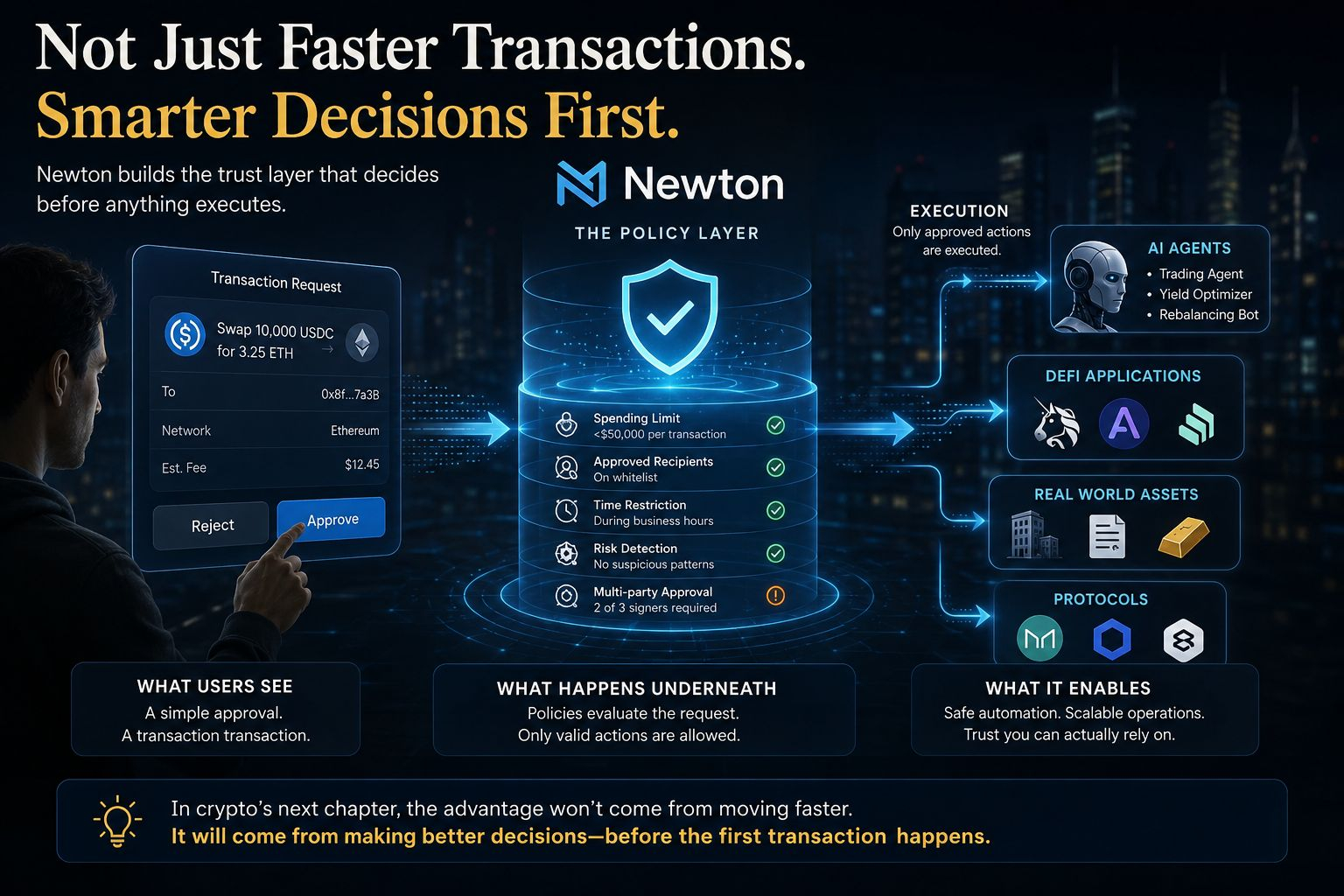
I noticed something recently that I couldn't stop thinking about. Every time people compared blockchain projects, the conversation sounded almost identical. Faster transactions. Lower fees. Higher throughput. Bigger numbers. It was as if the industry had quietly agreed that speed was the only thing left worth competing over.
Then I spent more time looking at Newton, and the interesting part wasn't what it was making faster. It was what it was asking before anything happened at all.
That sounds like a small distinction, but I don't think it is.
Most people experience crypto through a wallet. They connect an application, press a button, approve a transaction, and hope everything works as expected. If the transaction succeeds, the network has done its job. That's the part users see.
Underneath, though, something else is happening. Every approval is really a decision. You're giving software permission to move assets, interact with contracts, or execute instructions that often become irreversible within seconds. Crypto has become remarkably good at executing those instructions. It has spent far less time questioning whether they should have been approved in the first place.
When I first looked at Newton, that difference stood out immediately.
Instead of treating permission like a simple click on a wallet, Newton treats it as infrastructure. That changes the conversation completely because permission isn't just about security. It's about decision-making.
Imagine a company managing millions of dollars across several wallets. Today, that usually means creating internal policies outside the blockchain itself. Someone checks transactions. Another person approves them. Risk teams review unusual activity. The blockchain simply executes whatever finally arrives.
Newton tries to move more of that logic into programmable policies.
For someone seeing this for the first time, it helps to think about online banking rather than crypto. Your bank doesn't simply ask whether you know your password. It also checks where you're logging in from, whether the payment looks unusual, how much money is moving, and sometimes asks for another confirmation before allowing anything to happen.
Newton applies similar thinking to decentralized systems.
On the surface, a transaction still happens. Underneath, policies can define what conditions must be satisfied before software or AI agents are allowed to act. That extra layer sounds simple, yet it changes the structure of trust.
And trust has quietly become one of crypto's biggest bottlenecks.
Blockchain solved the problem of proving ownership without centralized databases. Smart contracts solved the problem of automating agreements. Yet users still spend enormous amounts of time verifying wallet addresses, checking contract permissions, and wondering whether they're signing something dangerous.
That hesitation tells us something.
If people truly trusted every interaction, they wouldn't double-check every approval screen. They wouldn't keep separate hardware wallets for larger holdings. Institutions wouldn't build expensive compliance processes around decentralized finance.
The technology works.
The decision process remains uncomfortable.
Understanding that helps explain why Newton feels different from many infrastructure projects. Instead of asking how transactions can execute faster, it asks how decisions can become more trustworthy before execution even begins.
That becomes even more interesting once AI enters the picture.
More automated software is beginning to interact with blockchains. Trading systems rebalance portfolios automatically. Agents monitor markets around the clock. Applications increasingly make decisions without waiting for humans to click every button.
On the surface, that creates convenience.
Underneath, it creates an entirely new problem.
Who decides what those autonomous systems are allowed to do?
An AI making financial decisions isn't dangerous because it moves quickly. It becomes dangerous if it receives permission that humans never intended to give.
Newton focuses on that missing layer.
Policies can define boundaries rather than simply authorizations. Instead of unlimited permission, software can receive structured permission. Certain assets. Certain amounts. Certain conditions. Certain times.
That sounds less exciting than another headline about transaction speed.
It may also prove more useful.
Early signs across digital finance suggest automation continues expanding, but automation without clear boundaries usually creates new risks instead of removing old ones. History outside crypto shows this repeatedly. Financial systems become safer not because decisions disappear, but because decision-making becomes structured.
Crypto appears to be moving toward that same lesson.
Of course, none of this guarantees adoption.
Adding another policy layer also introduces additional complexity. Developers need to understand it. Organizations need reasons to implement it. Users need interfaces that feel simple rather than overwhelming. Good architecture doesn't automatically become widely used.
That's an important uncertainty.
Crypto has seen many technically impressive ideas struggle because they demanded too much attention from ordinary users. Most people don't care how security works. They simply want confidence that nothing unexpected will happen.
Newton's success probably depends less on whether its technology is clever and more on whether people eventually stop noticing it altogether.
Ironically, invisible infrastructure often becomes the most valuable infrastructure.
The internet works because most people never think about routing protocols. Payment systems work because consumers rarely wonder how fraud detection operates underneath each purchase. The strongest foundations usually disappear into the background.
That pattern may matter here.
Meanwhile, regulation is also moving in a direction that makes programmable permission more relevant. Governments aren't asking blockchain networks to become slower. They're asking them to become more accountable. Businesses aren't demanding fewer automated systems. They're asking for clearer control over how those systems behave.
Those aren't identical goals, but they point toward the same destination.
Structure.
That's where Newton starts looking less like another blockchain project and more like infrastructure for behavior.
The token itself also makes more sense when viewed this way. Rather than thinking about price first, it helps to think about plumbing. Infrastructure needs incentives to operate. Networks need participants who maintain policies, validate activity, and coordinate economic behavior. Tokens often exist because decentralized infrastructure requires economic alignment, not because speculation is the primary purpose.
Whether that balance holds over time remains to be seen.
Markets tend to notice narratives before they notice foundations. Prices move faster than adoption. Headlines arrive long before habits change.
Yet habits are usually what determine which infrastructure survives.
Looking across crypto today, I find myself paying less attention to projects promising another improvement in raw performance and more attention to projects asking different questions entirely. Speed is becoming expected. Execution is becoming ordinary. The harder challenge is making increasingly autonomous financial systems behave in ways people can predict and trust.
Maybe that's the quiet pattern emerging underneath everything.
The next stage of crypto may not belong to the networks that execute decisions a fraction of a second faster. It may belong to the ones that make those decisions understandable before execution ever begins. If that turns out to be true, Newton isn't competing to build a faster blockchain. It's exploring something much quieter-the rules that determine when software should be trusted with money in the first place.
@NewtonProtocol #Newt #newton $NEWT