

@NewtonProtocol || $NEWT || #Newt
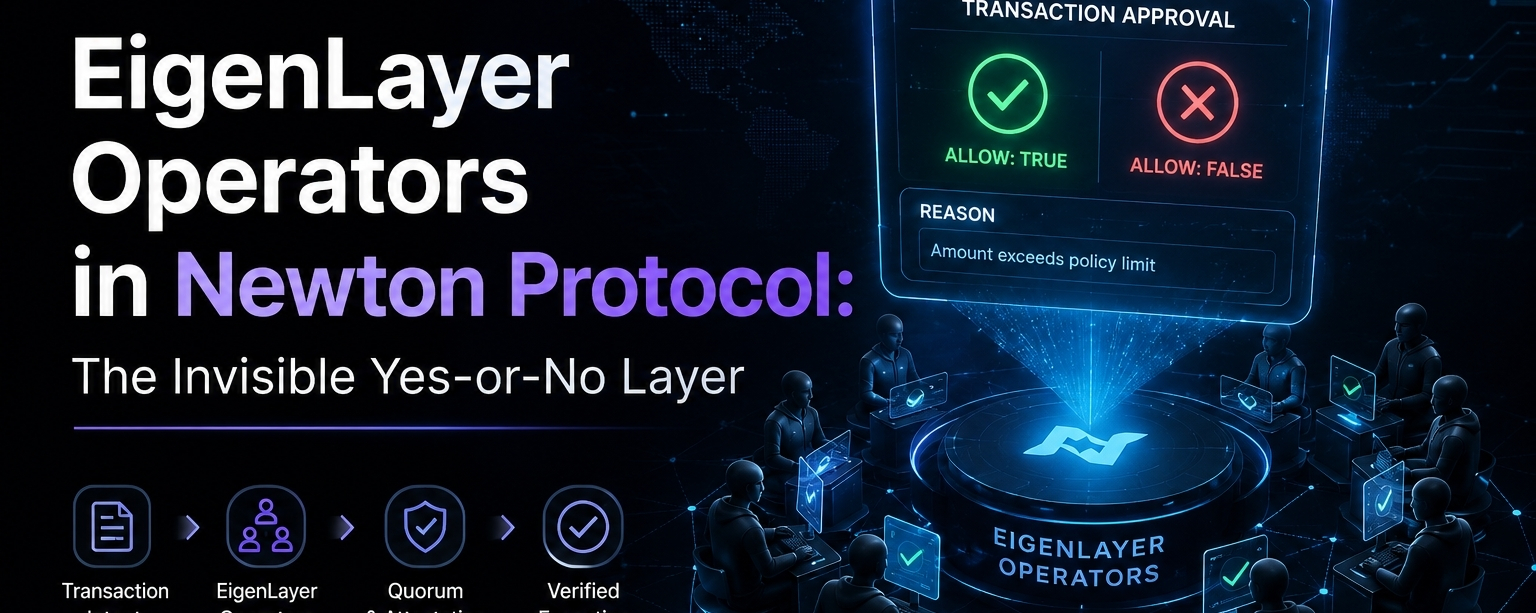
The weird part of Newton Protocol isn’t that EigenLayer operators approve transactions. It’s that the whole thing still collapses into a tiny, almost boring moment: "allow: true" or "allow: false".
That’s the part I kept staring at.
In the SDK flow, Newton can simulate a task and return whether the intent is allowed, denied, and why. Not a giant dashboard moment. Not some cinematic “restaking security” event. Just a small result object sitting between the user and the transaction. And honestly, that’s where the friction shows up.
The protocol side sounds clean. A transaction intent gets sent in, operators evaluate the policy, signatures get aggregated, quorum is reached, and the contract can verify the attestation before execution. Newton’s docs describe operators independently evaluating tasks and aggregating BLS signatures into one proof once quorum is hit, with a 67% stake threshold listed as the default minimum.
But from a user angle, it feels less like “decentralized infrastructure” and more like waiting for a card terminal to say approved.
That’s not an insult. It may actually be the most honest framing for Newton. The whole promise of verifiable transaction approval lives or dies in that pause. If the approval feels instant, nobody cares that EigenLayer operators were involved. If it fails, or lags, or gives a vague reason, suddenly the user becomes very aware that there’s another layer judging the transaction before the chain ever sees it.
That’s the small contradiction I find interesting. Crypto users are used to signing first and regretting later. Newton flips that into “prove this should be allowed before it executes.” Better safety, yes. But also a new kind of dependency. Not custody, not exactly censorship, not a frontend filter either. More like a decentralized pre-check that has to be fast enough to feel invisible and explainable enough to not feel creepy.
The timeout numbers make this feel real. Newton’s consensus docs list a 30-second prepare timeout and 15-second commit timeout, plus a 10% default tolerance for median consensus when operators fetch numeric external data like prices. Most users won’t know any of that. They’ll just feel “approved,” “blocked,” or “why is this still pending?”
And that’s probably the real product test.
Newton already had reported traction at launch: over 1.1 million user signups, 600,000 verified agent transactions, and 350,000 activated agents, according to Binance Research. Those numbers make the approval layer less theoretical. But volume doesn’t solve the awkward bit. The awkward bit is still the moment a normal transaction becomes a request for operator-backed permission.
I don’t think users will object to that if the denial reason is sharp. “Blocked because amount exceeds policy limit” feels fine. “Rejected by policy” feels like getting ghosted by infrastructure. Same mechanism, totally different emotional result.
That’s where EigenLayer operators are doing more than signing proofs. They’re quietly becoming the trust surface for a yes/no experience users may never consciously opt into. Kinda funny. The most advanced part of the stack has to disappear into a boring approval message, or people will blame it for being in the way 🙂.