
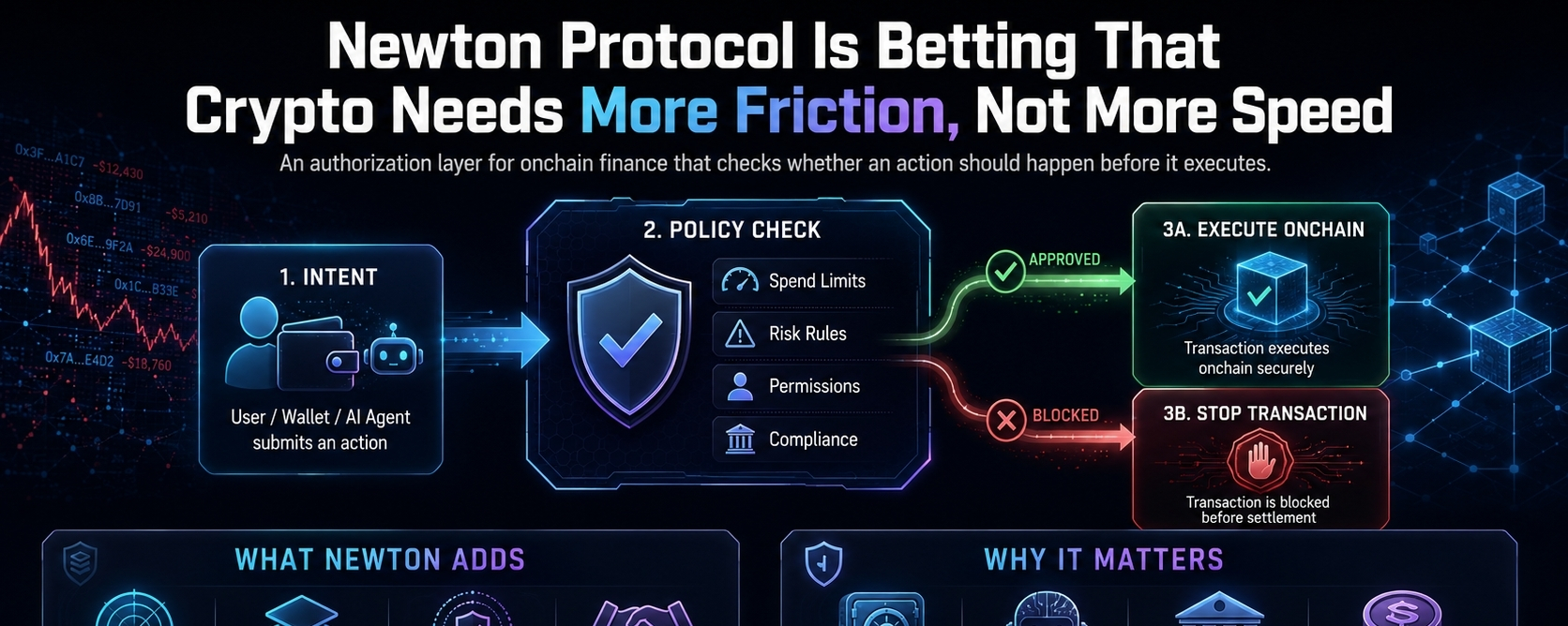

Newton Protocol is trying to deal with a problem most crypto teams only notice after something breaks.
Permission.
Not the flashy kind. Not the kind that gets a token chart moving for three days. I’m talking about the dull, ugly, necessary layer that decides whether an onchain action should be allowed before it actually happens.
That sounds boring. Good. Boring is usually where the real infrastructure hides.
I’ve watched too many projects sell automation like it fixes everything. Bots that trade. Agents that rebalance. Vaults that chase yield. Strategies that move capital across chains while everyone pretends the risk is “managed” because there’s a dashboard somewhere with clean fonts and a few green indicators. Then the market turns, the logic fails, the manager disappears, or someone realizes the rules were never really rules. They were suggestions.
Newton Protocol is aiming at that gap.
The project is building an authorization layer for onchain finance. The idea is simple enough on the surface: before a transaction goes through, it can be checked against a set of policies. If the action fits the rules, it moves. If it doesn’t, it stops.
That’s it.
And honestly, that’s why it’s worth paying attention to. Not because it sounds exciting. It doesn’t. It sounds like friction. But crypto needs more useful friction. The space has spent years worshipping speed, composability, and instant execution, then acting surprised when fast systems fail fast.
Newton is not just another “AI plus crypto” wrapper, at least not from how I read the project. The stronger angle is control. If an automated system can touch funds, it needs limits. If a vault manager can move depositor capital, there should be more than reputation standing between users and a bad decision. If onchain finance wants institutions, treasuries, tokenized assets, and agent-based workflows, then somebody has to answer the boring question first: what is this system allowed to do?
That is where Newton is trying to sit.
I’m not interested in the marketing version of this. Every cycle has infrastructure projects claiming they are building the missing layer. Most of them are not missing. They are just early, unnecessary, overdesigned, or waiting for a use case that never shows up. The graveyard is full of elegant protocol diagrams.
So the real test, for me, is not whether Newton can explain authorization. It can. The test is whether builders actually feel the pain badly enough to plug it in.
Vaults are probably the cleanest starting point. They already run on trust, even when everyone pretends they don’t. A curator says they will follow a strategy. A user deposits. The vault moves funds. The risk sits there quietly until it doesn’t. Newton’s approach is to make those limits harder, more enforceable, less dependent on someone remembering what they promised in a strategy note.
That matters.
Still, I’m cautious. I’ve seen “risk controls” become another decorative layer. I’ve seen compliance language used to dress up products that had no real demand. I’ve seen protocols build tools for institutions that never arrived, or arrived once for a pilot and then vanished into silence. Crypto keeps recycling the same ambition with new branding.
Newton has to avoid that grind.
The project needs real integrations. Not announcements that read well for a week. Actual usage. Vaults that depend on its policy checks. Developers who choose it because the alternative is worse. Systems where authorization is not an accessory, but part of the transaction path.
That is when I’ll start taking the bigger thesis seriously.
The NEWT token is part of the system, but I don’t think the short-term market noise tells the full story here. New tokens get chewed up all the time. Liquidity comes in, liquidity leaves, supply concerns hang over the chart, and traders move on to the next shiny thing. That cycle is exhausting because it rarely tells you whether the underlying project is becoming useful.
Newton’s slower story is more important.
Can it make onchain actions accountable before they happen? Can it give automated systems boundaries without turning everything into another centralized permission box? Can it become part of the plumbing for vaults, agents, treasuries, and more serious financial products?
Maybe.
But “maybe” is all I’m willing to give it right now. The idea is solid. The need is real. The market, as always, is noisy and impatient.
I’m watching for the moment this stops sounding like infrastructure theory and starts becoming something people quietly rely on.