
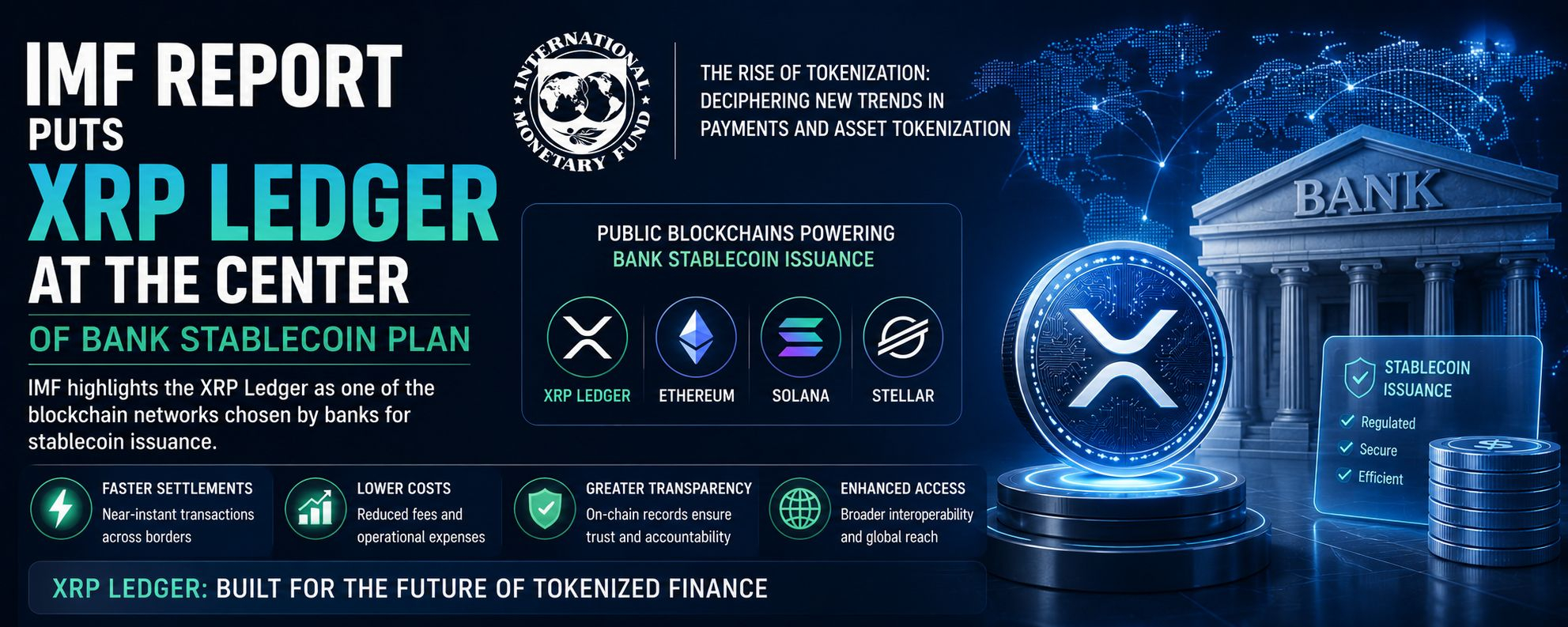

The International Monetary Fund (IMF) has recognized the XRP Ledger (XRPL) as one of the blockchain networks being used by financial institutions to issue regulated stablecoins. The mention comes in the IMF's latest report on tokenization and the future of digital finance.
The report suggests that public blockchains are playing a growing role in modern financial systems as banks explore faster and more efficient ways to manage payments and digital assets.
XRP Ledger Gains Institutional Recognition
In its report titled "The Rise of Tokenization: Deciphering New Trends in Payments and Asset Tokenization," the IMF explains how financial institutions are increasingly using blockchain technology for payments, settlements, and asset management.
Instead of relying only on private blockchain networks, some banks are now choosing public blockchains because they offer better interoperability, transparency, and wider market access.
The XRP Ledger is listed alongside Ethereum, Solana, and Stellar as one of the networks supporting this shift.
Banks Are Already Using XRPL
The IMF highlighted Société Générale's euro-backed stablecoin, EUR CoinVertible (EURCV), as an example.
The stablecoin has been deployed on multiple blockchain networks, including the XRP Ledger, showing that traditional financial institutions are beginning to use public blockchain infrastructure for regulated digital assets.
This demonstrates growing confidence in blockchain technology for real-world financial applications.
Tokenization Is Changing Finance
According to the IMF, tokenization is becoming one of the biggest innovations in global finance.
Tokenization converts real-world assets such as currencies, bonds, stocks, and other financial products into digital tokens that exist on blockchain networks.
This process can offer several advantages, including:
Faster settlement
Lower transaction costs
Greater transparency
Better liquidity
Reduced reliance on intermediaries
The IMF believes these improvements could reshape the future of financial markets.
Programmable Money and Smart Contracts
The report also supports the idea that programmable money and smart contracts will play a major role in the next generation of finance.
IMF Senior Economist Itai Agur previously stated that combining tokenized assets with programmable money could automate many financial processes, making transactions faster, cheaper, and more efficient.
Smart contracts can reduce manual work while improving security and transparency.
What This Means for XRP
The IMF's recognition of the XRP Ledger highlights its growing importance in institutional blockchain adoption.
As banks continue developing stablecoins and tokenized financial products, XRPL could become one of the preferred blockchain networks for regulated digital assets.
Its fast settlement speed, low transaction costs, and efficient infrastructure make it attractive for financial institutions looking to modernize payment systems.
Looking Ahead
The global financial industry continues to explore blockchain technology as tokenization gains momentum.
The IMF's latest report suggests that public blockchain networks like the XRP Ledger are no longer viewed as experimental technology but as practical infrastructure capable of supporting regulated financial products.
As institutional adoption continues to grow, the XRP Ledger could play an increasingly important role in the future of digital finance.
#xrp #Ripple #IMF #BitcoinFalls44%FromJanuaryPeak #SouthKoreanStocksRise5%