

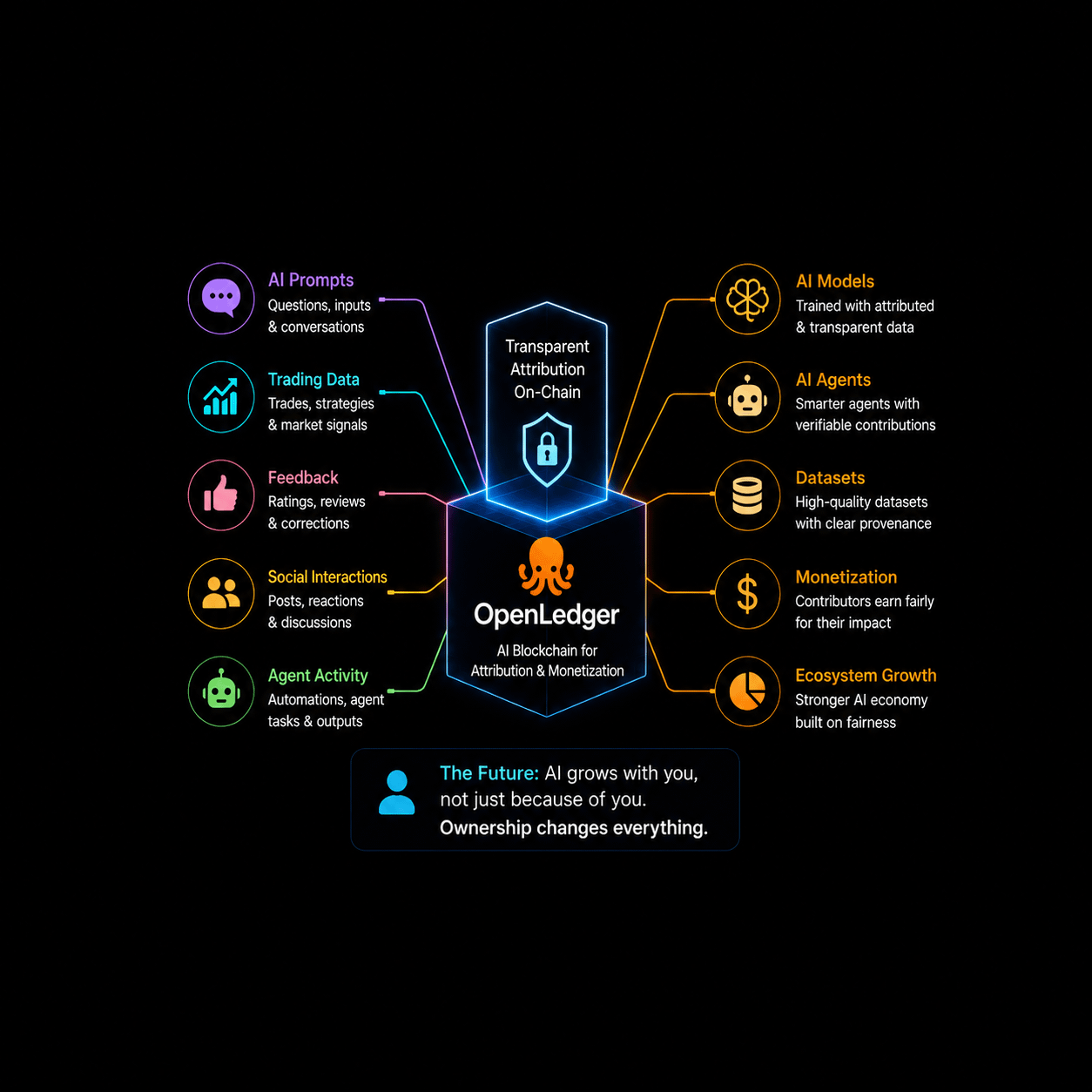
For a long time, crypto conversations revolved around a simple obsession — price. Charts moved, narratives rotated, and entire communities formed around momentum alone. But recently, especially during late-night discussions across crypto spaces, the tone feels different. Less noise about speculation, more curiosity about ownership.
Not ownership in the traditional blockchain sense of wallets and tokens, but ownership of the invisible value people create every day online.
The strange thing is that most of this value isn’t obvious while it’s happening. Every interaction with an AI assistant, every prompt typed into a model, every correction, preference, or feedback loop quietly becomes part of a larger intelligence system. People are constantly contributing to machines that improve because of them, yet very little of that contribution is visible or economically acknowledged.
That tension feels increasingly difficult to ignore.
When I first started reading about OpenLedger and its attempt to connect AI with blockchain infrastructure, the concept honestly felt difficult to place. It wasn’t the usual DeFi structure, and it didn’t sound like a traditional AI platform either. The idea of turning data, models, and AI agents into economically attributable assets seemed almost too ambitious.
But the more I thought about it, the more it reflected a larger shift already happening beneath the surface of the internet.
AI systems today depend heavily on continuous streams of human-generated input. Not just large datasets collected years ago, but constant real-time interactions. Conversations, decisions, edits, behaviors, trading patterns, reactions, and corrections all become part of systems that learn continuously. Yet the individuals generating those signals rarely have visibility into where that value flows afterward.
That imbalance may become one of the defining discussions of the AI era.
Blockchain introduced the idea that digital ownership could be transparent and verifiable. AI, on the other hand, evolved around absorption. Data enters a system, gets transformed into intelligence, and often loses clear attribution along the way. These two worlds developed with almost opposite instincts.
What makes OpenLedger interesting is that it appears to explore the uncomfortable middle ground between them.
The project’s broader framing around “AI liquidity” stayed in my mind longer than I expected. In earlier crypto cycles, liquidity was tangible. Capital entered pools, markets deepened, and activity became measurable through numbers on a screen. But now the idea seems to be evolving into something less physical and more informational.
What if information itself becomes a form of liquidity?
Not information in the casual sense, but structured contributions that help train, refine, or improve intelligent systems. In that context, value is no longer limited to financial capital alone. Human interaction becomes part of the productive layer.
That idea sounds powerful, but also incredibly complicated.
The biggest challenge may not be technical architecture, but defining contribution itself. AI models learn through layered relationships across billions of interactions. Attribution inside those systems is rarely clean or direct. One user’s correction may influence another user’s experience weeks later in ways nobody can fully trace.
So who deserves recognition?
Who decides what contribution actually matters?
And how do you measure value without oversimplifying human input into metrics that lose all nuance?
Those questions probably don’t have clean answers yet. Still, the fact they are starting to emerge at all says something important about where the industry may be heading.
Another layer of uncertainty is behavioral. If users eventually know their interactions carry measurable economic value, would people change the way they participate online? Would engagement become more intentional, or would attribution simply fade into the background like every other invisible system people already accept daily?
I honestly don’t know.
But I do think we are approaching a moment where AI systems can no longer be viewed purely as isolated technologies. They are becoming environments shaped continuously by human participation. The people interacting with them are not just users anymore. In many ways, they are contributors, trainers, validators, and signal generators all at once.
That changes the conversation.
Maybe projects like OpenLedger are early attempts to build infrastructure around this reality before the rest of the internet fully notices it. Or maybe they are experiments that expose how difficult it is to assign structure and ownership to something as fluid as human-generated intelligence.
Either way, the direction feels important.
Because if AI continues evolving through constant interaction with people, then the future debate may not center only on what artificial intelligence can do. It may center on who quietly helped build it in the first place — and whether that contribution was ever truly recognized.


