
I don’t care about narratives anymore.
I care about structural flaws.
And crypto has been running on one of the biggest ones for years it just dressed it up as a feature.
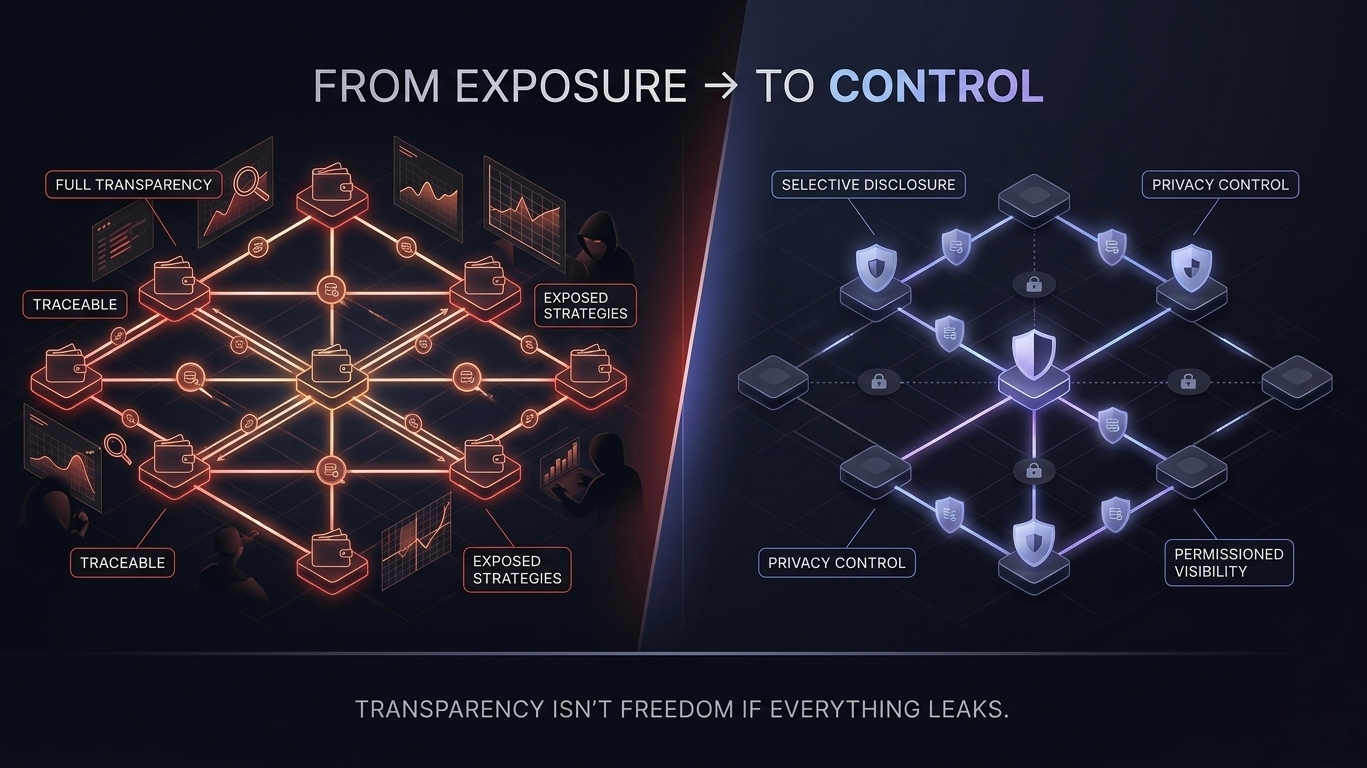
Total transparency.
It sounded good.
It sold well.
It attracted capital.
But let’s be honest about what it actually created:
A system where everything is visible…
and anything visible can be exploited.
Wallets get tracked.
Strategies get mapped.
Behavior gets predicted.
This isn’t financial freedom.
It’s financial exposure.
And the more serious the participant,
the less viable that environment becomes.
That’s the part most projects ignore.
They don’t solve it —
they build on top of it and hope nobody questions the foundation.
Midnight does something different.
It doesn’t try to kill transparency.
It tries to control it.
What is revealed.
When it’s revealed.
Who gets to see it.
That shift sounds small.
It isn’t.
It changes how systems behave.
It changes how users operate.
It changes who is even willing to participate.
Because in the next phase of this market,
information is not neutral — it’s weaponized.
If your system leaks everything by default,
you’re not creating openness.
You’re creating a hunting ground.
This is where Midnight becomes interesting.
Not because it promises privacy —
but because it treats privacy like infrastructure, not ideology.
Not absolute secrecy.
Not fake obfuscation.
Selective disclosure.
That’s harder to build.
That’s harder to explain.
That’s harder to execute.
Which is exactly why most projects avoid it.
But don’t mistake direction for success.
This is where people get lazy.
A good idea in crypto means nothing without pressure.
And pressure breaks almost everything.
It breaks weak incentives
It breaks overdesigned systems
It breaks anything that depends on attention instead of necessity
Midnight hasn’t faced that yet.
Not really.
The real questions are still unanswered:
Does this become needed, or just understood?
Do builders choose it when it matters — not when it’s interesting?
Does privacy reduce friction, or quietly introduce new layers of it?
Because if users have to think too hard,
they won’t use it.
And if builders don’t build,
it doesn’t exist.
What I will give it credit for:
It feels intentional.
Not assembled for a narrative.
Not patched together after launch.
The pieces look like they were designed to fit —
network logic, privacy model, purpose.
That already separates it from most of the market.
But intention doesn’t survive on its own.
Only systems that become unavoidable do.
Right now, Midnight sits in the only phase that matters:
Recognized… but not resolved.
People see it
but they don’t fully understand it.
That creates tension.
And tension is where real pricing happens.
Too early for consensus.
Too visible to ignore.
That’s the zone where things either emerge…
or disappear completely.
I’m not convinced.
I’m not dismissing it either.
I’m watching for one thing:
Does this become necessary?
Because if it does,
it won’t need narratives to carry it.
And if it doesn’t,
no narrative will save it.
Midnight isn’t interesting because it sounds good.
It’s interesting because it’s pointing at something uncomfortable —
and actually trying to fix it.
Now it just has to survive long enough to prove it matters.
Most won’t.
We’ll see if this one does.
#night @MidnightNetwork $NIGHT
