
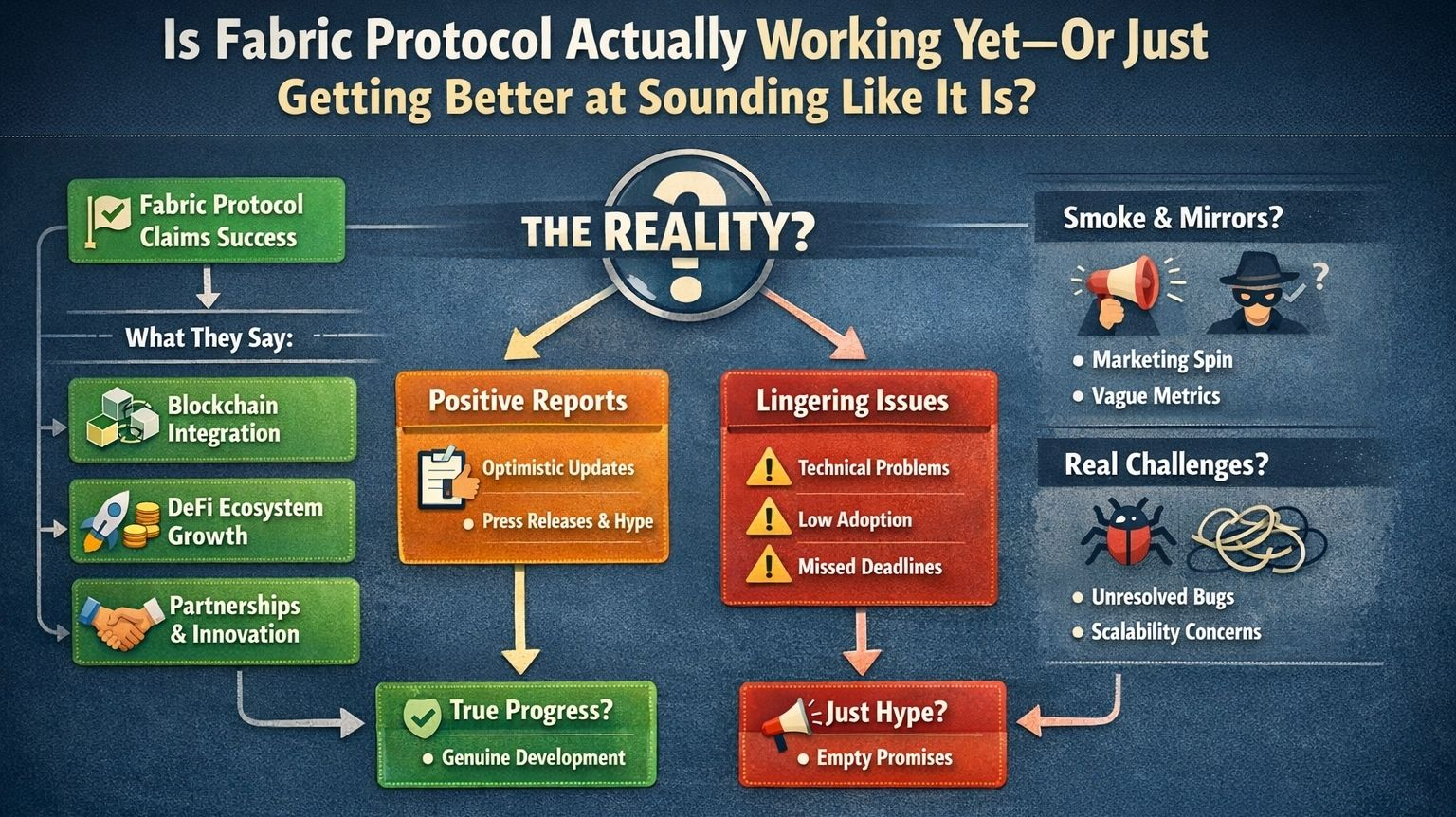
I’ve been checking in on Fabric Protocol again lately, and instead of getting caught up in all the updates, I keep asking myself one simple thing:
Is this actually getting closer to working in the real world—or just sounding more advanced?
Some of the recent progress does feel real, especially around how actions are verified. Before, a lot of it felt like “this should work in theory.” Now it’s starting to look like parts of the system can actually prove what an agent or robot did in a reliable way. That’s important. Without that, you can’t really trust anything happening on the network.
But here’s the thing—none of that is something a normal user would notice yet. There’s still no moment where someone can say, “this feels safer” or “I trust this more now.” The improvements are happening under the hood, not in the actual experience. So while it’s progress, it’s not quite felt progress.
For builders, though, things are clearly getting better. It’s becoming easier to plug into the system, connect data, and define how agents behave. That lowers the barrier to entry a bit. But at the same time, it’s also getting more complicated. You’re not just building an app—you’re dealing with verification, coordination, and incentives all at once. That’s powerful, but also easy to mess up.
The part I’m still unsure about is incentives.
On paper, it looks like Fabric is trying to align everyone—developers, data providers, compute contributors—but that’s always the hardest thing to get right. Systems like this often look stable early on, when there aren’t many users or conflicts. The real test comes later, when people start competing, cutting corners, or pushing the system in unexpected ways. I don’t think we’ve seen enough yet to know if this will hold up.
Governance feels similar. The idea of managing rules and decisions through a public system is interesting, but it still feels a bit abstract. What actually happens when something goes wrong? Who steps in? How fast can anything be fixed? Those answers still feel a bit unclear.
One shift I did notice is the stronger focus on agents themselves being part of the system—not just tools controlled by humans. That’s a big deal. It opens the door to more autonomous behavior, but it also raises the stakes. If agents are acting on their own, then mistakes aren’t just technical—they’re decisions happening inside the system. That makes reliability even more important, and I’m not sure the safeguards are fully there yet.
There have also been mentions of growth—metrics, integrations, that kind of thing. I’m not putting too much weight on those. Early numbers don’t tell you how a system behaves under pressure. I care more about what happens when things get messy—when usage increases, when data isn’t clean, when incentives clash. That’s where systems either prove themselves or break.
So overall, where do I stand now?
I’m a bit more confident than before. Fabric Protocol is starting to feel less like an idea and more like something that could actually be used. Some of the core pieces are becoming real, not just conceptual.
But at the same time, the hardest parts—like incentives and governance—still feel unfinished. And those are exactly the parts that decide whether something works long-term.
What would really change my mind?
I’d want to see this system running in a real environment—not a controlled demo, but something messy and unpredictable. Multiple agents interacting, making decisions, and being held accountable when things go wrong. I want to see how it behaves when it’s actually tested.
Until then, I’d say Fabric Protocol is making progress but it’s still early. It’s moving in the right direction, just not fully there yet.
Right now, Fabric Protocol feels like it’s standing at the edge of something big.
The next step won’t just be progress—it’ll be a test of whether any of this truly works when it actually matters.
@Fabric Foundation #ROBO $ROBO
