Robotics is evolving faster than most of us expected. Machines can see with computer vision, make decisions with AI models, and move with increasing precision. Yet despite all this progress, something fundamental is missing. Robots still live in silos. They are built by different companies, programmed with different standards, and deployed inside closed systems that rarely speak to one another. Each machine may be intelligent on its own, but collectively they remain disconnected.
Fabric Foundation’s Open Robotics Network begins with a simple realization: intelligence scales only when coordination scales. The real challenge is not just building smarter robots, but building a shared framework where they can trust, communicate, and collaborate with one another. The vision is not about control from the center. It is about enabling cooperation at the edges—where the machines actually operate.
Traditionally, robotics systems have been vertically integrated. A company designs the hardware, writes the firmware, develops the control software, and manages the data infrastructure. This approach works within a single organization, but it limits collaboration. If two different robotic systems need to work together, integration becomes complex and fragile. Data formats differ. Communication protocols conflict. Security assumptions vary. Innovation slows down because interoperability was never the priority.
Fabric’s Open Robotics Network proposes a different path. Instead of treating robots as isolated products, it treats them as participants in a shared network. Think of it less like a product platform and more like a protocol layer—a common language for machines. Just as the internet allowed computers from different manufacturers to communicate seamlessly, the Open Robotics Network aims to give robots a shared foundation for coordination.
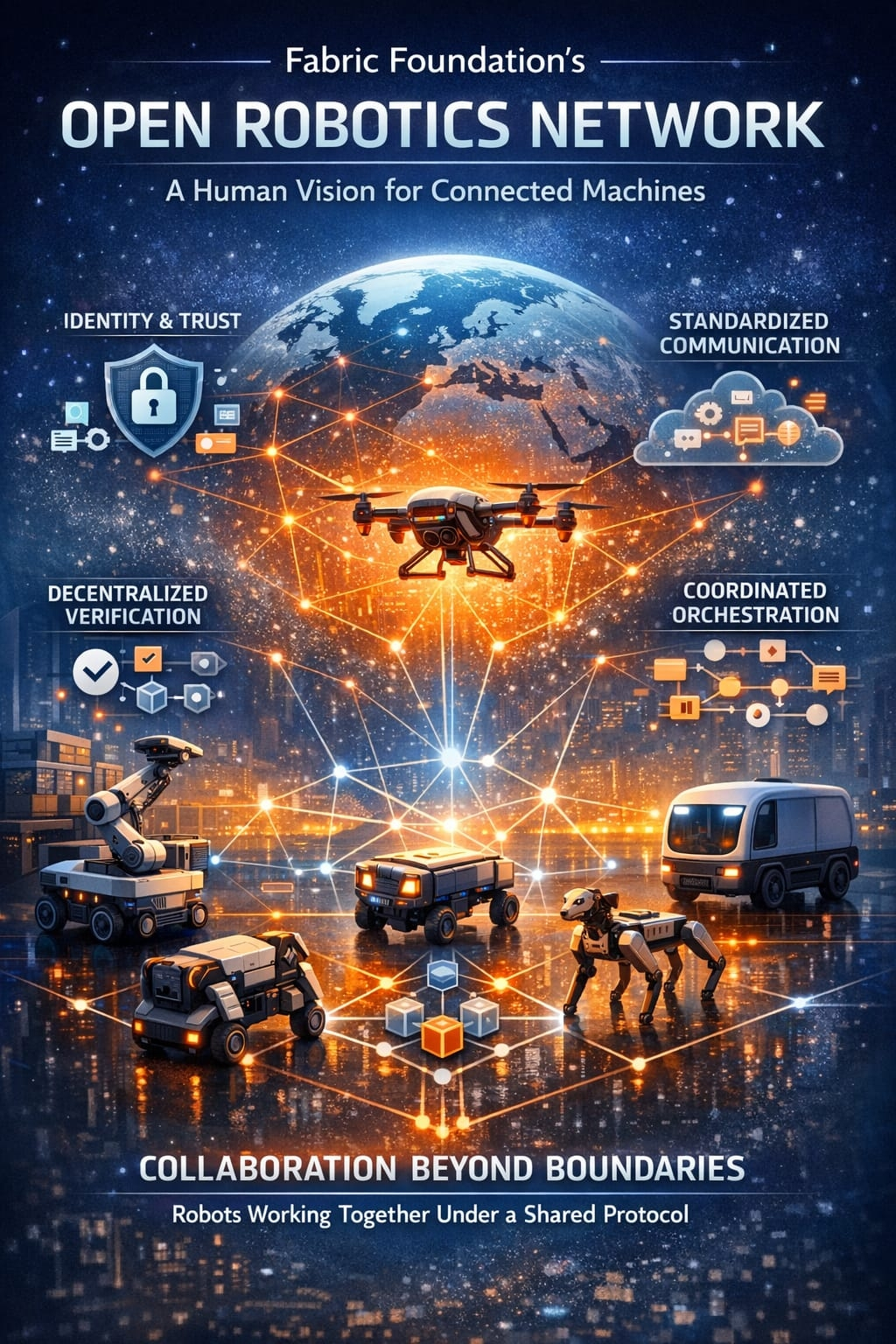
At the heart of this vision is identity. Before robots can trust each other, they must know who they are interacting with. The network assigns cryptographic identities to machines, allowing them to authenticate securely without relying on a central authority. This is more than a technical feature. It is a philosophical shift. Trust is no longer granted because a single company says so; it is established through verifiable proof. Every action a robot performs can be traced to its identity, creating accountability in distributed environments.
Communication is the next piece of the puzzle. Robots generate enormous amounts of data—sensor readings, location updates, task states, performance metrics. But without standardization, this information becomes fragmented. The Open Robotics Network defines structured messaging formats so machines can exchange data in predictable ways. A delivery robot, a warehouse scanner, and an agricultural drone can all share relevant updates without needing custom integrations. This reduces friction and encourages collaboration across vendors and industries.
Verification adds another layer of resilience. In real-world operations, mistakes carry consequences. A miscalculated movement in a factory could damage equipment. An incorrect environmental reading in agriculture could reduce yield. Fabric integrates decentralized validation mechanisms that allow actions to be logged and, when necessary, verified by other network participants. Instead of blind trust, the system encourages shared oversight. It is not about slowing robots down; it is about making their outputs reliable enough for critical environments.
Beyond identity, communication, and verification lies orchestration. A single robot performing a task is useful. Multiple robots coordinating seamlessly is transformative. The Open Robotics Network allows developers to define workflows that span different machines. A scanning robot can detect an issue, trigger a transport robot, and update a shared system automatically. Dependencies can be defined clearly. Responses can be automated. The network becomes not just a communication layer, but a programmable coordination engine.
There is also an economic dimension. Open ecosystems need incentives. Fabric introduces mechanisms that allow contributions to be recorded and, where appropriate, rewarded. A robot providing valuable services—such as computational processing or logistics support—can participate in a transparent contribution model. This creates a sustainable environment where collaboration is encouraged rather than enforced.
To understand how this works in practice, imagine a robot joining the network. It generates a cryptographic key pair and registers its identity. It announces its capabilities—perhaps it can lift heavy loads, scan barcodes, or map indoor spaces. Other participants in the network can discover it through capability queries. When a workflow is defined, the orchestration engine assigns subtasks based on availability, location, and past performance. The robot acknowledges the task securely, executes it, and logs relevant updates. Upon completion, its contribution is recorded. The process feels natural, but beneath the surface, every interaction is authenticated and verifiable.
The practical applications are wide-ranging. In smart warehouses, robots from multiple vendors can coordinate inventory checks and goods transportation without centralized bottlenecks. In disaster response, drones and ground robots deployed by different organizations can share real-time data and dynamically allocate responsibilities. In agriculture, soil sensors, irrigation systems, and harvesters can synchronize operations to maximize efficiency. In urban delivery systems, autonomous units can coordinate routes and avoid conflicts through shared signaling. Each scenario demonstrates the same principle: collaboration scales better than isolation.
Developers building within this framework benefit from thoughtful design practices. Modular architecture becomes essential, allowing systems to remain flexible. Clear capability definitions prevent miscommunication during task allocation. Fail-safe mechanisms ensure that partial network failures do not cascade into system-wide disruptions. Secure key management protects identity integrity. Comprehensive logging simplifies debugging and compliance.
At the same time, certain mistakes can undermine the benefits of decentralization. Reintroducing centralized control layers defeats the purpose of distributed trust. Ignoring latency requirements can create delays in time-sensitive operations. Poorly defined metadata leads to inefficient task routing. Weak security practices compromise the network’s integrity. These challenges are not unique to Fabric’s model, but they become more visible in open ecosystems where coordination depends on shared responsibility.
Optimization strategies further strengthen the network. Hybrid execution models allow robots to make instant local decisions while synchronizing strategically with the network. Predictive algorithms can anticipate workload spikes and allocate resources proactively. Idle robots can contribute computational capacity, transforming underused hardware into shared assets. Reputation systems can prioritize reliable agents for critical missions. Simulation environments can test workflows before real-world deployment, reducing costly mistakes.
What makes Fabric Foundation’s Open Robotics Network compelling is not just its technical architecture. It is the broader perspective behind it. The team recognizes that robotics is entering an era where machines will operate across organizational and geographic boundaries. Centralized control models will struggle to keep pace with this complexity. Openness, backed by cryptographic trust and programmable coordination, offers a more scalable alternative.
The vision is deeply human at its core. It acknowledges that progress depends on cooperation. Just as the internet unlocked global collaboration between people and computers, a shared robotics network could unlock collaboration between machines. When robots can trust, verify, and coordinate with one another under common standards, innovation accelerates naturally.
In the end, the future of robotics may not be defined solely by smarter sensors or faster processors. It may be defined by how well machines work together. Fabric Foundation’s Open Robotics Network suggests that the next leap forward lies in connection—building a world where autonomous systems share rules, share verification, and share purpose.