Most people do not think much about where their data lives. Photos, documents, application files, and messages usually sit inside systems owned by a few large companies. We trust those systems mostly because they work and because there has never been a real alternative that feels both practical and open. But slowly, that assumption is being questioned. Not in a loud or dramatic way, but in a quiet, technical way. Walrus is part of this change. It is not trying to become a brand or a story. It is trying to become something more boring and more important at the same time: infrastructure.
Walrus is a protocol built on the Sui blockchain, and WAL is the token that keeps this system running. The idea behind it is simple to explain but not simple to build. Instead of storing data in one place, Walrus breaks data into many pieces and spreads those pieces across a network of independent storage nodes. No single machine holds the full file. No single operator controls the system. And yet, the data can still be recovered even if many of those nodes disappear or act in bad faith.This approach changes the way storage works at a fundamental level. You are no longer trusting a company to keep your files safe. You are trusting mathematics, cryptography, and a network that has no central owner.
A System Designed Around Survival, Not Perfection
One of the most interesting things about Walrus is that it does not assume the network will behave perfectly. In fact, it is designed with the expectation that some nodes will go offline, some will fail, and some may even try to cheat. This is not treated as an exception. It is treated as normal.
Under the hood, Walrus uses modern error correction techniques based on fast linear fountain codes. In simple terms, this means your data is turned into many encoded fragments in such a way that you only need a portion of them to rebuild the original file. Even if a large part of the network disappears, the data can still be recovered. This system is also hardened against Byzantine faults, which means it still works even if some participants actively try to break the rules or return bad data.The network itself is not static. Storage nodes can join and leave over time. Walrus is built to adapt to this constantly changing environment without needing a central coordinator. This makes the system feel more like a living network than a fixed service.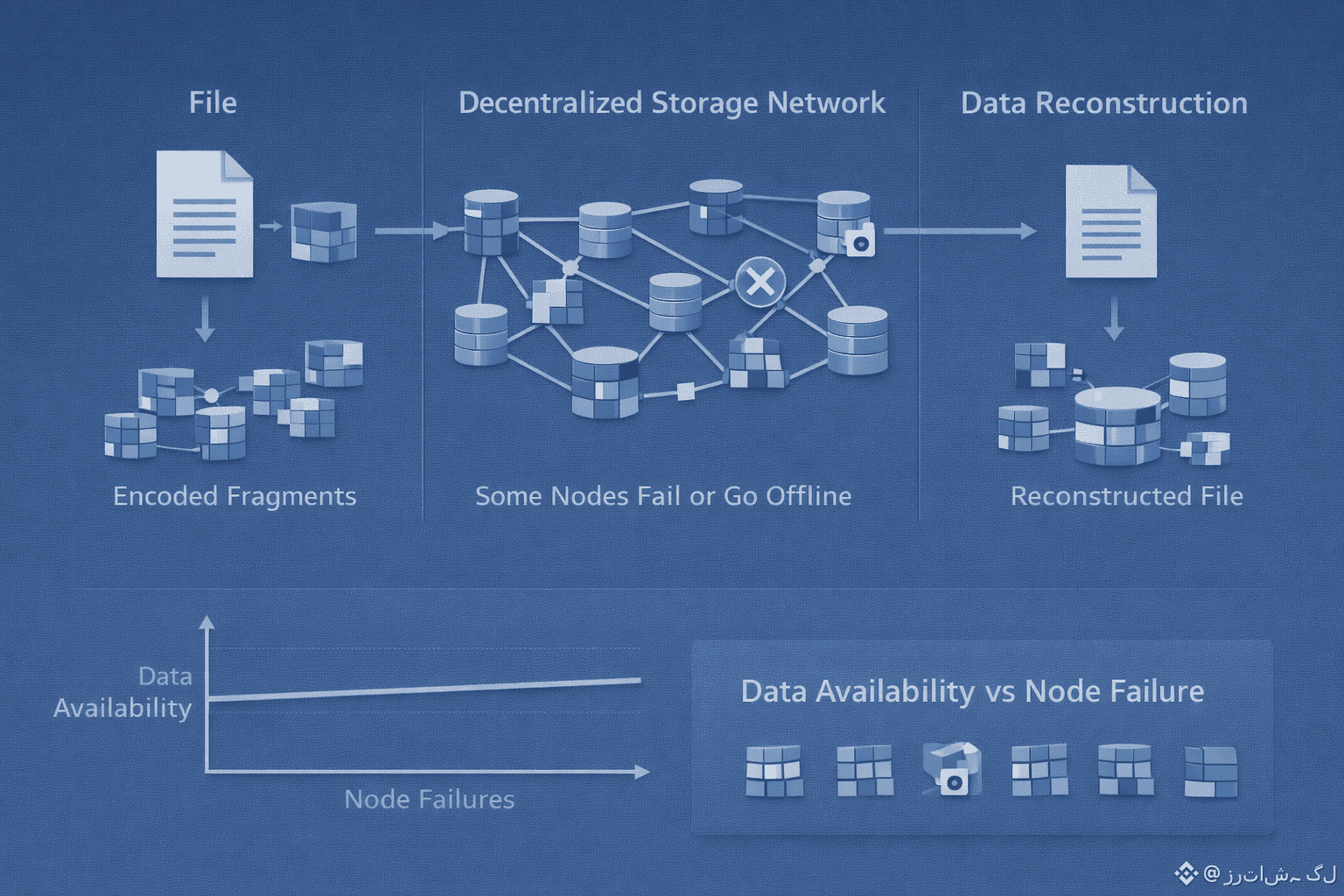
Why Sui Is More Than Just a Base Layer
Walrus does not try to put all this data directly on a blockchain. That would be slow and extremely expensive. Instead, it uses Sui as a coordination and verification layer. Sui keeps track of what data exists, who owns it, how long it should be stored, and whether it has been properly certified by the network.
The actual heavy data lives in the Walrus storage network. Sui handles the logic, the rules, and the bookkeeping. This separation of responsibilities is one of the reasons the system can scale without becoming unusable. The blockchain provides order and trust. The storage network provides capacity and resilience.This also makes Walrus easier to integrate into applications. Developers can use Sui smart contracts to manage storage rights, access control, and payments, while Walrus quietly takes care of the physical problem of keeping the data alive.
WAL as a Working Token, Not a Decorative One
The WAL token exists for a very practical reason. It is used to pay for storage, to reward nodes that provide resources, and to secure the system through staking and governance. It is not designed to be a symbol. It is designed to be a tool.
When someone stores data on Walrus, they pay in WAL. When a node contributes storage and bandwidth, it earns WAL. When decisions about the protocol need to be made, WAL is used to participate in that process. This ties the token directly to real activity inside the network. Over time, if the system is actually used, the token moves because the system is being used, not because people are just trading stories about it.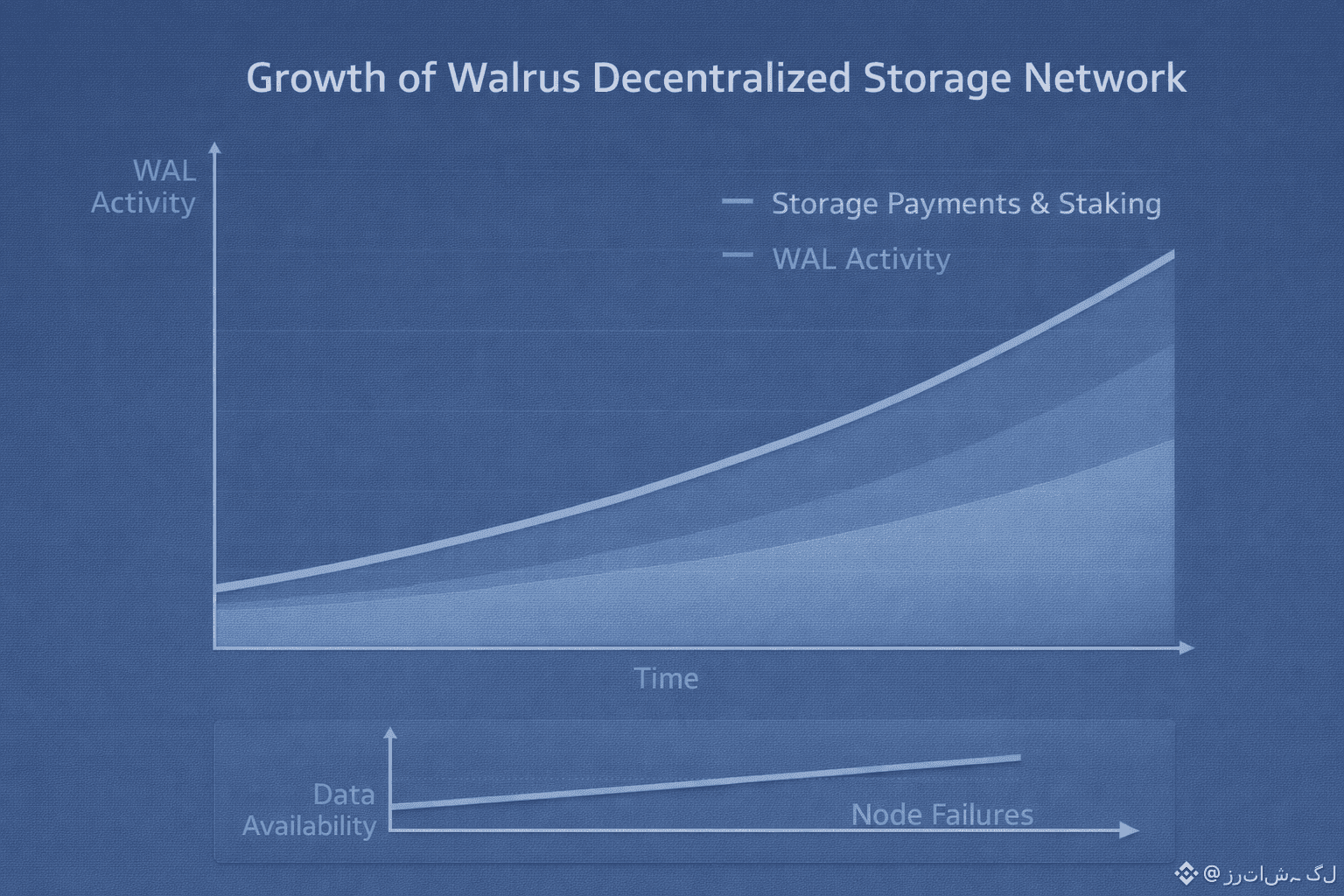
A Different Kind of Privacy and Control
Walrus is not only about storage. It is also about how applications interact with data. Because it is built for decentralized and privacy-preserving use cases, it allows developers to build systems where not everything has to be public by default, but where rules are still enforced by code rather than by trust in a company.
This is especially important for applications that handle sensitive data, business logic, or user-owned content. Instead of choosing between full transparency and full centralization, Walrus offers a third option: verifiable systems with controlled access and decentralized storage underneath.
The Quiet Shape of Real Infrastructure
Walrus does not promise to change the world overnight. It does not need to. Real infrastructure rarely announces itself. It simply becomes something people rely on without thinking about it too much.
If Walrus succeeds, it will not be because people talk about it every day. It will be because applications use it, data lives on it, and systems depend on it in the background. That is the kind of success that does not look exciting on the surface, but quietly changes how things are built.In a space that often moves very fast and very loudly, Walrus feels like something built to last by moving carefully. Not by trying to replace everything, but by slowly becoming something that no longer needs to be replaced at all.