Most decentralized storage networks sell a vague promise that your data is “somewhere out there” and hope reputation fills the gaps that engineering cannot. Walrus feels like it was built by people who got tired of that ambiguity. The distinctive move is that Walrus turns data availability into an explicit, time-bounded obligation that can be proven, priced, and enforced onchain. Instead of treating storage as a passive warehouse, it treats storage as a liability ledger. The moment this clicks, Walrus stops looking like “another decentralized drive” and starts looking like a new kind of infrastructure primitive for applications that need guarantees, not vibes.
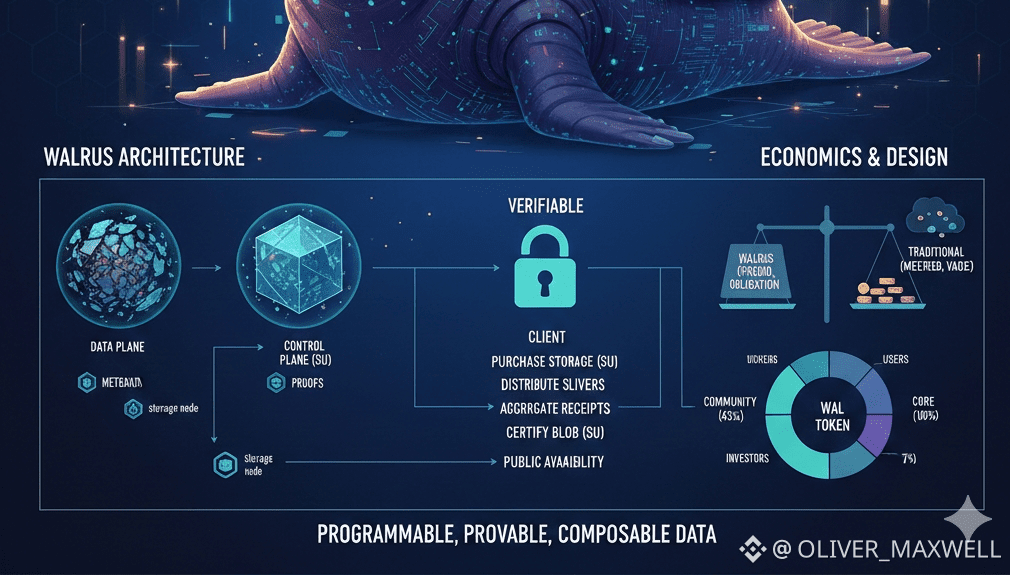
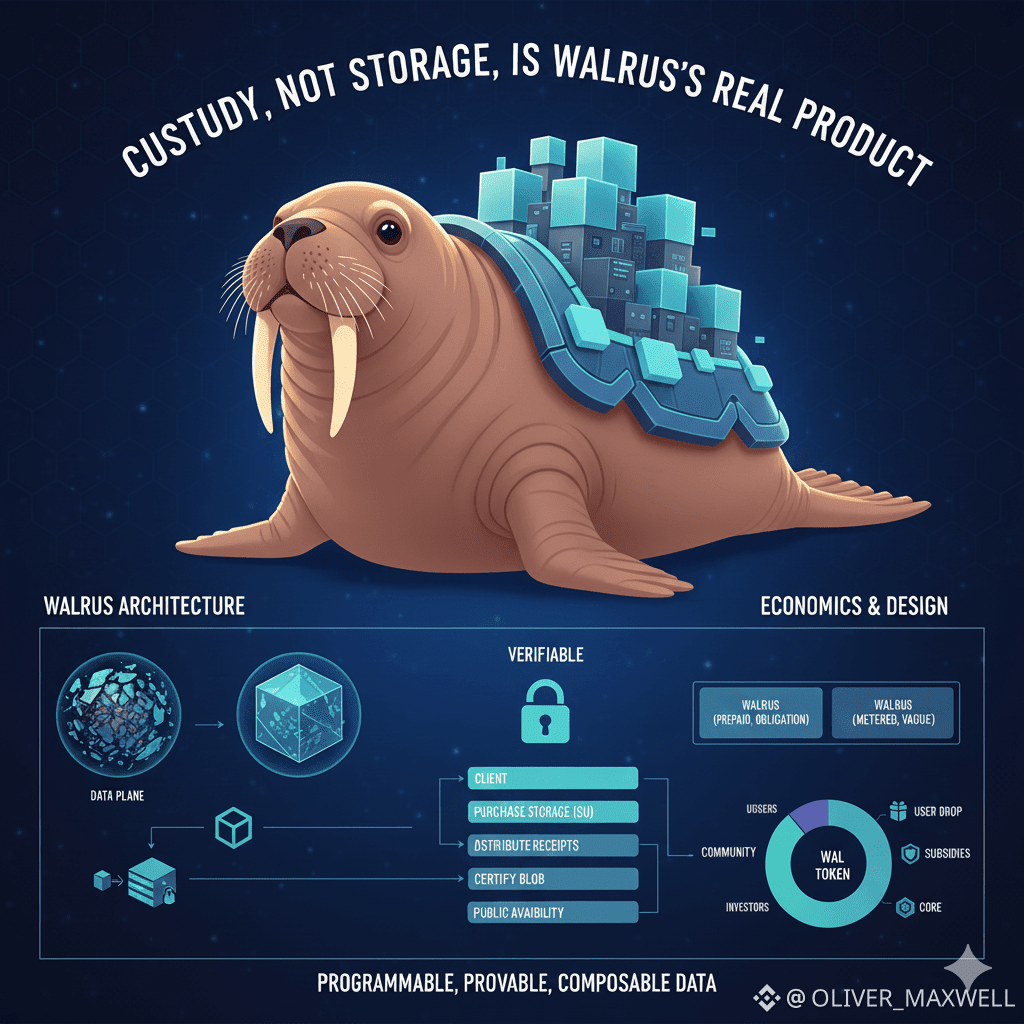
Walrus’s core architectural difference is its separation of concerns. The data plane is a specialized network that stores and serves encoded fragments of large blobs, while Sui acts as the control plane that coordinates metadata, payments, and proofs. The practical consequence is that Walrus does not try to be a general-purpose blockchain that also stores files. It uses Sui objects and events as the canonical record of who owns a blob, how long it must remain available, and whether the network has accepted custody. This is not just a design preference. It is what allows Walrus to talk about availability as a verifiable state rather than an assumption. The docs describe the write flow in a way that makes this concrete: a client derives a blob ID, purchases storage and registers the blob on Sui, distributes encoded slivers to storage nodes, aggregates signed receipts, and then certifies the blob on Sui so that availability becomes a publicly verifiable condition.
When you compare this to older decentralized storage models, the interesting contrast is not marketing, it is overhead and recovery behavior. Walrus is built around erasure coding rather than full replication. Its Red Stuff design uses a two-dimensional encoding approach intended to remain resilient under churn and recover lost pieces efficiently, with recovery bandwidth proportional to what was actually lost instead of re-downloading everything. This is a subtle point that matters operationally. Replication-based systems pay a fixed “insurance premium” forever by storing whole copies. Walrus tries to pay only for the redundancy it needs, and then pay again only when real loss occurs. That makes Walrus naturally suited to workloads where availability is non-negotiable but storing multiple full copies is economically irrational, like media libraries, dataset distribution, and application state snapshots that are large but frequently accessed.
The economic layer is where Walrus becomes unusually opinionated. Storage on Walrus is not metered like a cloud bill that drifts with usage and pricing changes. Users prepay for a defined number of epochs, and the system is designed so costs can remain stable in fiat terms over long horizons, with payments distributed over time to the parties who actually keep the data available. This structure is more important than it sounds. For builders, it converts “ongoing operating expense uncertainty” into a contract you can reason about. For node operators and stakers, it makes revenue a function of fulfilling custody over time rather than chasing short-term bursts of demand. It also enables a market in storage resources themselves, because a resource can be owned, transferred, and potentially traded or reassigned through onchain logic.
Walrus’s pricing mechanism also reveals a mature threat model. Instead of letting the lowest-priced nodes dictate market price, Walrus selects key parameters like price from a stake-weighted 66.67th percentile of proposals. The intent is clear: resist Sybil-style undercutting and keep the price anchored to the economics of the reputable majority rather than the tactics of the smallest actors. This is not just governance theater. It changes what “competition” means inside the network. Nodes can still compete, but the network refuses to let a thin tail of low-stake bidders collapse the economics to a level that would later be “fixed” by sudden fee hikes. It is a design that tries to preserve long-run reliability by preventing short-run price games.
Walrus’s cost story, however, is not a free lunch, and the protocol is candid about where costs come from. The encoded size of a blob is roughly five times the original size plus metadata overhead, and that metadata can be large enough that very small blobs are dominated by fixed costs rather than the data itself. This leads to a practical segmentation of ideal users. Walrus is naturally strong for fewer, larger blobs, or for batching many small items together so metadata is amortized. The existence of dedicated batching tooling in the ecosystem is not just a convenience feature, it is an economic necessity implied by the model. What looks like “a dev tool choice” is actually the protocol revealing what it wants workloads to look like.
On privacy and security, Walrus is easy to misunderstand if you expect it to behave like an encrypted vault by default. Its core innovation is not hiding data, it is making custody and integrity verifiable. The Proof of Availability mechanism is explicitly an onchain certificate on Sui that records that a quorum of nodes has taken custody, and it is backed by an economic framework where nodes stake WAL to earn ongoing rewards and eventually face slashing if they fail obligations. The write protocol computes commitments for each sliver and an overarching blob commitment that ties the original data to its distributed fragments. That means the network can prove it is storing the right thing and serving consistent fragments, and clients can reconstruct and verify. Privacy, in practice, becomes a composition choice. If you encrypt client-side, Walrus still gives you censorship resistance and auditability without needing to see plaintext. The trade-off is that some metadata remains visible onchain, because programmability requires the chain to know the blob exists, who owns the associated object, and when it expires. Walrus is not pretending otherwise. It is choosing verifiable infrastructure over invisible infrastructure.
The institutional adoption question is where Walrus’s control-plane design matters most. Enterprises do not reject decentralized storage only because of ideology. They reject it because reliability is hard to audit, costs are hard to forecast, integration is messy, and accountability is unclear when something goes wrong. Walrus attacks those pain points directly by moving the accountability surface onchain. A blob is not “stored because the network says so.” It is stored because a certified object and events on Sui make custody publicly checkable, and because economic penalties can be tied to that obligation. In other words, Walrus provides a compliance-friendly artifact: an auditable record that can be independently verified without trusting a vendor’s internal logs.
There are still institutional frictions Walrus does not magically erase. Data residency requirements do not disappear because storage is decentralized, and some organizations will still require control over geography, operator identity, and legal recourse. Walrus’s committee model is also time-bounded, which is good for reconfiguration and adapting to churn, but it means enterprise deployments will care deeply about how committees are formed, how quickly misbehavior is punished, and how predictable service remains across epoch boundaries. Walrus Mainnet is designed around two-week epochs, and the network supports contracts up to a maximum number of epochs, which frames storage as a renewable obligation rather than a one-time “forever” decision. That is arguably closer to how enterprises buy storage anyway, but it forces operational discipline: renewals, lifecycle policies, and explicit deletion behaviors. Walrus supports deletable blobs and explicit object lifecycle management, which suggests the protocol is aiming to be compatible with real data governance rather than romanticizing permanence.
Real-world adoption signals matter, and Walrus has at least one that is more meaningful than a generic “partnership” claim. Tusky publicly committed to migrating its app and developer interfaces to Walrus, explicitly citing the need for a more versatile and cost-effective path to mass adoption and highlighting Walrus’s robustness under node failure. This kind of migration is the right kind of evidence because it forces the protocol to meet production ergonomics: APIs, tooling, uptime expectations, and cost predictability under real usage, not just testnet demos.
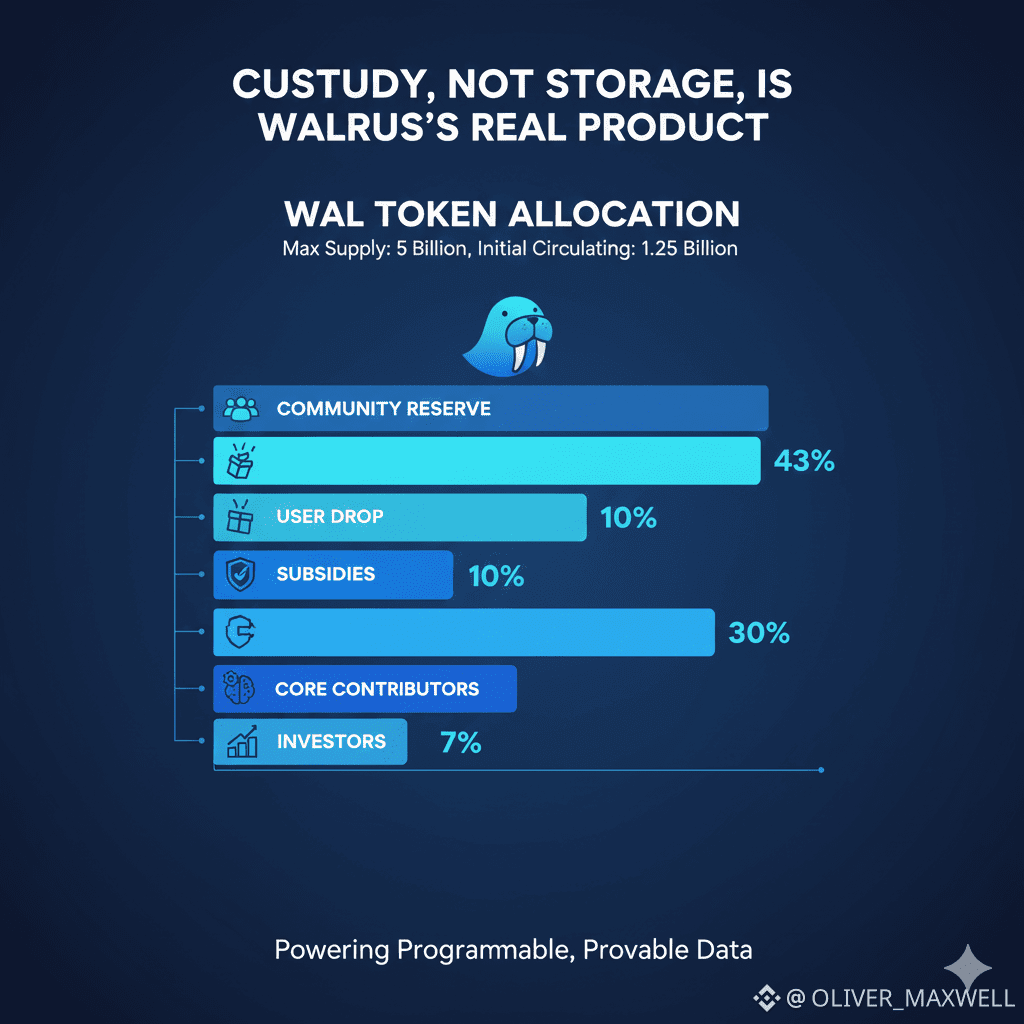
Tokenomics in Walrus should be read as an attempt to pay for availability rather than to subsidize speculation. WAL is the payment and coordination token, and the distribution is heavy on community and ecosystem support, with max supply set at 5 billion and initial circulating supply described as 1.25 billion. The allocation also makes the protocol’s priorities legible: community reserve at 43 percent, user drop at 10 percent, subsidies at 10 percent, core contributors at 30 percent, and investors at 7 percent. Subsidies are not a cosmetic add-on either. The mainnet announcement notes a subsidies contract operated to help early adopters acquire subsidized storage as the fee base grows, which is a pragmatic bridge between “cold start” and “self-sustaining market.”
Governance and sustainability come down to whether the system can evolve without breaking the guarantees it sells. Walrus has a concrete governance surface in the form of quorum-based voting among node operators for contract upgrades, with the practical constraint that votes must complete within an epoch because committees change. That is a very Walrus-like choice: it prioritizes continuity of custody guarantees over endless governance debates. It also means power is weighted toward operators who carry operational risk, which can be stabilizing for reliability but can frustrate purely financial holders if their preferences diverge from what operators consider safe. The WAL token page also frames slashing and potential burning as mechanisms to reinforce performance and discourage gaming once fully implemented, pushing value accrual toward “network correctness” rather than “network hype.”
Network health is the hardest part to judge from the outside, and the most important part to judge honestly. Walrus Mainnet launched as a production network operated by over 100 storage nodes, which is a credible starting base for decentralization and capacity. The protocol also exposes resilience properties in operational terms: reads are designed to succeed even if up to one-third of storage nodes are unavailable, and after synchronization many blobs can still be read even if two-thirds of nodes are down, which is an aggressive availability posture for an erasure-coded network. The right way to evaluate ongoing health is not to stare at token charts, it is to watch proof submission rates, committee churn, slashing events as they mature, and whether prices remain stable without subsidy crutches. Walrus’s own design choices, like stake-weighted parameter selection and prepaid storage obligations, imply that it expects adversarial behavior and is trying to make the steady state robust.
The strategic positioning inside Sui’s ecosystem is often described as “programmable storage,” but the more precise claim is that Walrus makes data itself composable. When blobs and storage resources become objects, smart contracts can treat data availability as something they can own, transfer, and reason about. That gives Walrus a path to become infrastructure that is difficult to replicate outside an object-centric chain architecture because ownership, lifecycle, and programmability are native rather than bolted on. The dependency cuts both ways. If Sui’s object model and execution performance continue to attract applications that actually need dynamic data, Walrus becomes a default data layer. If Sui stagnates, Walrus still claims chain-agnostic usability at the application layer, but its settlement and proof logic remain tied to Sui, which is a strategic coupling the market will price in.
Looking forward, the most plausible catalysts for Walrus adoption are not “more awareness” or “more narratives.” They are workload shifts. AI-adjacent applications, data marketplaces, and rich media apps all have the same problem: they need large data, fast access, and verifiable provenance, but they do not want vendor lock-in or opaque auditing. Walrus’s thesis is that data should be provable and programmable, and that availability should be purchased as a contract, not assumed as a service. The threats are equally concrete. If centralized providers offer cryptographic audit layers and predictable long-term pricing that satisfies regulators and procurement teams, Walrus has to win on composability and censorship resistance, not just cost. If competing decentralized networks evolve erasure coding and proof systems that achieve similar recovery efficiency without the same onchain control-plane coupling, Walrus has to defend why its Sui-native programmability is not merely a convenience but a moat.
My take is that Walrus’s defensibility will hinge on whether developers start treating storage resources and blob ownership as first-class building blocks, not just a backend. If Walrus becomes the place where applications put data they need to reference in logic, trade, escrow, version, or prove, then WAL’s role as a coordination and security token is structurally justified. If Walrus is used mainly as “cheaper decentralized hosting,” it will be forced into a commodity war it deliberately designed against. The protocol’s design reads like a bet that the next wave of applications will want data with legal-like guarantees, explicit obligations, and verifiable custody trails. If that wave arrives, Walrus is not just ready for it. Walrus is one of the few storage systems that already speaks the language those applications will require.