
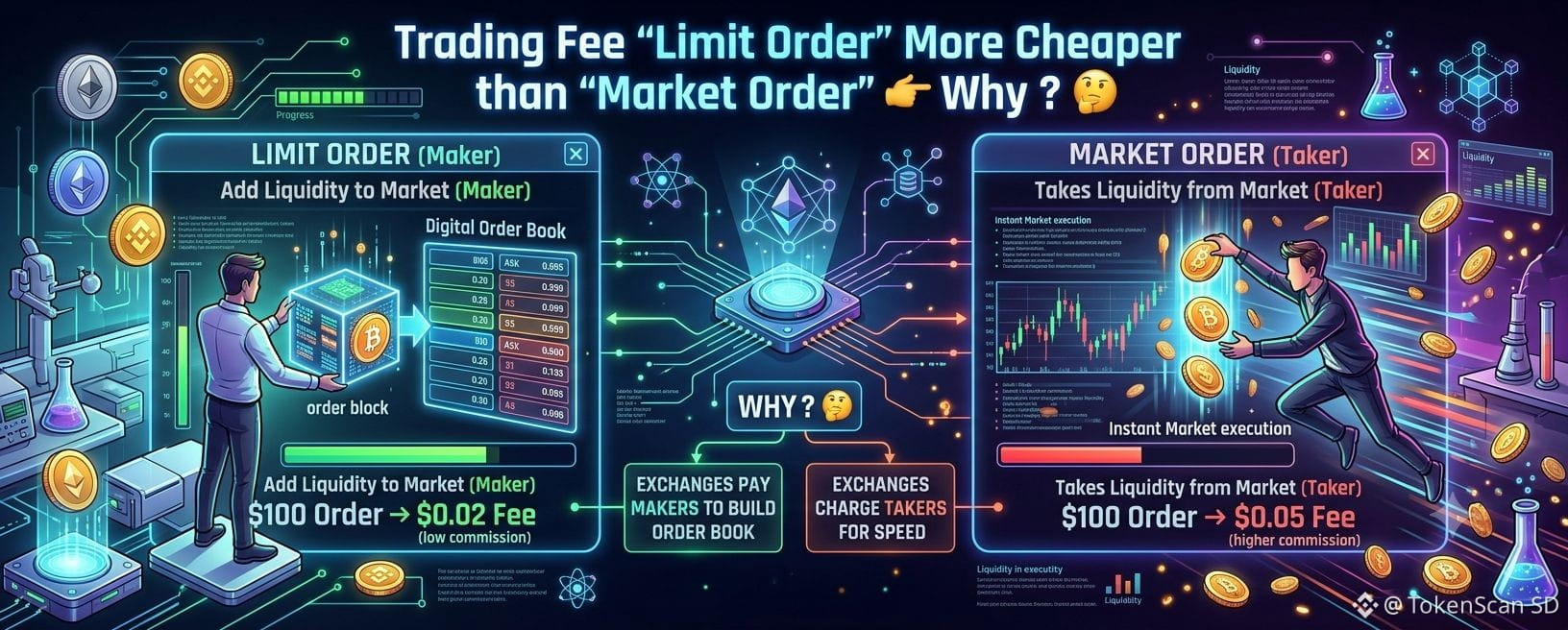
TokenScanSD SD Class — Limit Order vs Market Order
Ever traded $SOL and made $100 profit, but only $99 showed up in your wallet?
Or made $1000 profit, but only $990 landed?
Or lost $1000, but the recorded loss shows $1010?
One of the biggest reasons behind this is the type of order you use to enter and exit a position. A lot of people don't realize that simply choosing a market order over a limit order can mean paying way more in fees — when there's actually an option that can cost you 0%. Let's break it down so you understand crypto a little better.
1. What Is a Market Order?
A market order gets executed immediately at the best available price on the orderbook. You don't set the price — the system matches your order straight to the current market price.
Pros:
Fast, filled instantly
Good when you need to enter/exit a position urgently
Cons:
Higher fee (falls under the taker category)
Prone to slippage — the execution price can shift from what you see on screen, especially during volatile or thin-liquidity markets
2. What Is a Limit Order?
A limit order is an order you place at a specific price you choose yourself, then it "waits" in the orderbook until someone else matches at that price.
Pros:
Cheaper fee (falls under the maker category), and on many exchanges it can even be 0% if your trading volume is high or there's a promo running
You control the entry/exit price, not the market
Avoids slippage since the execution price matches what you set
Cons:
Not guaranteed to fill — if the price never reaches your set level, your order just sits idle in the orderbook
Requires patience, not ideal if you need instant execution
3. Why Can Maker Fees Be Cheaper, Even 0%?
Here's the logic worth understanding: exchanges need liquidity to keep the orderbook "alive" — plenty of orders sitting at different price levels so other transactions can flow smoothly.
Maker (limit order) = you're "providing" liquidity by placing an order in advance. The exchange rewards this with a lower fee, sometimes free
Taker (market order) = you're "removing" liquidity that other makers already provided. Since you need instant execution, the exchange charges a higher fee
Simple analogy: a maker is like someone patiently queuing and placing an order at a shop in advance, while a taker cuts straight to grabbing what's already on the shelf. The patient one gets the cheaper price.
4. The Impact on Your Trading
For occasional traders, the maker vs taker fee gap might feel small. But for active traders — especially scalpers or day traders opening and closing positions multiple times a day — this gap adds up significantly.
Simple example:
Taker fee 0.1% vs maker fee 0.02% (illustrative numbers, check your exchange's actual fee tier)
If you do 20 round trips a day, the difference multiplies fast over a month
On top of that, limit orders also protect you from slippage — another "hidden cost" that doesn't show up directly in the fee number.
5. When Should You Use Which?
Use Market Order when:
You need instant execution, like cutting a loss quickly during a sharp price drop
Volatility is high and you don't want to miss the momentum
Use Limit Order when:
You're not in a rush and want to execute at a specific price
You want to save on fees and avoid slippage
You're trading with a planned strategy, not panic buying/selling
Conclusion
Limit order and market order are both tools — neither is always better than the other. But when it comes to cost efficiency, limit order clearly wins: lower fees (even 0%), execution price under your control, and protection from slippage.
So before you hit "buy/sell" with a market order out of habit, ask yourself: do you really need it instant, or could you actually save more with a limit order?
Disclaimer: This article is for educational purposes only and is not financial advice. Always DYOR (Do Your Own Research) before making trading decisions.