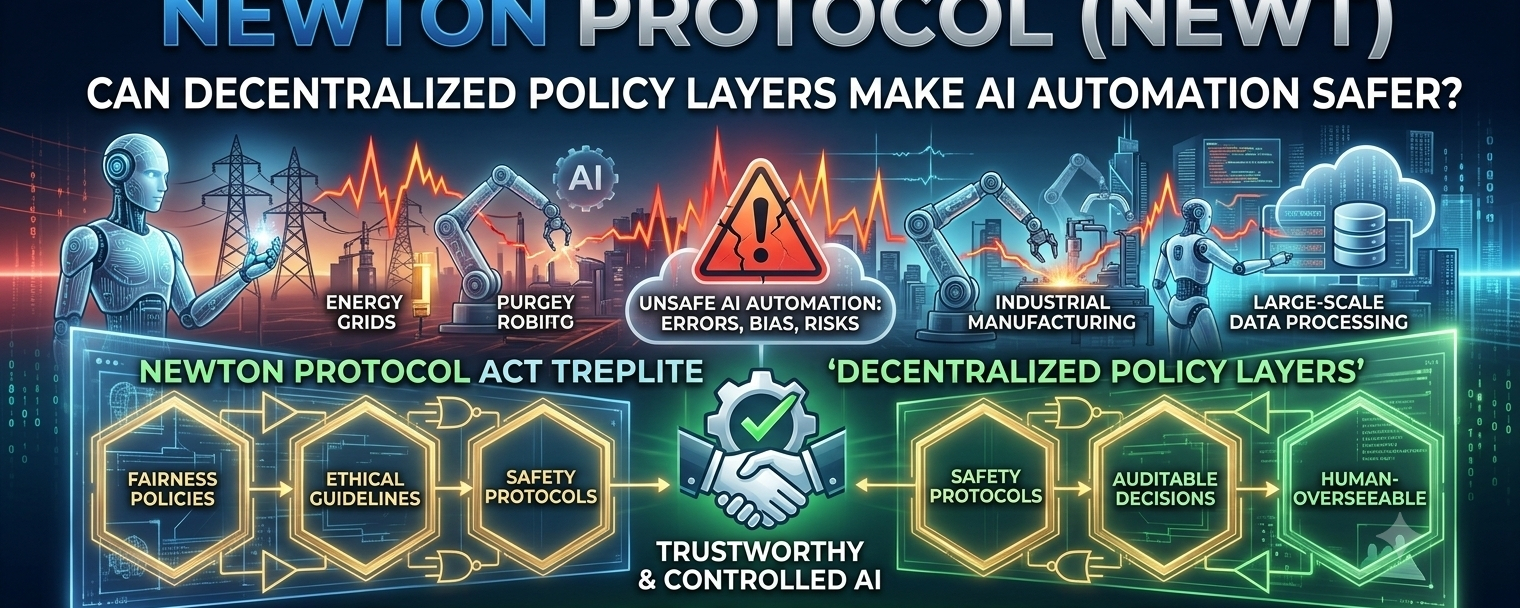
Every major technology wave promises to simplify complex tasks, yet it often introduces new challenges. As artificial intelligence becomes more capable of making financial decisions, one important question continues to emerge: who ensures that AI agents operate within safe and verifiable limits instead of simply following instructions without accountability?
Blockchain has made digital transactions transparent, but transparency alone does not solve every problem. Smart contracts execute code exactly as written, yet they cannot naturally verify real-world information such as identity, compliance requirements, sanctions, or changing regulations. This limitation has become more noticeable as developers build AI-powered trading systems and automated financial applications.
Before projects like Newton Protocol, developers relied on centralized APIs, manual compliance checks, or front-end restrictions to control automated systems. While these methods worked in certain situations, they introduced trust assumptions and potential points of failure. Users often had to depend on centralized organizations to verify whether automated actions met regulatory or security requirements.
These earlier solutions also struggled with scalability. Every application often needed its own compliance framework, making development slower and more expensive. At the same time, centralized verification reduced one of blockchain's main advantages—its ability to operate without relying on a single trusted authority.
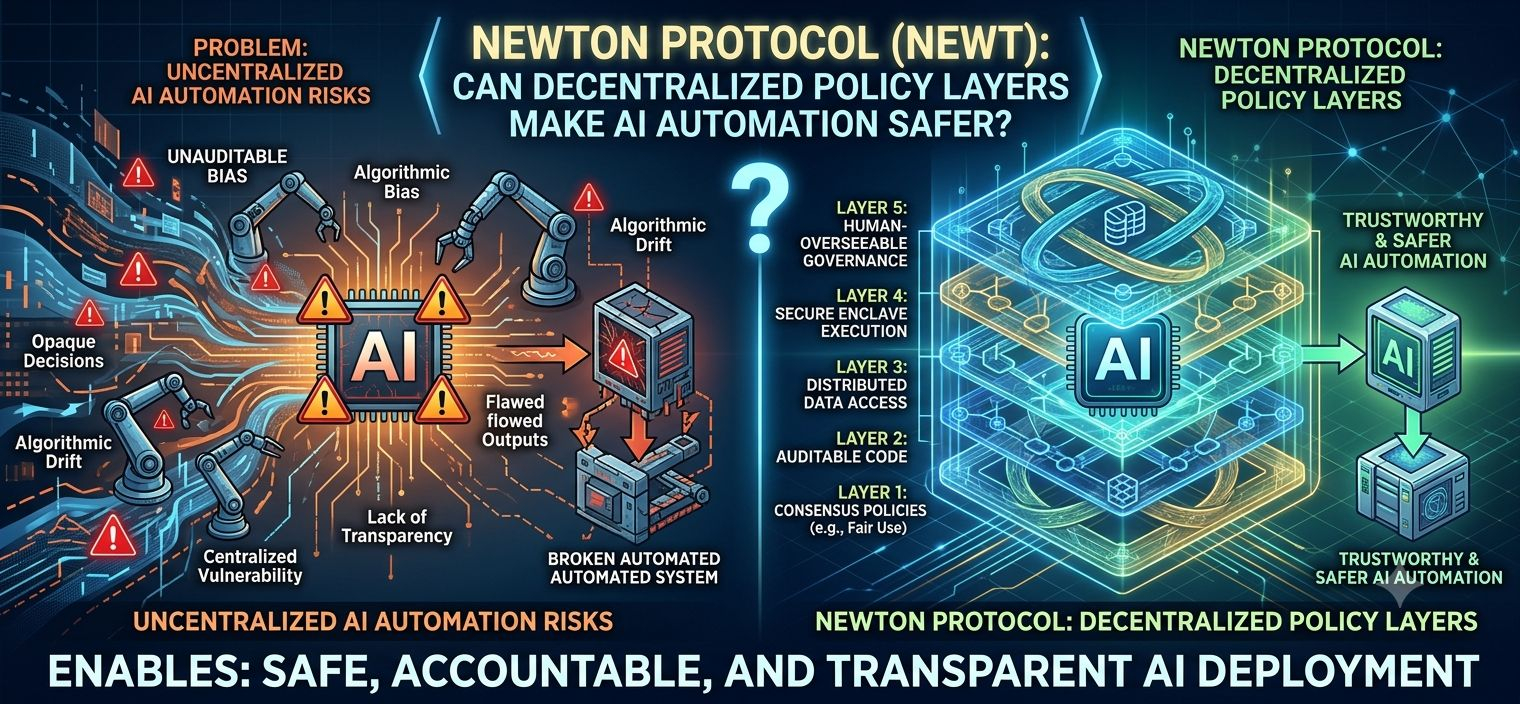
Newton Protocol introduces itself as one possible approach to addressing these challenges. Rather than replacing existing blockchains, it focuses on adding a decentralized policy layer that evaluates whether certain conditions have been satisfied before transactions are allowed to proceed. The project does not claim to solve every problem surrounding AI automation, but instead attempts to improve accountability.
The protocol is designed around programmable policies. Developers can define rules that determine what an AI agent, wallet, or decentralized application is allowed to do. These rules may include spending limits, identity verification, geographic restrictions, or transaction approval requirements depending on the application's needs.
One of Newton Protocol's notable design decisions is separating policy verification from transaction execution. Instead of placing every compliance rule directly inside smart contracts, the protocol allows external information to be verified and represented through cryptographic proofs before a transaction reaches the blockchain.
This approach attempts to solve a long-standing blockchain limitation. Smart contracts cannot independently determine whether someone has completed identity verification or whether an address meets regulatory requirements. Newton Protocol aims to connect trusted off-chain information with on-chain decision-making while reducing unnecessary exposure of personal data.
Artificial intelligence is another central focus of the project. As AI agents become capable of managing portfolios, executing trades, or interacting with decentralized finance protocols, developers increasingly need reliable methods to define exactly what those agents can and cannot do. Newton Protocol seeks to provide those programmable boundaries.
The project also includes a marketplace intended for AI developers and infrastructure operators. Developers can publish AI agents, while operators execute approved tasks using decentralized infrastructure. This model attempts to create accountability by encouraging operators to follow established policies rather than acting independently.
The NEWT token supports several functions within the protocol. According to the project's documentation, it is intended for staking, governance participation, network security, transaction fees, and collateral within the ecosystem. These roles are designed to connect incentives with the operation of the network instead of serving only as a transferable asset.
From a technical perspective, Newton Protocol aims to remain compatible with Ethereum Virtual Machine (EVM) ecosystems. Rather than requiring applications to migrate entirely onto a separate blockchain, developers can integrate the protocol alongside existing decentralized applications and blockchain networks.
However, interoperability also creates additional complexity. Every external data source introduces another dependency, and the overall reliability of the system depends not only on blockchain security but also on the quality and trustworthiness of off-chain information providers.
Governance presents another challenge. Someone must determine how policies are written, updated, and enforced. Even within decentralized systems, disagreements about regulations, compliance standards, and acceptable risk are unlikely to disappear. Instead, those discussions may simply move into governance processes.
The growing use of AI also raises broader questions. While automated systems can improve efficiency, they cannot eliminate uncertainty. AI models may produce unexpected outcomes, and financial markets remain unpredictable regardless of how advanced automation becomes. Technology alone cannot remove investment risk.
Institutions working with tokenized assets or regulated decentralized finance may benefit from policy-based infrastructure that simplifies compliance. At the same time, developers could reduce the need to build separate authorization systems for every application they create.
On the other hand, privacy-focused users and fully permissionless communities may view policy-driven infrastructure differently. Systems that emphasize compliance and identity verification could reduce accessibility for participants who prefer unrestricted interaction with decentralized networks.
Newton Protocol represents an interesting attempt to balance blockchain openness with increasing demands for accountability in AI-powered applications. Whether this balance proves effective will depend not only on technical implementation but also on governance, adoption, and the ability to preserve decentralization while introducing stronger policy controls.
Rather than asking whether AI automation should continue expanding, perhaps the more important question is whether decentralized policy frameworks like Newton Protocol can provide meaningful accountability without gradually reducing the openness that originally defined blockchain technology.