
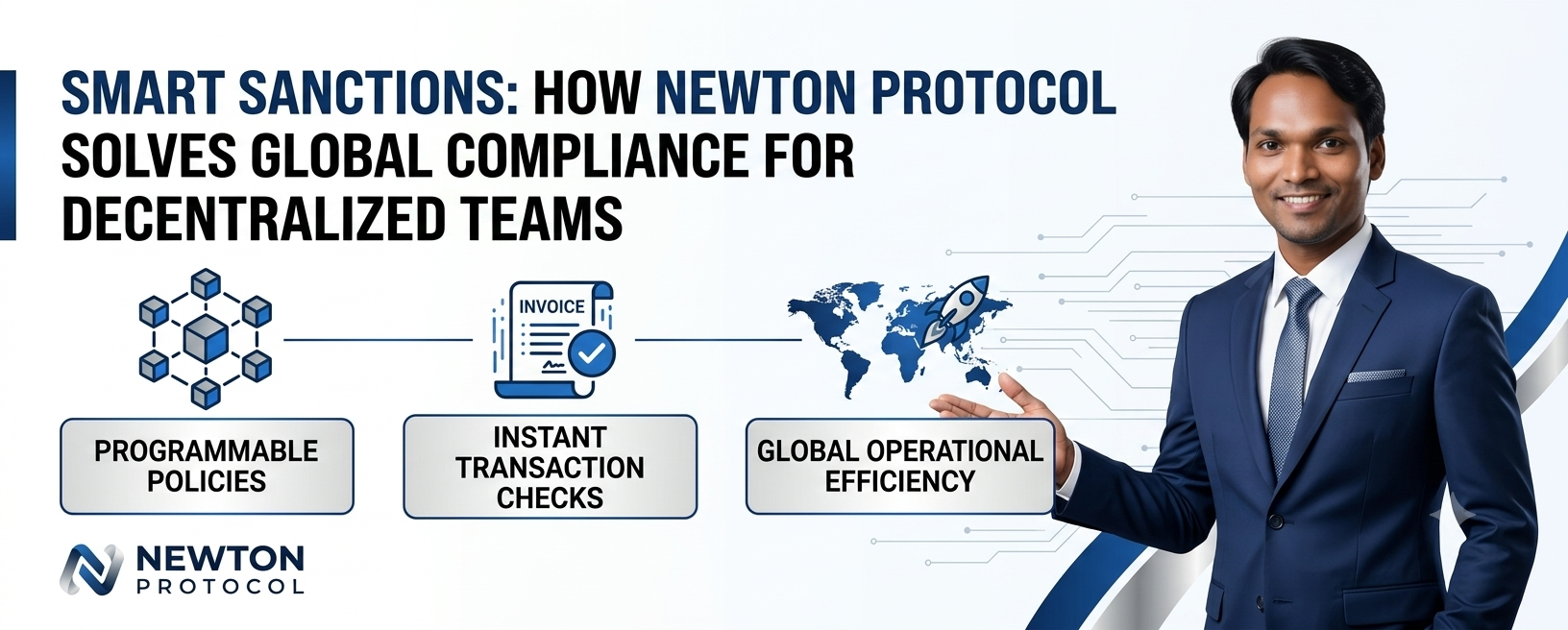

Crypto has always been built around with one big idea.
Anyone and everywhere, should be able to participate.
That openness is one of the industry's greatest strengths, but it also creates an challenge that becomes harder to ignored, as the projects grow. Once the protocol starts working with contributors, investors, partners, and the users across dozens of countries, compliance is no longer just a legal topic. It becomes an operational one.
The reality is that most decentralized teams are global from day one. Developers may be spread across different continents. Treasury managers could be in different time zones. Community often come from different countries with completely different regulatory environments.
Managing all of that safely is much harder than it sounds.
The traditional approach has usually been manual. Teams rely on internal reviews, spreadsheets, legal advice, and wallet monitoring before approving payments or moving treasury funds. That process might work when a project is small, but it also becomes difficult as activity grows. Every manual review slows things down, and every mistake can have serious consequences.
What makes this even more complicated is that blockchain transactions happen almost instantly. Once a transaction is signed and confirmed, reversing the transaction is practically impossible. If a payment is accidentally sent to a restricted address or violates an organization's compliance policy, discovering the mistake afterward does very little to solve the problem.
That is one reason I think projects like Newton Protocol are becoming more relevant.
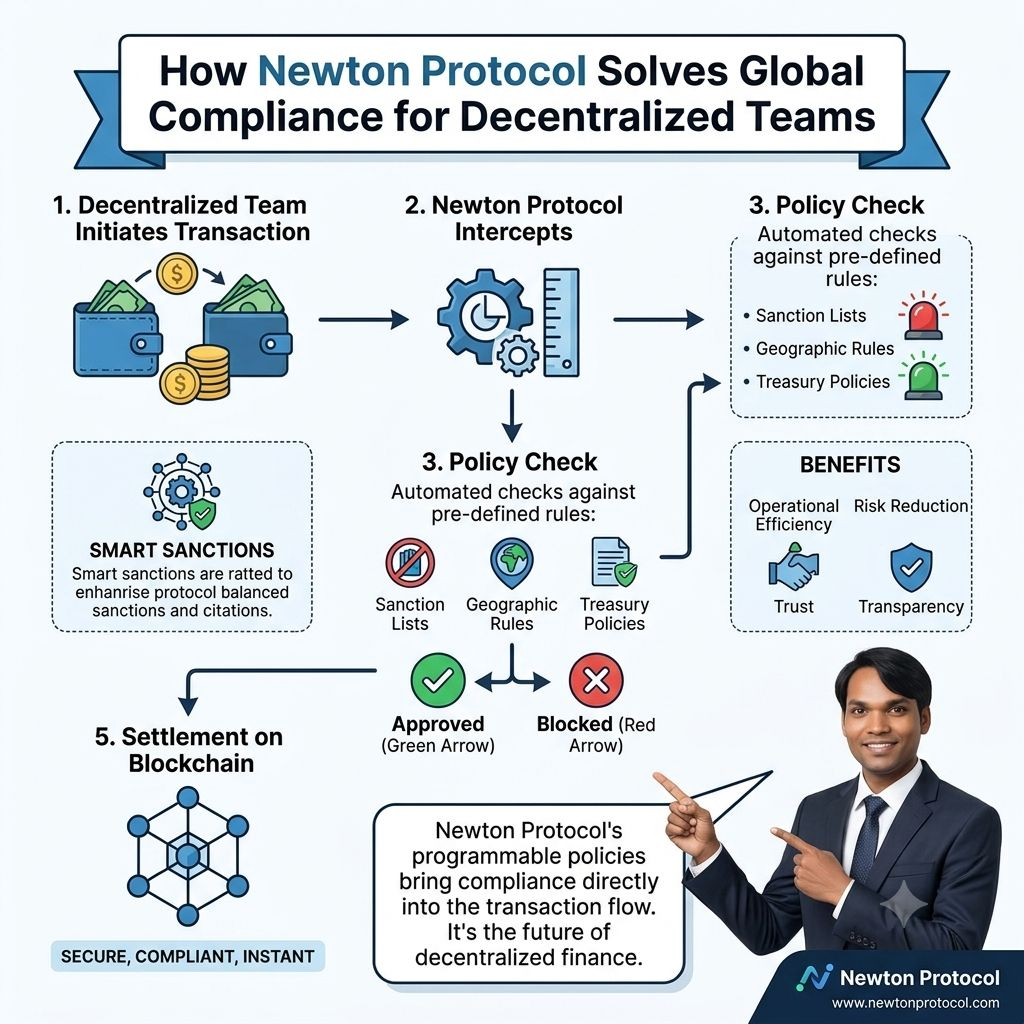
Instead of treating compliance as something that happens outside the blockchain, Newton brings it directly into the execution process through programmable policies. Rather than allowing every signed transaction to move automatically, the protocol enables transactions to be checked against predefined rules before settlement.
That shift may seem subtle, but it changes how decentralized organizations can manage risk.
Imagine a DAO paying contributors across multiple regions every month. Most payments are completely routine, but the organization still needs confidence that treasury funds are not accidentally sent to restricted wallets, or destinations that conflict with its internal policies.
Without automated safeguards, every payment depends heavily on manual verification.
With policy based execution, those checks become part of the transaction flow itself.
I think this is where Newton's approach becomes particularly practical. Compliance does not have to rely entirely on people remembering every rule or checking every address individually. Organizations can define the conditions that matter most and allow those policies to evaluate transactions before assets move.
That doesn't necessarily make the process more restrictive.
In many cases, it actually makes operations smoother because everyone understand the rules in advance.
Another point that stands out to me is that compliance often gets misunderstanding within the crypto community. Many people hear the word and immediately assume it means sacrificing decentralization, or introducing unnecessary control.
I do not think those two ideas have to conflict.
There is an important difference between centralized censorship and decentralized policy enforcement.
If a decentralized organization collectively agrees on how its treasury should operate, encoding those decisions into transparent and verifiable rules is very different from giving a single authority unlimited control over transactions.
That distinction matters.
Newton appears to focus on helping organizations enforce their own governance decisions rather than replacing them with external decision makers.
As decentralized finance continues to mature, this kind of infrastructure feels increasingly necessary. Crypto is moving beyond individual traders experimenting with small portfolios. More protocols now manage hundreds of millions of dollars. Some oversee billion dollar ecosystems with contributors spread across the world.
The operational standards for managing that level of capital are naturally becoming higher.
One trend I have noticed is that, Institutional participants rarely ask whether blockchain technology works anymore. That question has largely been answered. Instead of they want to know whether decentralized systems can satisfy practical operational requirements while remaining true to their core principles.
That includes governance.
It includes treasury management.
And it certainly includes compliance.
Projects that ignore those realities may struggle to attract larger participants regardless of how innovative their technology appears.
I also think the rise of AI and automated treasury management makes policy based infrastructure even more valuable. As organizations totally rely on software to execute payments, rebalance assets, and interact with decentralized protocols, expecting humans to manually review every transaction becomes unrealistic.
Automation increases efficiency.
It also increases the importance of setting clear operational boundaries.
Newton's programmable policies seem designed with exactly that future in mind. Rather than assuming automation should operate without limits, the protocol allows organizations to define what acceptable behavior actually looks like before execution occurs.
Personally, I believe this represents a healthier direction for decentralized finance. The goal should never be to eliminate human judgment entirely. Instead of the important decisions should be translated into transparent rules that automated systems can consistently follow.
That creates confidence without sacrificing efficiency.
More importantly, it reduces the gap between governance decisions and real world execution.
When I look at where blockchain infrastructure is heading over the next several years, I expect programmable compliance to become just as important as scalability and transaction speed. Decentralized organizations are becoming much larger, and more complex every year. Their operational tools need to evolve alongside them.
Newton Protocol is attempting to solve that challenge by making compliance as an active part of transaction execution rather than a manual process that happens before or after the fact.
Whether the industry ultimately adopts this model on a wide scale remains to be seen. But the underlying idea feels soo much increasingly difficult to ignore.
As decentralized teams continue expanding across borders, trust will depend not only on transparent governance but also on reliable execution. The organizations that succeed will be likely those that can move quickly while still operating within clearly defined rules.
That is what makes Newton Protocol interesting to me. It is not simply adding another security feature to blockchain infrastructure. It is helping decentralized teams build operational confidence in a world where global collaboration is becoming the norm rather than the exception.