The more I explored Newton Protocol's VaultKit, the more I found myself thinking about an uncomfortable reality: what happens when the system designed to authorize critical actions becomes unavailable?
Most discussions about security focus on preventing unauthorized access. Far fewer examine how a protocol should recover when its own authorization layer cannot make decisions.
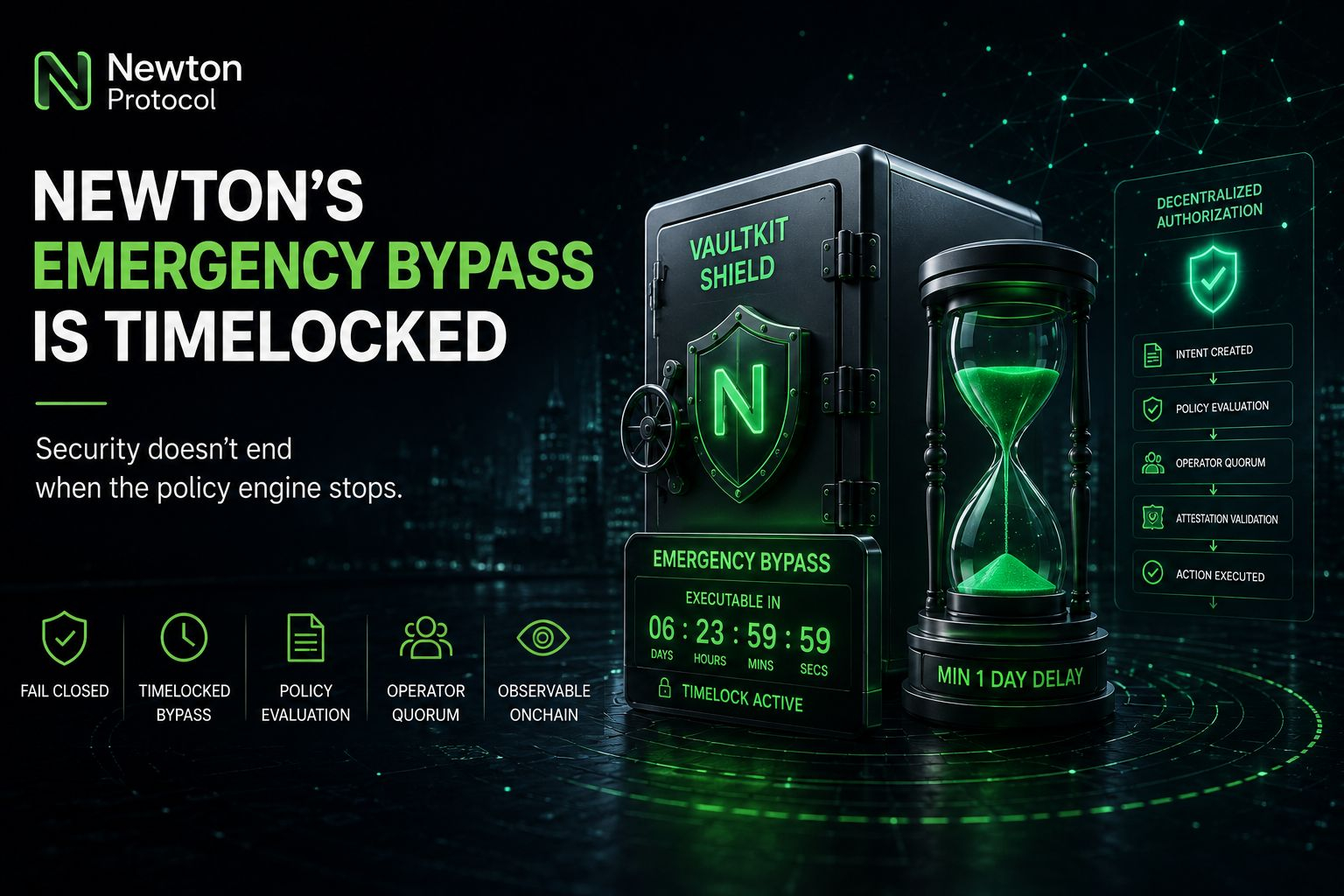
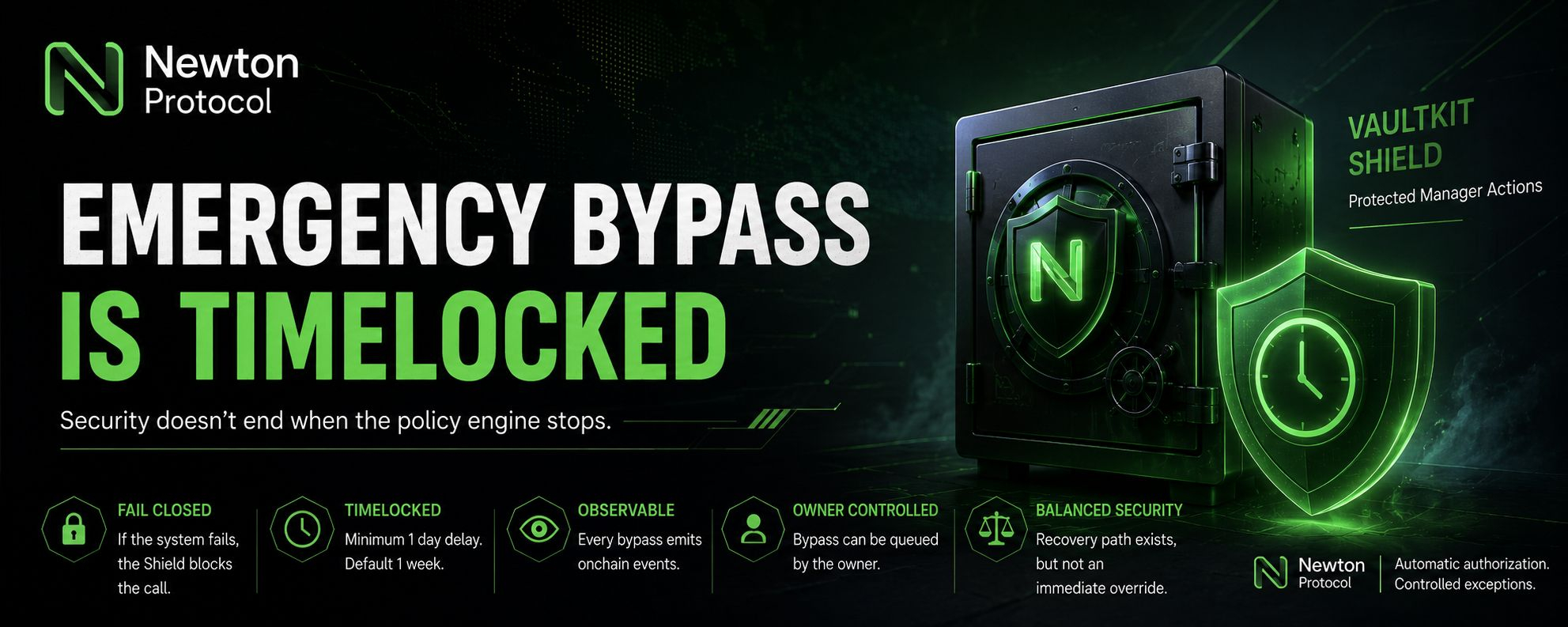
VaultKit approaches this with a clear philosophy. Protected vault-manager operations are designed to fail closed. If the Gateway cannot be reached, operators fail to achieve quorum, policy evaluation rejects the request, delegate validation fails, or attestation verification cannot be completed, the Shield simply refuses to forward the privileged management call.
That is exactly how a security system should behave under uncertainty. When trust cannot be established, permission is denied.
But real-world infrastructure introduces a different problem.
Vaults may occasionally require urgent management while the authorization network itself is unavailable. Leaving every privileged action permanently blocked could create operational risks just as serious as allowing unauthorized execution.
Newton's solution is surprisingly restrained.
Rather than giving the owner an unrestricted override, VaultKit introduces a timelocked emergency bypass. According to the official documentation, the owner must first queue the bypass before it can be executed. The waiting period is one week by default, and the SDK prevents deployments from configuring it below one day. Every use of the bypass also emits onchain events, ensuring that the action is publicly observable.
That design immediately stood out to me.
The protocol acknowledges that every fail-closed system eventually needs a recovery mechanism, yet it deliberately avoids making that recovery instantaneous. The waiting period creates time for monitoring, review, and community awareness before exceptional authority can be exercised.
This feels like an intentional balance.
An immediate override would reduce the practical strength of policy enforcement whenever the owner preferred another path. Eliminating emergency recovery entirely could leave critical vault management frozen during prolonged infrastructure failures.
The timelock sits between those extremes.
Yet it also changes the security assumptions.
During normal operation, privileged manager actions follow Newton's complete authorization pipeline. An exact Intent is created, operators evaluate it against the configured policy, approvals reach quorum, attestations are produced, and the Shield verifies those attestations before forwarding the transaction. Every approval is cryptographically tied to the intended signer, contract, calldata, value, chain, and function.
The emergency bypass operates differently.
Instead of relying on operator consensus and policy attestations, execution ultimately depends on owner authority, the configured delay, and public visibility through emitted events.
Those protections are valuable.
But they are not the same protections.
A timelock determines when an emergency action can execute. It does not determine why it should execute.
Likewise, observable events make exceptional actions transparent, but transparency should not be confused with policy approval. The owner may activate the bypass because Gateway availability has failed or operator quorum cannot be reached. The resulting transaction can still proceed without completing Newton's standard policy-attestation workflow.
That distinction matters because the trust model shifts.
The configured delay also becomes an important governance decision rather than a simple deployment parameter.
A shorter delay allows faster recovery during genuine emergencies but reduces the time available for oversight. A longer delay strengthens review opportunities while increasing the chance that legitimate operational intervention arrives too late.
No single value perfectly balances every possible failure scenario.
Perhaps the most interesting conclusion is that VaultKit's security model is not defined solely by automated authorization.
It is defined by two complementary guarantees.
The first is Newton's policy-driven authorization system, where operator consensus and cryptographic attestations determine whether privileged manager actions are allowed.
The second is the documented owner-controlled recovery mechanism, where authority is constrained by time rather than replaced by policy.
Neither guarantee exists in isolation.
Understanding VaultKit requires understanding both.
It is also important to remember the scope of these protections. VaultKit secures privileged curator and manager operations such as reallocations, cap updates, and similar administrative actions. Standard user deposits and withdrawals continue through the underlying vault protocol unless an integration explicitly routes those operations through a Shield.
Ultimately, the timelocked bypass does not weaken the idea of policy-based authorization.
Instead, it acknowledges a practical truth: resilient infrastructure must plan not only for successful authorization but also for the rare moments when authorization itself becomes unavailable.
The real question is whether users will evaluate those two trust assumptions independently—or simply assume that every protected vault operation always relies on the same security guarantees.
Does Newton's timelocked emergency bypass provide the operational resilience that decentralized vault management needs, or does it become the primary trust assumption whenever the normal authorization path is unavailable?
#Newt @NewtonProtocol l $NEWT $VANRY $TLM