
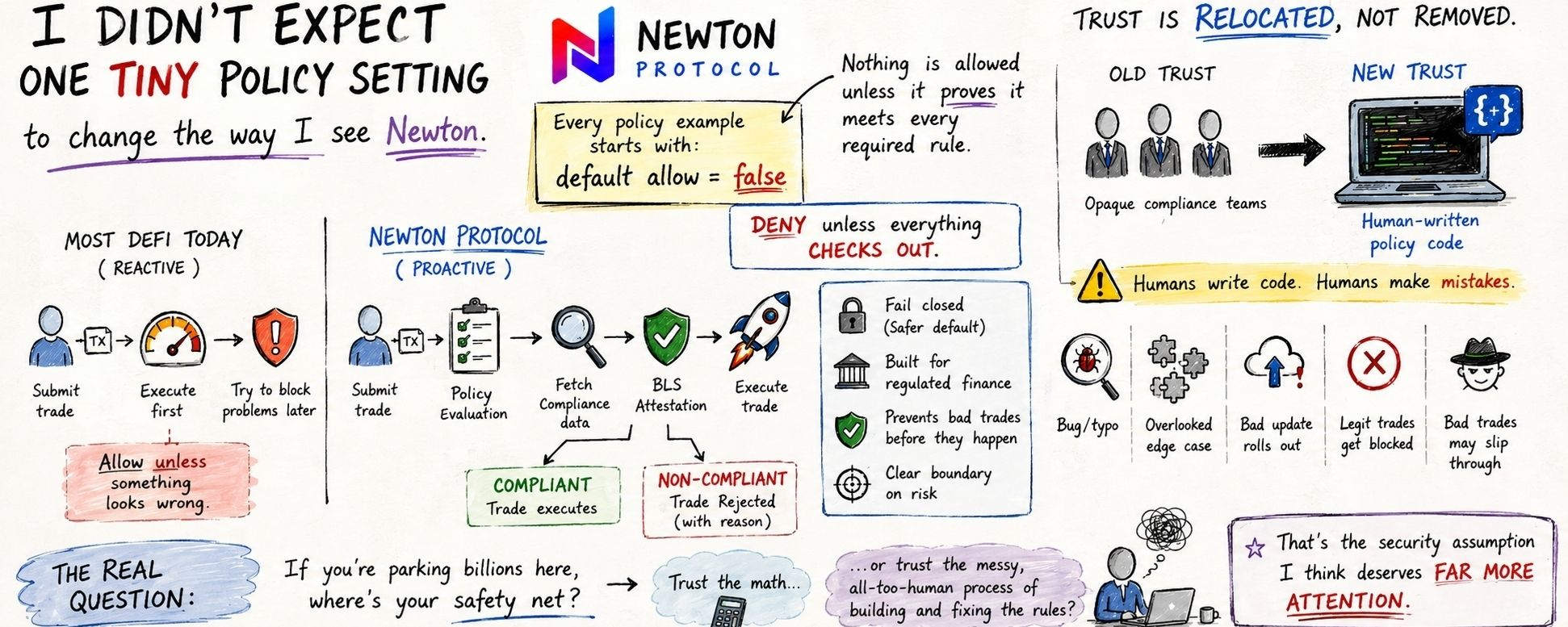

The more time I spent reading through Newton Protocol's policy examples, the more one thing kept catching my eye: every single one starts with "default allow = false." At first, I brushed it off as a technical detail. But the longer I sat with it, the more I realized it wasn't just a footnote—it was shaping the whole security model.
It's Newton setting a clear boundary on risk. By design, nothing is allowed to happen unless it first proves it meets every required rule. The default changes from allow unless something looks wrong to deny unless everything checks out.
Most DeFi systems are so busy trying to block bad transactions after the fact—they’re pretty reactive. What caught my attention in Newton's design is that policy evaluation happens before settlement rather than after it. That distinction matters because the goal isn't just to detect violations—it is to prevent non-compliant transactions from ever being finalized. Newton reverses that behavior. If even one policy isn’t satisfied, the transaction stops immediately. No gray area, no fancy exceptions.
For compliance teams, this suggests an understandable default. Sure, it might occasionally block a legitimate transaction, but that's usually easier to deal with than accidentally approving something risky or non-compliant. In heavily regulated environments, failing closed often makes more sense than failing open.
One reason may be programmable compliance is becoming one of the biggest infrastructure narratives in crypto. As institutions explore tokenized assets and regulated on-chain finance, the question isn't just whether transactions are cryptographically valid—it's whether the policy layer governing them can be trusted at scale.
That likely extends beyond Newton itself. It's still an early narrative, but one that could shape how regulated capital eventually moves through DeFi.
There's another side to it: that rarely gets discussed explicitly.
People often focus on how cryptography lets us "trust the math." But Newton doesn't eliminate trust—it relocates it. Instead of trusting opaque compliance teams, you're trusting the correctness of human-written policy code. That's a very different security assumption.
But who writes these policies? Actual people. After spending time writing Rego policies myself, I've realized how easy it is to slip up. A small typo or an overlooked edge case can completely change a policy's behavior—either nothing works, or far too much does. I almost launched a faulty policy today myself before catching a logic bug at the last second. That's an uncomfortable realization when you realize how close you came to bricking everything.
So, Newton is replacing murky compliance middleware for open, readable policy code. On paper, that sounds empowering. Except, you know, software can still mess up. A single busted policy? Now every legit transaction gets nuked. Or maybe a subtle mistake slips through and greenlights things that should be blocked.
I’m on board with Newton’s call to fail closed versus open. Most of the time, that’s the safer move for compliance. But the real puzzle isn’t about “default allow = false.” It's about whether the people operating these systems—protocol governance, policy developers, and the institutions relying on them—are paying enough attention to the messy parts: thoroughly testing policies, rolling back bad updates quickly, having emergency controls, and handling disputes when code doesn't behave as intended. All of that is just as important as the cryptography itself.
If you’re an institution parking billions in here, where’s your safety net? Trust the math—or trust the messy, all-too-human process of building and fixing the rules that actually decide what you can or can’t do? For me, that's where the real security question lies. Newton's cryptography may be deterministic, but the policies governing it are still written by humans. That's the security assumption I think deserves far more attention.