
In distributed systems, reaching agreement is often more challenging than performing the computation itself. A policy may be evaluated correctly by one operator, but a decentralized protocol still needs a reliable mechanism for coordinating agreement across multiple participants before that result can be trusted. Newton's documented Streaming Consensus architecture addresses this coordination challenge by enabling distributed operators to produce a verifiable authorization outcome without relying on a single decision-maker.
The Engineering Problem
Decentralized authorization requires more than independent policy evaluation. If each operator evaluates a transaction in isolation, the network still needs a documented process for determining which result represents the collective decision.
Without a coordination mechanism, inconsistent operator responses could reduce confidence in authorization outcomes and complicate downstream verification.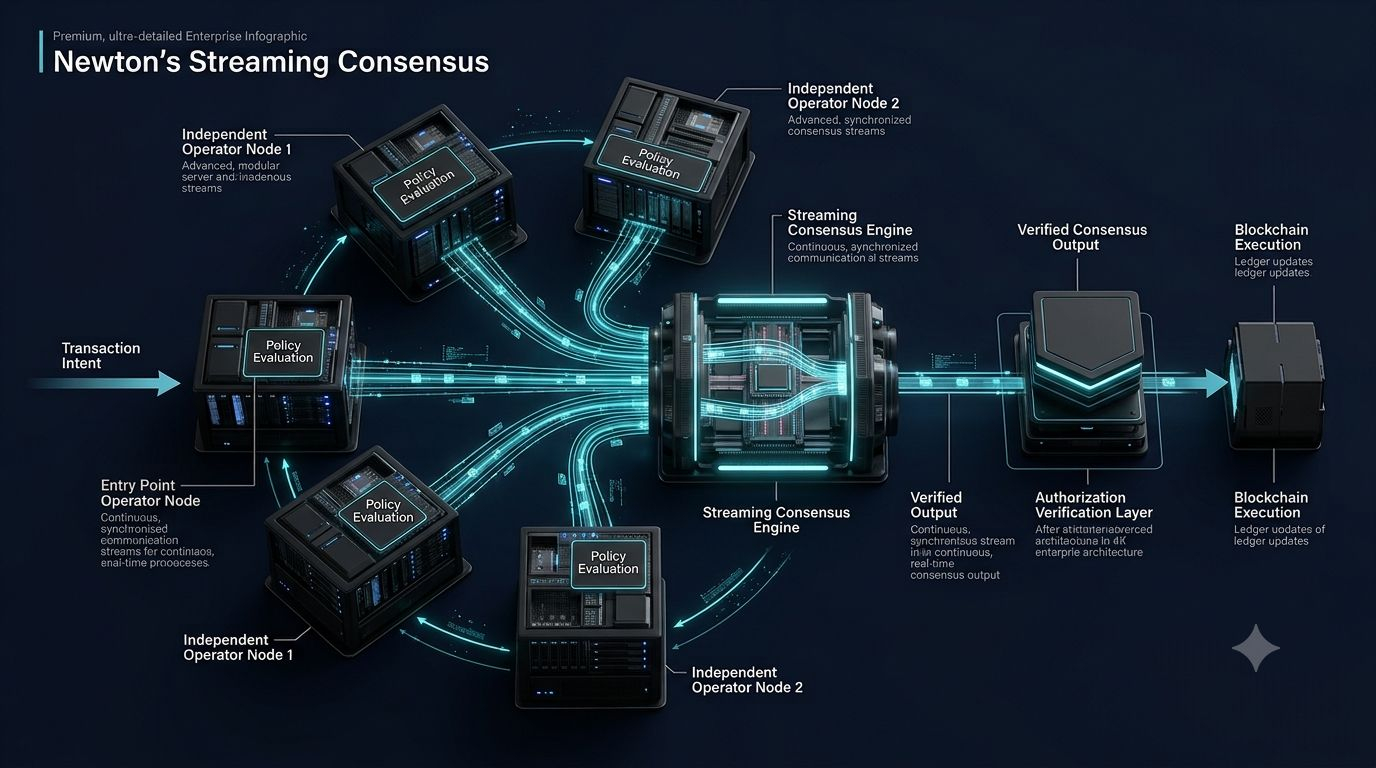
Newton introduces Streaming Consensus as part of its protocol architecture to coordinate distributed operator participation before authorization decisions are finalized.
What Is Streaming Consensus?
According to the Newton Technical Whitepaper, Streaming Consensus is designed to coordinate deterministic policy evaluation among distributed operators. Rather than treating authorization as the output of a single service, participating operators independently evaluate the same request and contribute toward a shared protocol outcome.
This architecture separates three distinct responsibilities:
Independent policy evaluation by operators
Coordination of distributed agreement
Verification before execution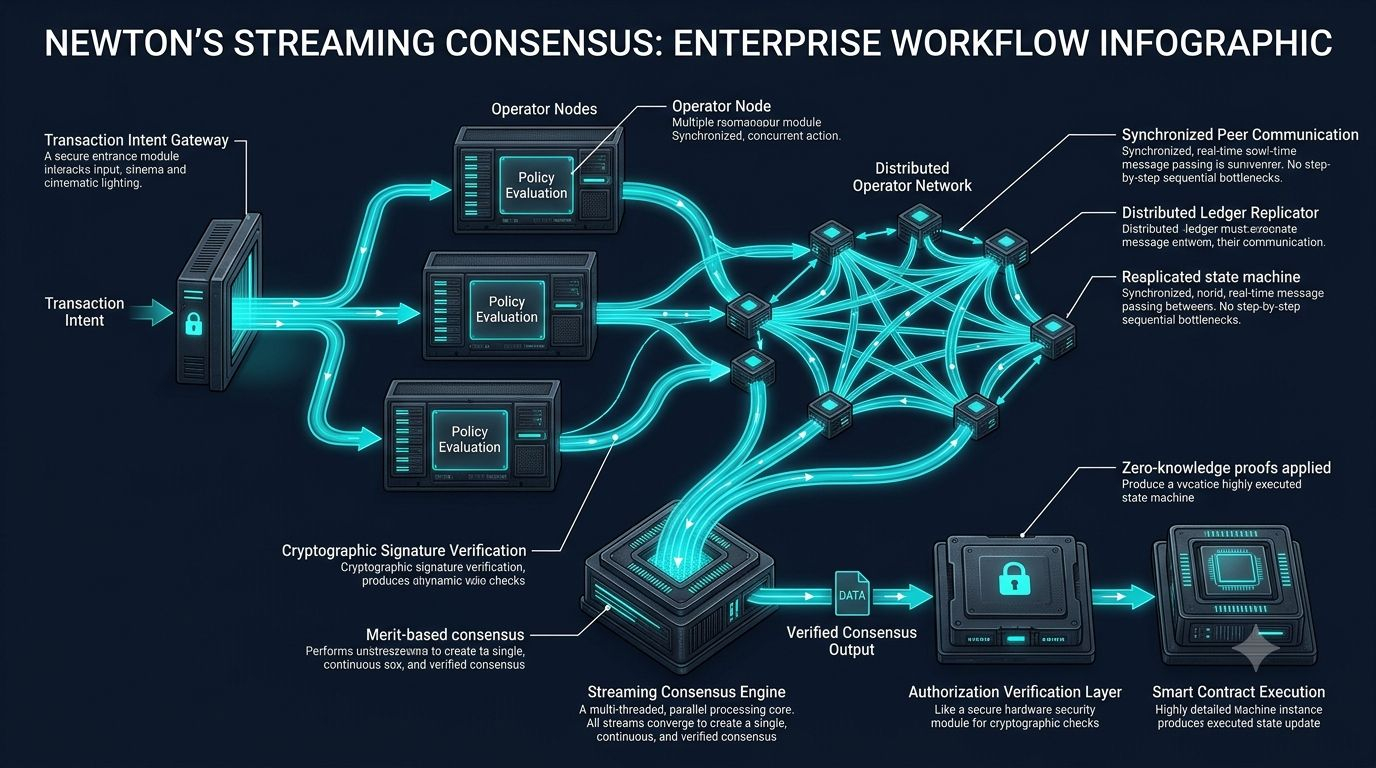
By separating these concerns, the protocol avoids concentrating authorization authority in a single infrastructure component.
Where It Fits in the Architecture
Within Newton's documented workflow, Streaming Consensus operates between policy evaluation and authorization verification.
The conceptual flow is: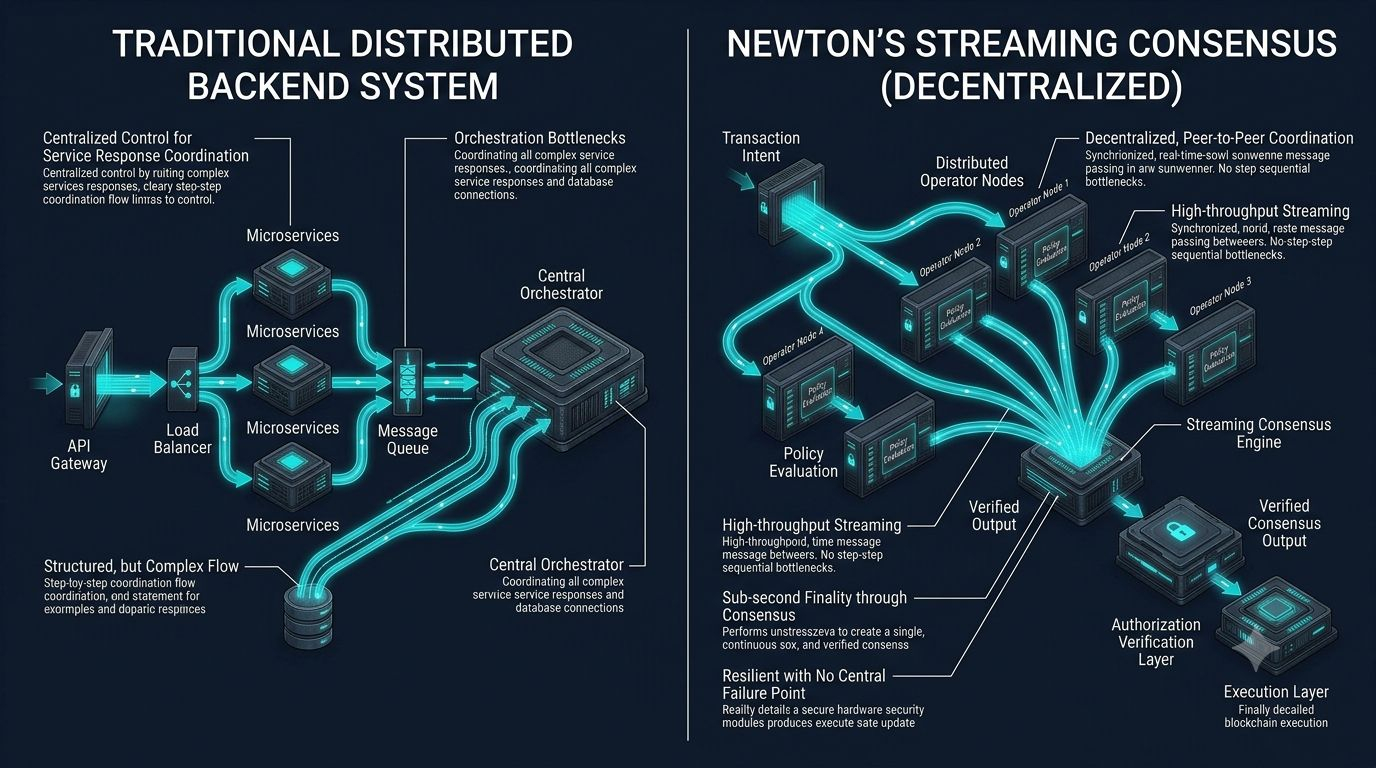
A transaction intent enters the authorization workflow.
Operators independently evaluate the associated policy.
Streaming Consensus coordinates agreement across participating operators.
Once the required protocol conditions are satisfied, a verifiable authorization result is produced.
The verified authorization can then be consumed by the execution layer.
Instead of relying on sequential approvals from individual participants, the protocol coordinates distributed agreement as part of a unified authorization pipeline.
A Backend Analogy
Developers familiar with Node.js, TypeScript, or distributed microservices can compare Streaming Consensus to an orchestration layer coordinating several independent backend services.
Imagine multiple stateless services processing the same request. An orchestrator collects their responses and determines whether the workflow should continue based on predefined coordination rules.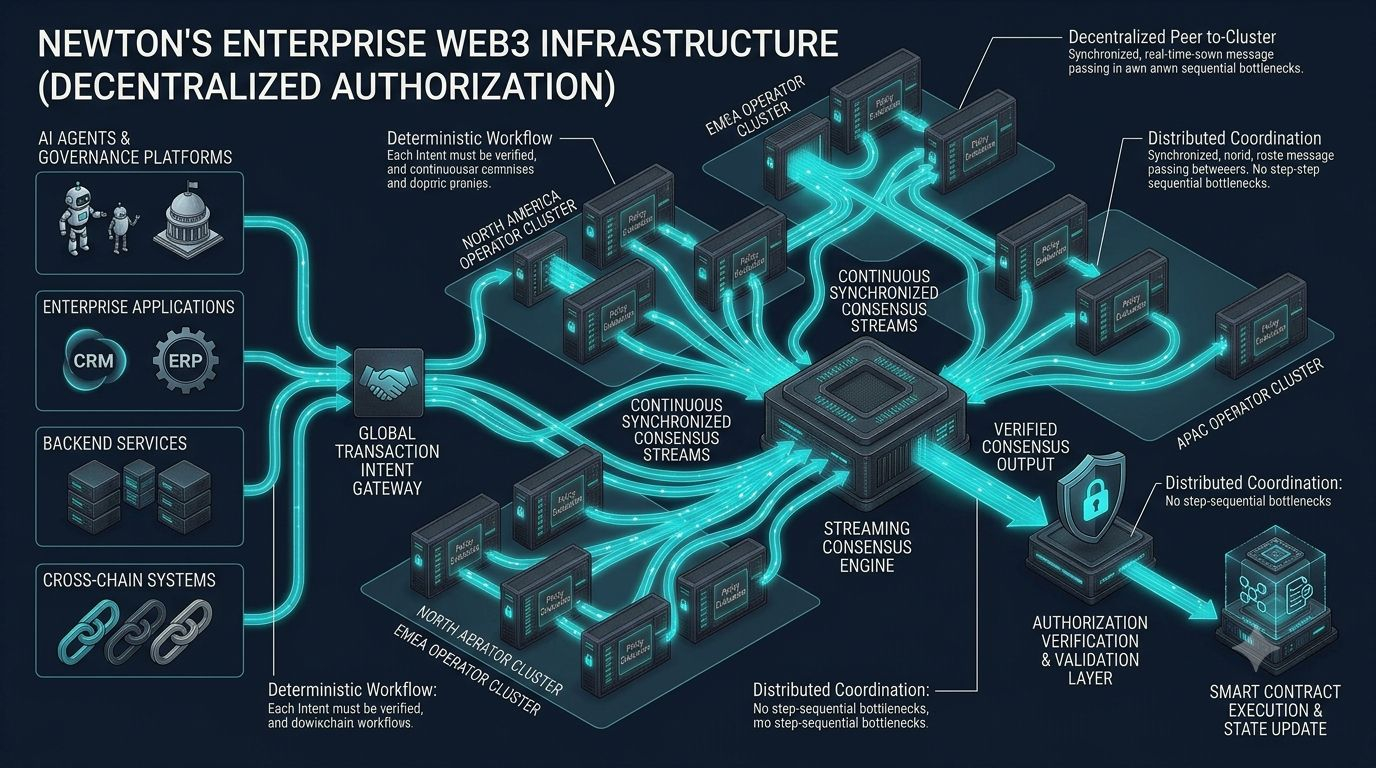
Newton applies a similar architectural principle, but the comparison ends there. Traditional orchestrators operate under centralized administrative control, while Streaming Consensus coordinates participation within a decentralized protocol where agreement must be independently verifiable rather than simply trusted.
Why This Matters
For developers, Streaming Consensus provides a structured coordination layer that separates distributed agreement from business logic.
For AI agents, authorization decisions are backed by coordinated operator participation instead of depending on a single execution environment.
Enterprise architectures benefit because distributed coordination improves the separation between evaluation, agreement, and execution, making authorization workflows easier to understand and reason about.
Operators likewise participate within a documented coordination process instead of independently determining authorization outcomes.
Independent Architectural Analysis
Based on Newton's documented design, Streaming Consensus contributes to a modular authorization architecture.
Policy evaluation, operator coordination, cryptographic verification, and execution each remain independent responsibilities, improving maintainability and architectural clarity.
This layered approach also enhances extensibility. Changes to coordination mechanisms can be isolated from execution logic, while policy definitions remain focused on authorization rules rather than distributed workflow management.
For infrastructure engineers, the design reflects a familiar principle: separate computation from coordination whenever both evolve independently.
Conclusion
Streaming Consensus demonstrates that decentralized authorization is not only about evaluating policies correctly—it is also about coordinating agreement across distributed operators in a verifiable and structured manner.
By introducing a dedicated coordination layer between policy evaluation and execution, Newton reinforces a modular architecture where each stage has a clearly defined responsibility, improving the transparency and organization of the authorization workflow.
Paid Partnership Notice: This technical analysis is part of the Newton CreatorPad campaign and is intended solely for educational discussion.
Discussion Question: As decentralized applications grow more complex, what advantages do dedicated coordination mechanisms offer over embedding distributed agreement directly into execution logic?