
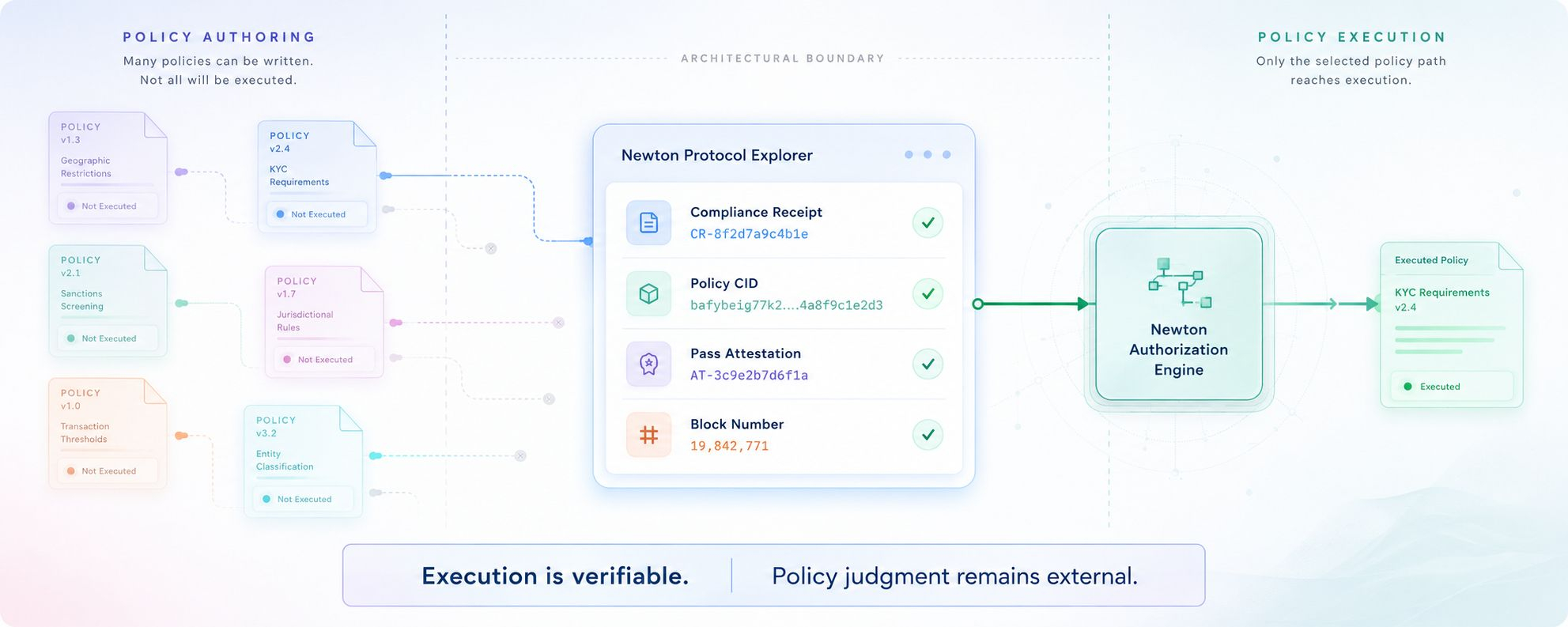

The first thing I opened after reading about Newton Mainnet Beta wasn't another document.
It was the Newton Explorer.
The receipt looked complete.
The policy CID was there.
The attestation was there.
The block number was there.
Every field I expected to verify was present.
I almost stopped there.
Then I realised I still couldn't answer the only question I'd opened the Explorer to ask.
Was this actually the right policy to run?
I scrolled again.
Nothing.
I opened the documentation.
Not because I wanted to understand @NewtonProtocol
I wanted to understand what the receipt believed it had proved.
The answer was much narrower than I'd assumed.
The receipt never certifies judgment.
Only execution.
I'd quietly started treating proof of enforcement as proof of compliance.
Newton never makes that leap.
I did.
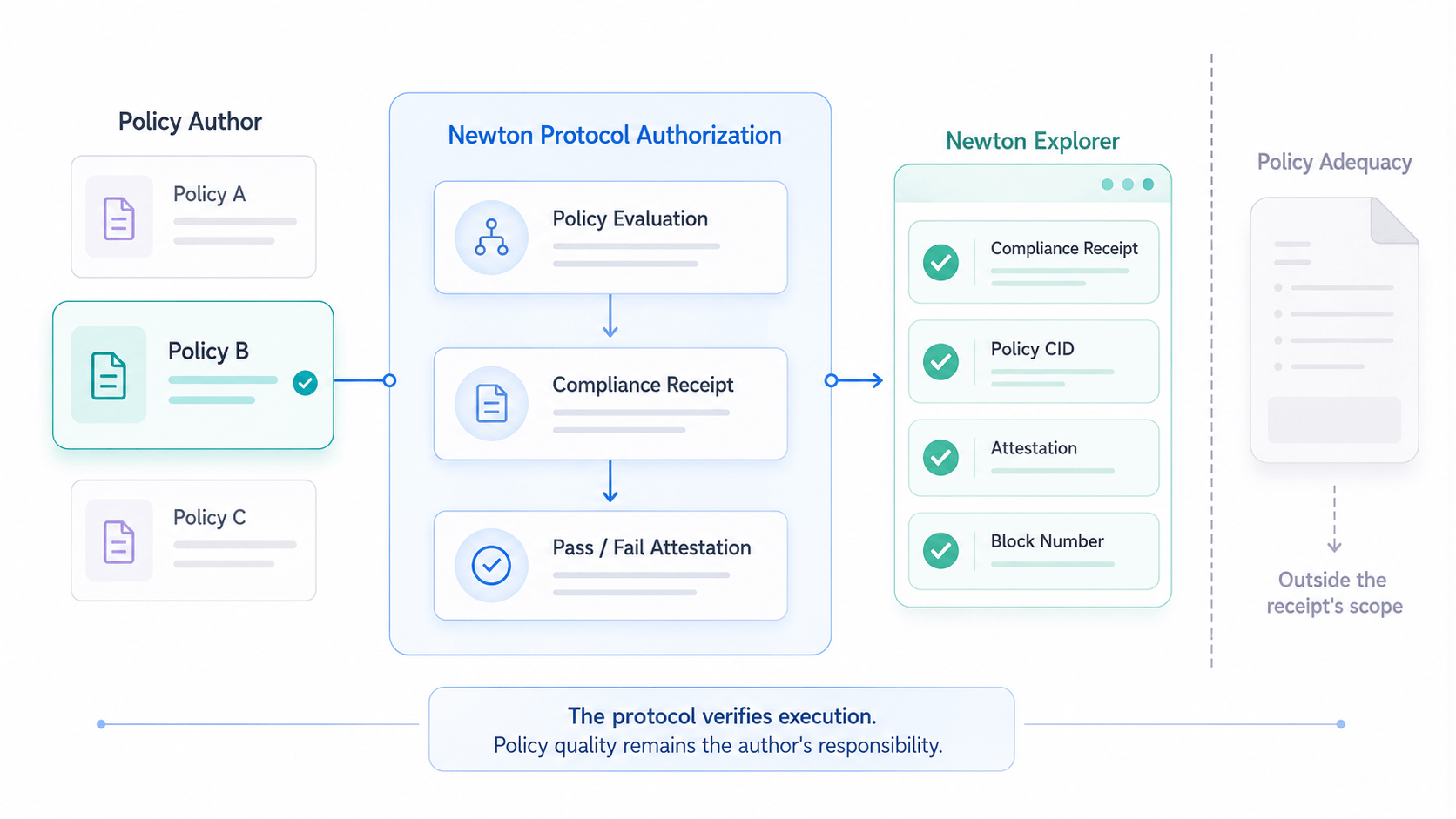
I went back to the Explorer one more time.
The receipt hadn't changed.
Only the way I was reading it had.
A perfect receipt can faithfully prove the execution of an imperfect policy.
Nothing about the cryptography fails.
Nothing about the attestation becomes invalid.
The mechanism is doing exactly what it was designed to do.
It simply refuses to answer a different question.
That refusal turned out to be the interesting part.
I kept looking for the place where Newton accepted responsibility for whether the policy itself was adequate.
I never found it.
Eventually I stopped looking.
If Newton started deciding which policies were acceptable, it wouldn't simply enforce policy anymore.
It would become the policy author.
That would be a completely different protocol.
I wrote one sentence in my notes.
Then I underlined it.
Execution became verifiable.
Judgment didn't.
Everything else suddenly felt easier to interpret.
The receipt isn't incomplete.
It's disciplined.
It proves one boundary.
It deliberately refuses to cross the next one.
That changes where responsibility lives.
Before Newton, the difficult question was whether enforcement happened at all.
A cryptographic receipt now answers that with unusual precision.
But solving one question exposes another.
Who decides whether the policy itself deserves to be trusted?
Not the Explorer.
Not the receipt.
Not the protocol.
Every vault manager answers that the moment they publish a policy.
Which leaves me with the production question I can't answer from documentation alone.
As more vaults come online during Mainnet Beta, do operators gradually converge on a small set of policy templates that institutions, auditors, and regulators begin trusting...
or does every deployment quietly end up carrying its own definition of "adequate"?
That's the signal I'm watching.
Not because it changes how the receipt works.
Because it changes what the receipt ultimately means.
$NEWT only becomes interesting to me if the ecosystem develops policy templates that become trusted through repeated operational use, not because Newton declares them correct, but because experienced operators keep choosing them when the cost of getting the policy wrong is highest.