
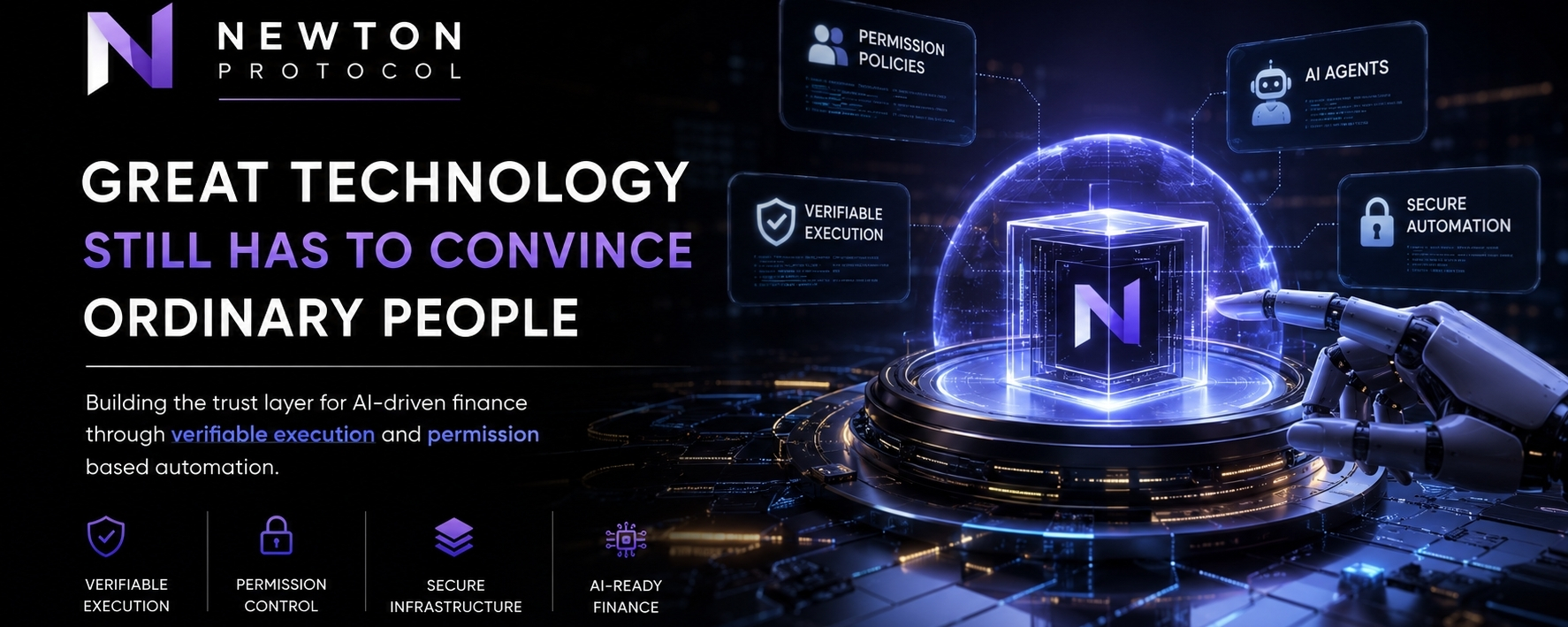
Every crypto cycle introduces another protocol promising faster execution, stronger security, or a more efficient architecture. Most discussions quickly become technical—throughput, scalability, cryptography, or consensus. Yet history suggests that technology alone rarely determines which platforms succeed.
The deciding factor is usually whether the market is ready.
That is why Newton Protocol is an interesting project to think about. It is not competing to become another trading platform or another DeFi application. Instead, it is building infrastructure for a future where AI agents can carry out financial actions within predefined rules, allowing automation without giving software unlimited authority over digital assets.
It is an ambitious vision because it shifts the conversation from simply proving ownership to controlling behavior.
Traditional blockchain systems answer a simple question: Who signed this transaction? Newton attempts to answer a much harder one: Should this transaction be allowed in the first place?
That distinction may become increasingly important as artificial intelligence takes on larger financial responsibilities.
The challenge is that most users do not wake up worrying about authorization frameworks or cryptographic policy engines.
They care about outcomes.
If their wallet works, their trades execute correctly, and their assets remain secure, the underlying infrastructure becomes almost invisible. In many ways, great infrastructure succeeds precisely because nobody notices it.
This creates a familiar dilemma for projects building foundational technology.
Infrastructure often creates enormous long-term value while receiving very little short-term attention.
The internet itself evolved this way. Cloud computing spent years serving enterprises before becoming an everyday assumption. Even modern payment systems operate beneath the surface, rarely appreciated until something stops working.
Newton Protocol could follow a similar path.
Its biggest opportunity may arrive only when AI-driven finance becomes common enough that permission management turns into an obvious necessity instead of an abstract concept.
Today's environment is different.
Most crypto users still interact directly with exchanges, wallets, or simple automation tools. They may trust centralized platforms more than they realize because convenience frequently outweighs theoretical improvements in decentralization.
That creates an uncomfortable reality for any new infrastructure project.
Being technically superior does not automatically create demand.
Markets reward solutions to problems people actively feel—not problems they might experience years from now.
This is where timing becomes more valuable than engineering.
If autonomous AI eventually begins managing significant amounts of capital, users will likely demand stronger guarantees regarding what those systems are allowed to do. Permission boundaries, verifiable execution, and transparent policies could become standard expectations rather than premium features.
If that transition happens, Newton will appear remarkably well positioned.
If adoption arrives more slowly, however, the protocol may spend years educating a market that is not yet asking the right questions.
Technology has encountered this challenge repeatedly.
Many successful innovations looked unnecessary before they became indispensable.
Another important aspect of Newton's approach is that it reframes trust rather than eliminating it.
Crypto often speaks about removing trust entirely, but practical systems rarely function that way.
Instead of trusting a centralized automation provider, users begin trusting transparent code, decentralized validation, cryptographic proofs, governance mechanisms, and economic incentives.
Trust does not disappear.
It becomes measurable.
For institutions, that distinction could matter enormously.
Banks, enterprises, and asset managers often value auditability, accountability, and predictable execution more than maximum simplicity. Systems that reduce operational risk can justify significant investment because mistakes at institutional scale are extremely expensive.
Retail users evaluate products differently.
They usually prioritize convenience first.
Institutions frequently prioritize certainty.
That difference suggests Newton's earliest adoption may come from organizations rather than individual investors.
Long-term success, however, depends on something no protocol can manufacture.
Real usage.
Token incentives may encourage experimentation during the early stages, but sustainable value emerges only when networks support activity that would exist even without rewards.
If AI agents eventually execute meaningful financial operations every day, demand for secure authorization infrastructure becomes structural.
If that future never materializes, elegant architecture alone will not create lasting adoption.
Ultimately, Newton Protocol is not asking whether decentralized finance can become more automated.
It is asking whether automation itself can become trustworthy enough for people to delegate meaningful financial responsibility to software.
That is a much larger question than blockchain performance.
It is a question about confidence.
The protocol may already possess sophisticated technology.
Its greater challenge is convincing the market that this level of authorization will eventually become essential rather than optional.
If history offers any lesson, it is that transformative infrastructure rarely wins because it is technically impressive.
It wins because one day the old approach suddenly feels inadequate.
Should that moment arrive for AI-powered finance, Newton Protocol may find that years of building invisible infrastructure were not early at all—they were simply preparing for the market that had not yet caught up.
In the end, Newton's future will depend less on whether its technology works and more on whether the world reaches the point where trustworthy AI automation is no longer a luxury, but an expectation.
@NewtonProtocol #Newt #VitalikOutlinesLeanEthereumRoadmap
#BrazilCentralBankSaysStablecoinsElectronicMoney #UKFCAPublishesCryptoRegFramework #BitcoinFallsOver50%FromOctoberHigh