
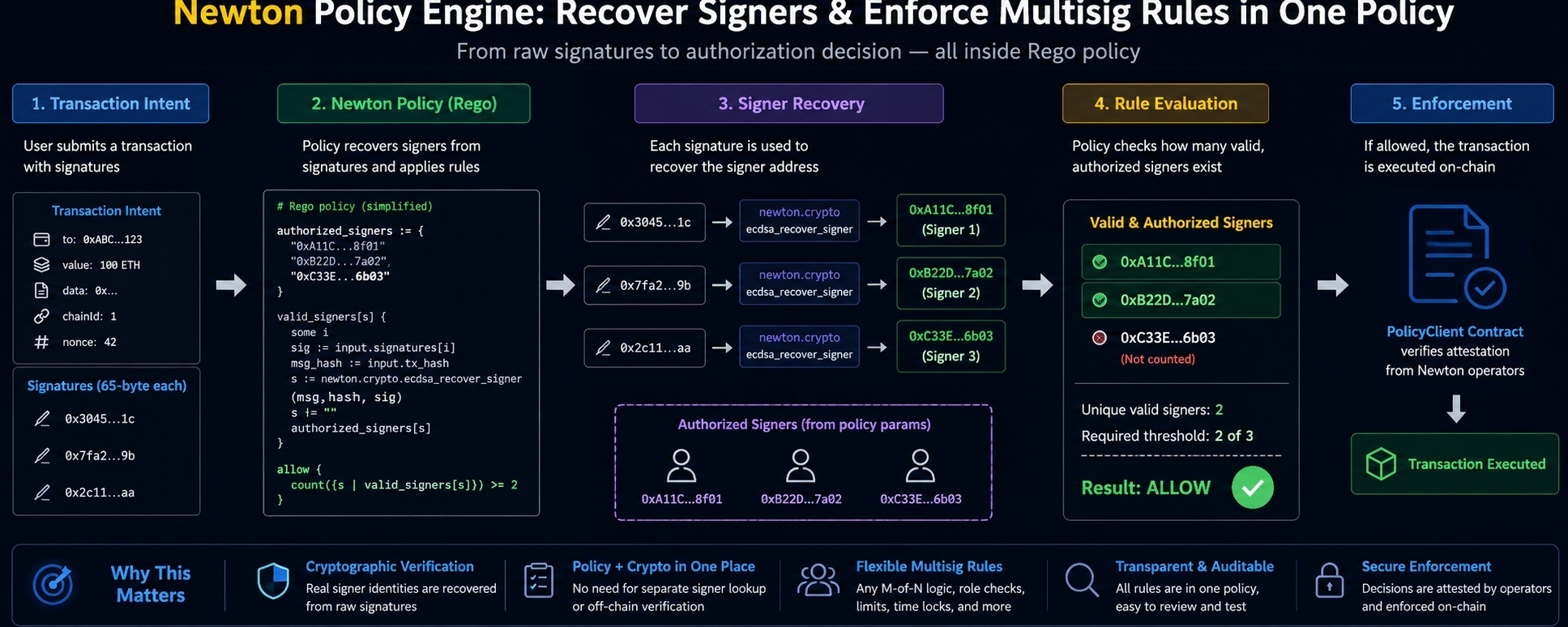

I’ve been spending time looking at Newton as a project rather than treating it as a simple approval tool. What stands out is the way Newton tries to bring two decisions closer together: proving who signed a transaction, and deciding whether that signer had the right to approve it. In many systems, those are handled separately. One part checks whether a signature is valid, while another checks whether the signer belongs to an approved group. Newton appears to treat those steps as part of the same policy decision.
That becomes especially clear in its multisignature design. Instead of relying only on an address supplied by the user, Newton can recover the actual signer identity from the submitted signature itself. The policy can then compare that recovered identity with the approved signer list and decide whether enough valid approvals exist. For a two-of-three requirement, the system is not simply counting uploaded signatures. It is checking whether two distinct approved signers actually authorized the transaction.
This may seem like a small technical difference, but it changes the trust model. A user can claim that a signature belongs to a certain person, but the policy does not need to accept that claim at face value. It can derive the signer directly from the signature and make its decision based on that result. That reduces the reliance on metadata provided by the transaction sender and gives the policy stronger evidence to work with.
At the same time, signature recovery alone does not solve the full authorization problem. A valid signature only proves that a key signed a particular message. It does not automatically prove that the signer intended to approve a specific transaction under a specific set of conditions. That depends on how the message was created in the first place. The message needs to be tied closely to the transaction details, such as the intended action, destination, amount, timing, and any limits that apply. Without that connection, a signature could be valid in a technical sense while still being used in a way the signer never intended.
This is where Newton becomes more demanding than a basic signature check. The project gives policy authors the ability to combine signature verification with approval rules, but it also places more responsibility on them. A policy cannot safely stop at recovering a signer address. It must also confirm that the signature belongs to the exact action being evaluated. That means the quality of the policy depends not only on cryptographic correctness, but also on how carefully the transaction context is defined.
The issue of duplicate signatures shows why this matters. A two-of-three approval rule should count two different approved signers, not two copies of the same signature. If the system only counts submissions, one person could potentially satisfy the threshold by repeating the same approval. Newton can avoid that by treating recovered signer identities as unique values, but that protection depends on the policy being written correctly. The system provides the structure, yet the final outcome still depends on how clearly the rule defines what counts as an independent approval.
Newton becomes more interesting when signatures are only one part of the decision. A simple approval rule may only require two trusted signers. But real operational policies often involve more than that. A transaction may need multiple approvals while also staying below a spending limit, going to an approved destination, following a timing restriction, or meeting another internal condition. In those cases, Newton can bring several checks into the same decision process instead of treating each one as a separate manual or technical step.
That flexibility is useful, but it also introduces trade-offs. A fixed approval rule is easier to understand because there are fewer moving parts. Once signatures, transaction details, changing parameters, and outside conditions are all included in one policy, the system becomes more capable but also more difficult to review. The risk is not necessarily that the system becomes weaker. The risk is that complexity can hide mistakes. A policy may look correct at a high level while still failing because of an overlooked detail in signer handling, message structure, duplicate counting, or policy updates.
Governance is another part of the picture that cannot be ignored. A two-of-three policy is not only defined by the signatures it accepts. It is also defined by who can change the approved signer list, who can change the threshold, and who can update the policy itself. If one person has the power to replace the signer list or lower the approval requirement, that person has meaningful control over the system even without holding the approved signing keys. The real security model therefore includes both the policy logic and the process used to manage changes to that logic.
This is why Newton should not be viewed only as a tool for checking signatures. Its larger purpose appears to be making authorization programmable. The project allows a policy to look at the signer, the transaction, and the surrounding rules in one place. That can make decision-making clearer when the organization needs more than a fixed threshold of static approvals.
Still, the value of that approach depends on whether the additional flexibility is actually needed. For a simple approval setup with stable signers and a permanent threshold, a smaller and more direct design may be easier to operate. Newton becomes more relevant when approval rules need to change over time or when the decision depends on several conditions at once. In that situation, the project provides a way to connect cryptographic proof with real operational requirements.
What I keep coming back to is that Newton makes the relationship between identity and authority more visible. A signature shows who approved something. A policy explains whether that approval is enough. Newton brings those ideas together, which can make authorization more precise, but it also means the policy itself becomes a critical layer of responsibility. The project’s long-term strength will depend on how carefully teams define those rules, how transparently they manage policy changes, and how well they avoid turning flexibility into unnecessary complexity.