

In distributed systems, trust should not depend on a single server declaring that an authorization decision is correct. If one component alone approves or denies every request, it becomes both a security risk and a potential single point of failure. Newton addresses this challenge by using BLS attestations to provide cryptographic evidence that authorization decisions were agreed upon by a qualified set of operators before smart contracts rely on them.
The Engineering Problem
Modern blockchain applications increasingly depend on offchain information, such as compliance checks, policy evaluation, or AI-assisted decision making. Simply returning an "allow" or "deny" result from an offchain service requires users and smart contracts to trust that service.
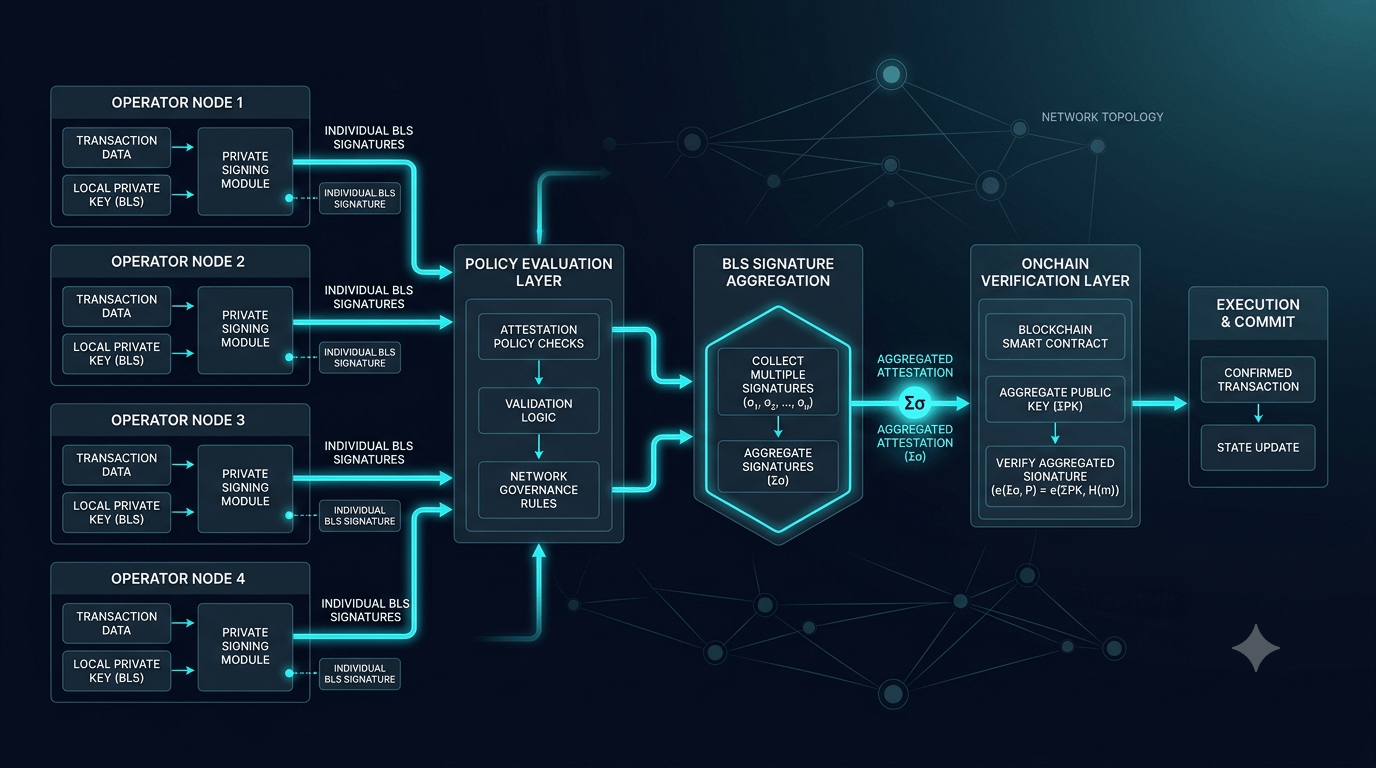
Newton's documented architecture instead produces a cryptographic attestation for policy evaluation results, allowing smart contracts to verify that the decision originated from the protocol's distributed operator network rather than from a single authority.
What Are BLS Attestations?
According to the Newton Technical Whitepaper, operators independently evaluate the same policy task. After reaching the same deterministic result, participating operators produce individual BLS signatures, which are aggregated into a single BLS attestation representing quorum agreement. This aggregated attestation is then verified before the associated transaction proceeds.
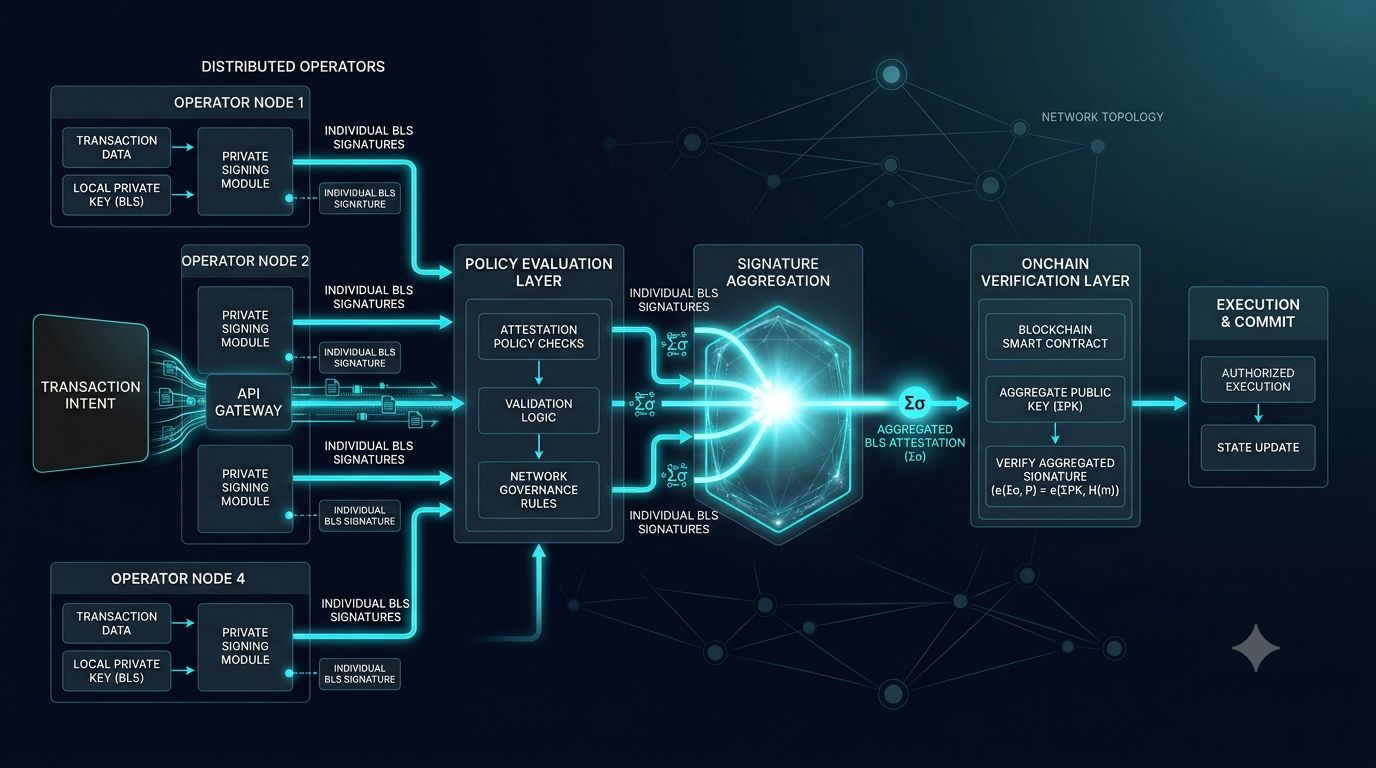
Rather than proving that one operator approved a request, the attestation proves that the required operator quorum participated in producing the authorization decision.
Where They Fit in the Architecture
Within Newton's documented workflow, BLS attestations appear after policy evaluation and before onchain execution.
The process can be summarized as follows:
A transaction intent is submitted.
Operators evaluate the policy deterministically.
Individual BLS signatures are generated for the evaluation result.
The signatures are aggregated into a single BLS attestation.
The smart contract verifies the aggregated attestation before executing the authorized transaction.
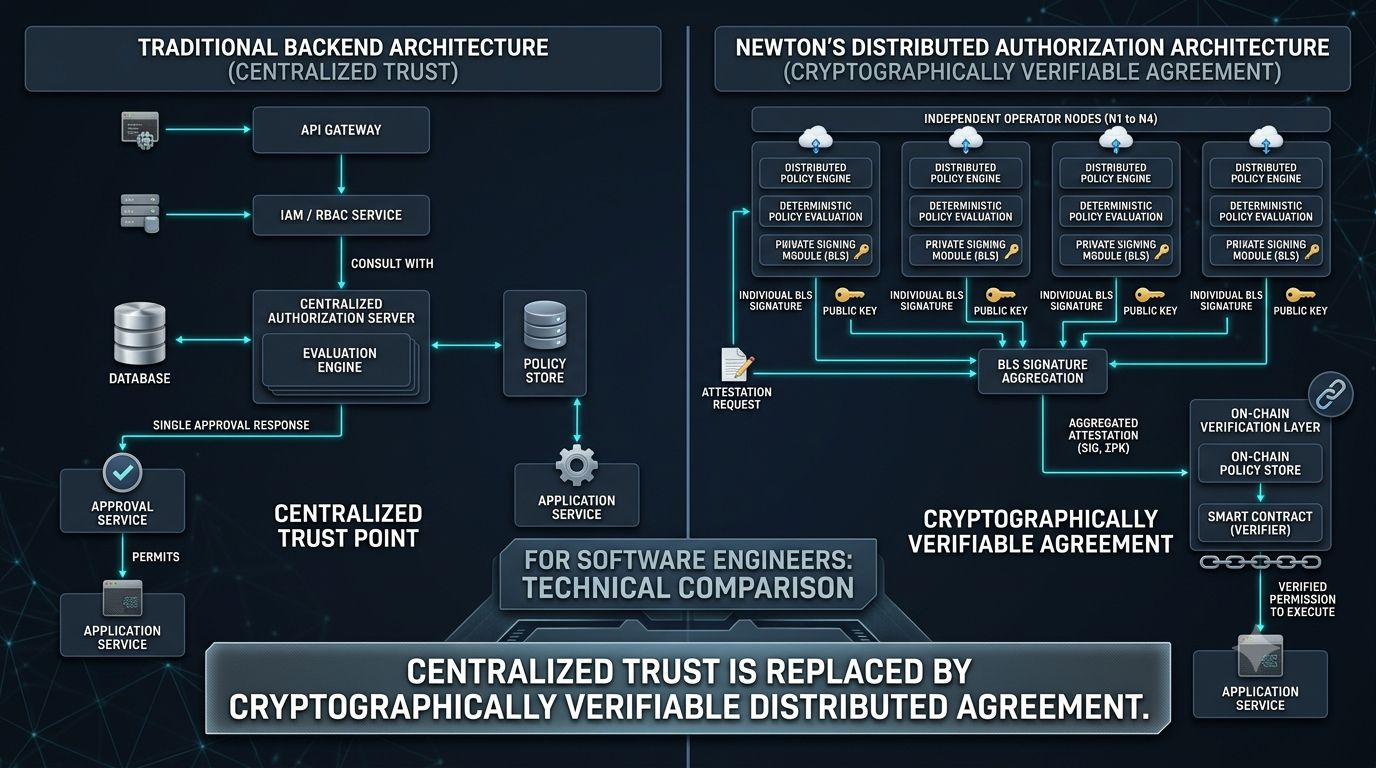
This separation ensures that execution depends on cryptographic proof of distributed agreement instead of trusting a single offchain response.
A Backend Analogy
Backend engineers can think of a BLS attestation as something similar to requiring multiple independent approval services before an API request is accepted.
In a traditional microservice environment, several approval systems might each sign off before a deployment proceeds. Newton follows a related architectural principle, except the approvals are represented as cryptographic signatures that are combined into one compact attestation suitable for blockchain verification.
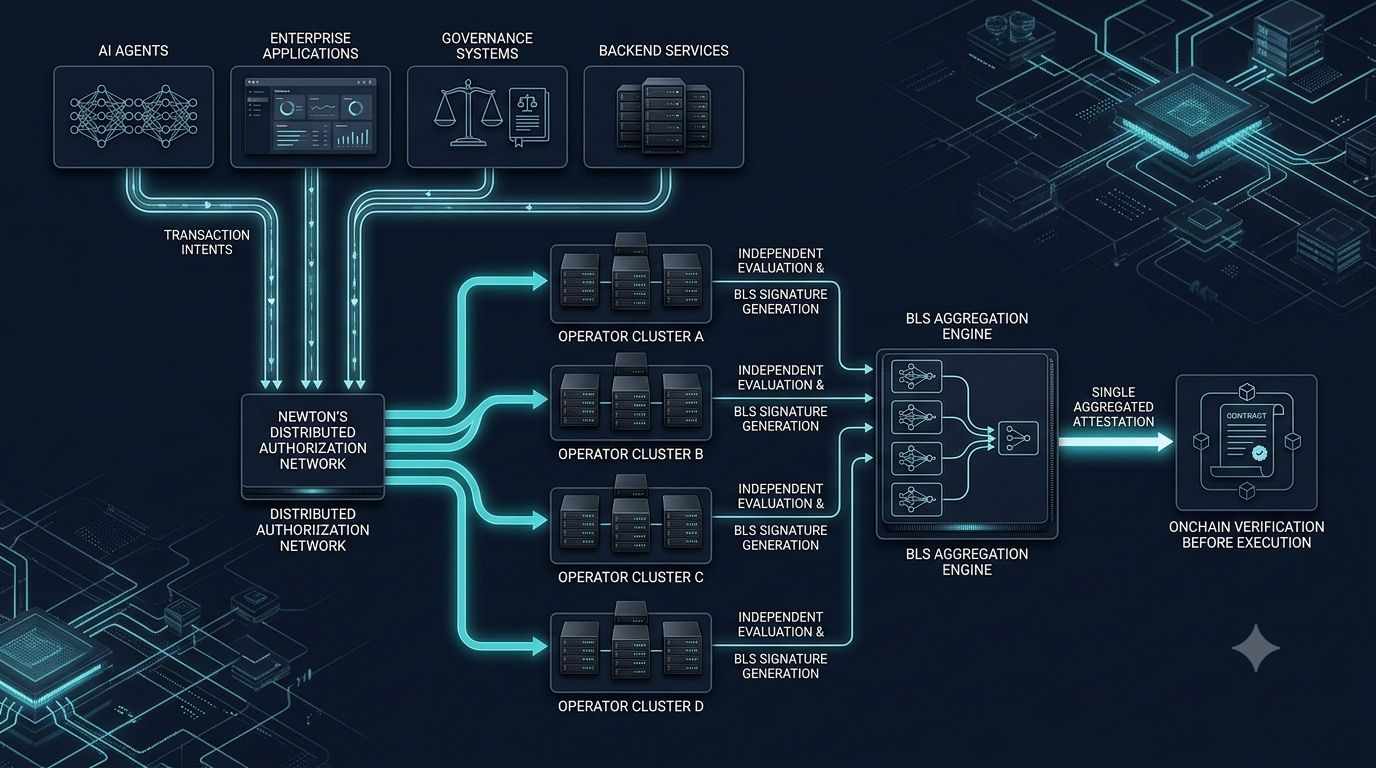
The comparison has limits. Enterprise approval systems usually rely on organizational trust, whereas Newton's verification depends on cryptographic validation of aggregated operator signatures rather than trusting individual infrastructure providers.
Why This Matters
For developers, BLS attestations provide a verifiable bridge between offchain policy evaluation and onchain execution.
For AI agents, they allow automated actions to be backed by distributed cryptographic agreement rather than a centralized authorization server.
Enterprise systems benefit because authorization outcomes become independently verifiable, while auditors can inspect immutable compliance receipts recorded by the protocol. The documentation also explains that policy evaluations are deterministic, making them replayable for verification and challenge when necessary.
Independent Architectural Analysis
The documented design highlights several engineering advantages.
Aggregating signatures into a single attestation reduces the need for smart contracts to process numerous individual approvals while preserving evidence of distributed agreement. The protocol also requires a configurable quorum of staked operators before a valid attestation can be produced, preventing a single operator or a coalition below the quorum threshold from authorizing transactions on its own.
By combining deterministic policy evaluation with aggregated cryptographic attestations, Newton cleanly separates evaluation, agreement, and execution into distinct architectural responsibilities.
Conclusion
BLS attestations illustrate an important principle in Newton's architecture: authorization should be verifiable, not merely asserted. Instead of asking smart contracts to trust an external service, the protocol supplies cryptographic proof that a qualified operator quorum agreed on the authorization result before execution.
Paid Partnership Notice: This technical analysis is part of the Newton CreatorPad campaign and is intended solely for educational discussion.
Discussion Question: As decentralized applications incorporate more offchain policy evaluation, should cryptographic attestations become the standard mechanism for proving authorization decisions before smart contract execution?