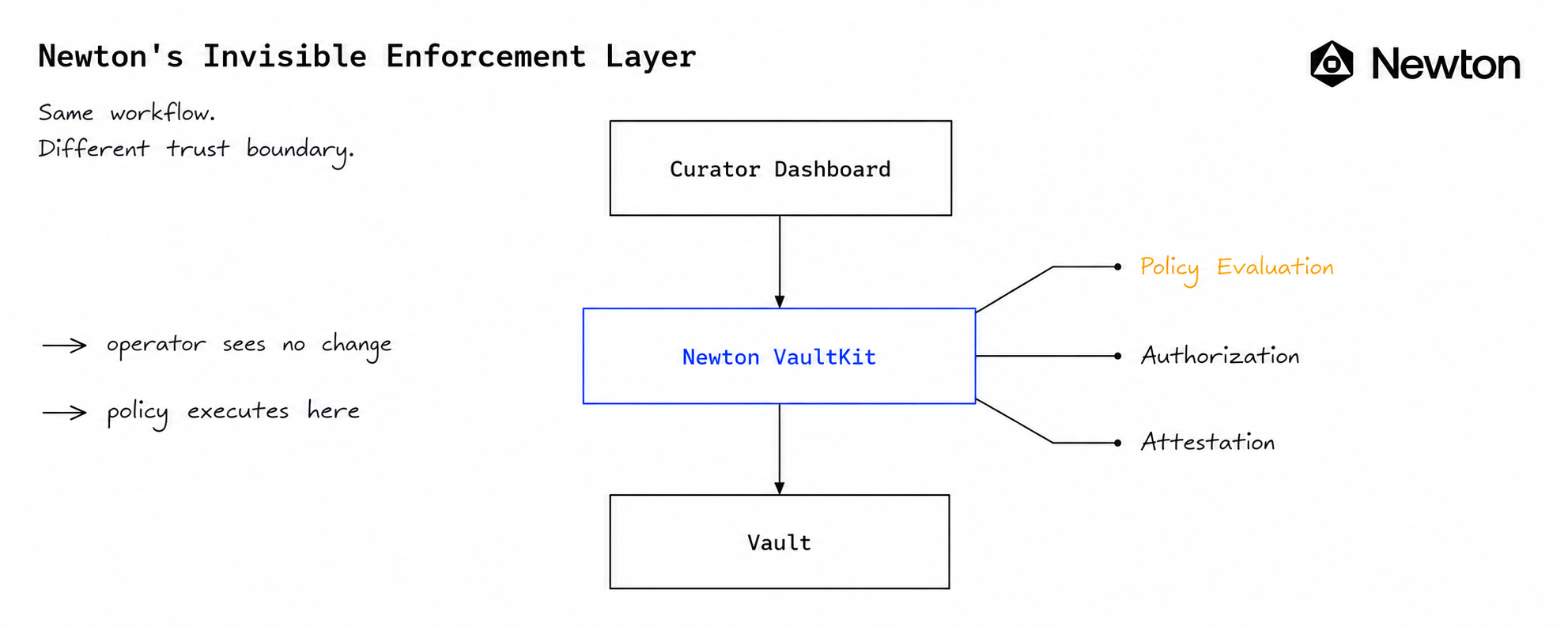

The curator's dashboard didn't change.
That was the part I couldn't stop coming back to.
I was tracing how VaultKit fits into an existing vault workflow. I expected policy enforcement to announce itself somehow. Another approval screen. A different workflow. Something that made it obvious another system now sat between the curator and the vault.
I couldn't find it.
The dashboard stayed the same.
The workflow stayed the same.
I went back through the integration again because I assumed I'd missed where the policy became visible.
I hadn't.
That surprised me more than it should have.
I'd always assumed good compliance was supposed to leave fingerprints.
Not because friction is desirable.
Because friction reminds operators that a boundary exists.
VaultKit seems to begin from a different assumption.
Maybe the strongest policy isn't the one operators constantly notice.
Maybe it's the one they almost forget is there because it quietly refuses anything outside its rules.
At first I thought that was simply better product design.
The more I reread the flow, the less complete that explanation felt.
Convenience didn't seem important enough to justify the architecture.
I kept wondering what Newton's engineers were actually optimizing for.
Eventually I stopped thinking about interfaces.
I started thinking about trust.
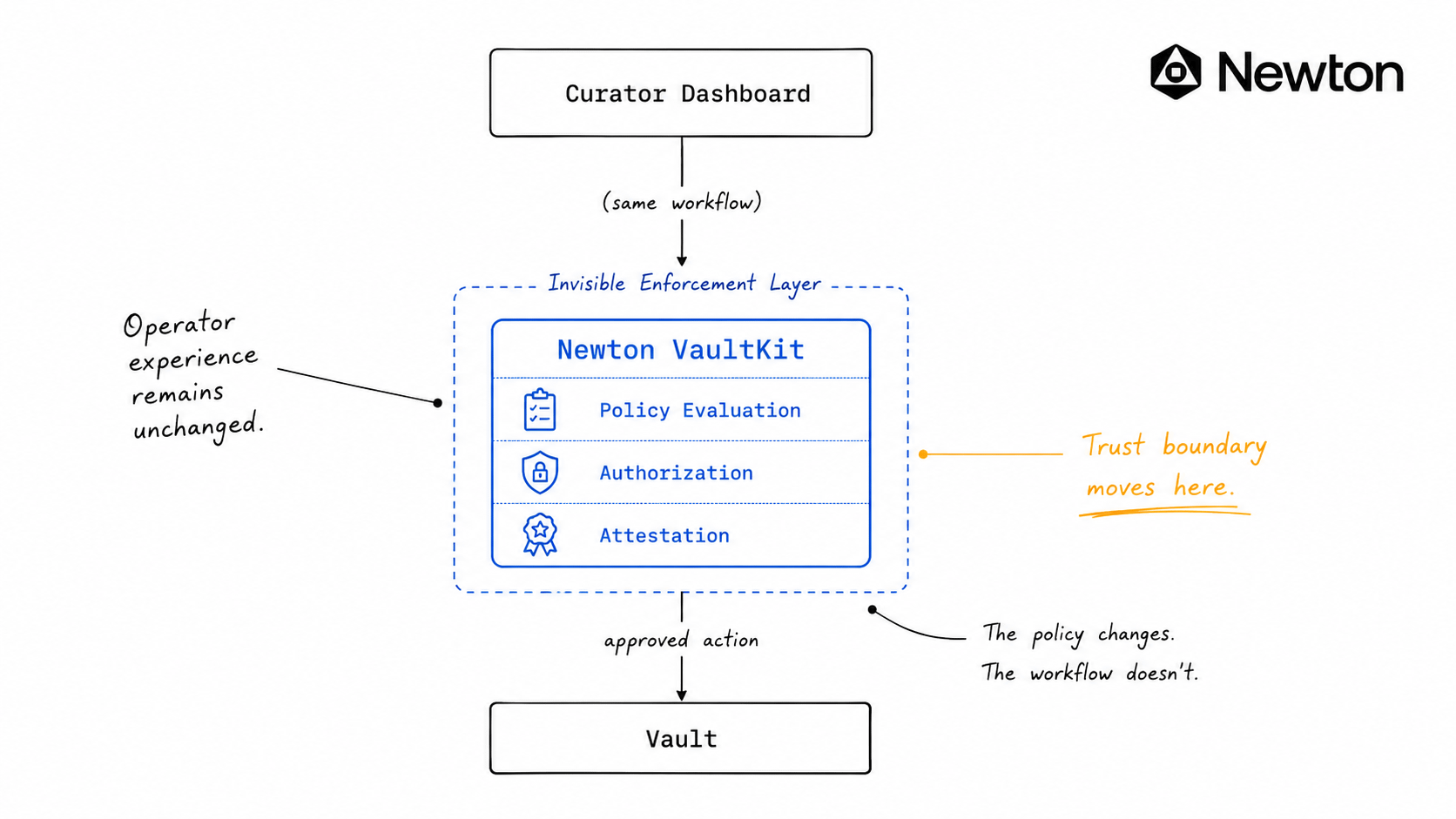
If enforcement disappears into infrastructure, operators don't have to change how they work.
The policy changes.
The workflow doesn't.
That feels deliberate.
But it also creates a question I couldn't shake.
If enforcement becomes almost invisible, where does policy understanding live?
The protocol never forgets the policy.
The operator might.
Not because anyone becomes careless.
Because reliable infrastructure has a habit of disappearing from conscious thought.
That's usually a sign of good engineering.
I'm just not convinced it's the whole story.
Institutional systems don't only depend on correct enforcement.
They also depend on operators who still understand the boundaries they're operating inside.
Those aren't the same engineering problem.
One can be solved in code.
The other has to survive routine.
I kept wondering whether Newton's engineers accepted that trade-off deliberately...
or whether it's simply the cost of making enforcement almost invisible during normal operations.
I still haven't settled on that.
The first real test probably won't happen while every policy quietly approves every action.
It'll happen months later.
One ordinary transaction.
One unexpected rejection.
The protocol will know exactly why it refused.
I'm still watching to see whether the operator understands that answer just as clearly.
$NEWT only becomes interesting to me if invisible enforcement scales without gradually making policy understanding disappear alongside it.
Those feel like two separate engineering problems.
I'm watching to see whether production treats them that way too.