
During my sista yesterday when checking thoroughly at the @NewtonProtocol Whitepaper, what struck my attention was how Newton combines Attestation, a Challenge Window, Rego policy execution, Zero-Knowledge Proofs (ZKPs), and EigenLayer slashing into a single verification pipeline. Instead of asking
users to simply trust operators, every attestation stays challengeable until finality. That changes the security model in a meaningful way. Verification doesn't stop when an operator signs a result. It remains open to independent verification by anyone willing to reproduce the computation. If a challenger executes the same deterministic Rego policy inside a zkVM and generates a valid proof that produces a different outcome, the protocol can verify that proof on-chain. A successful challenge doesn't just expose an error. It invalidates the original attestation and triggers EigenLayer slashing, creating immediate economic consequences for incorrect or dishonest execution.
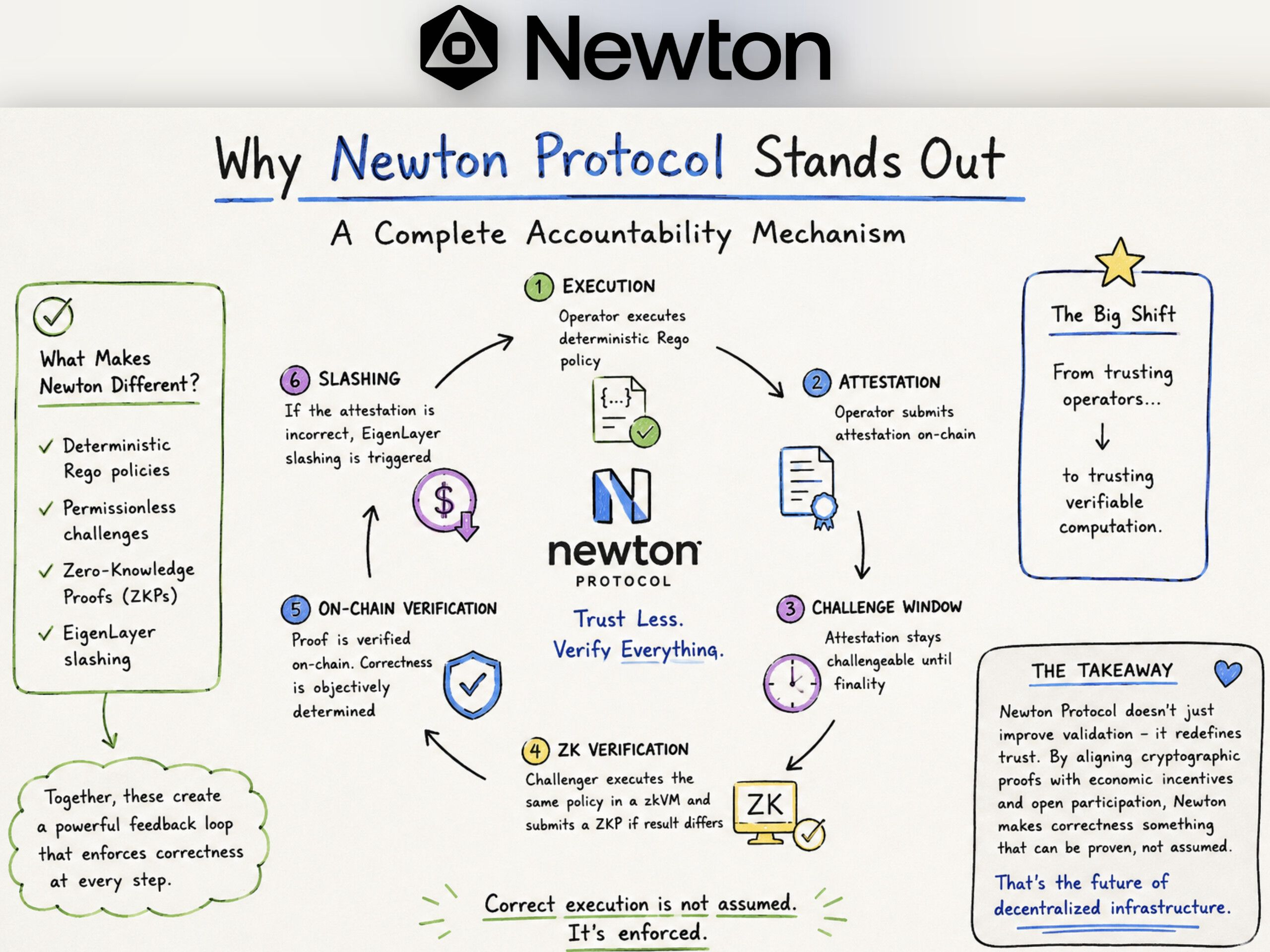
I think that's where Newton starts to separate itself from many existing validation systems. Most oracle or committee-based designs ultimately depend on a majority of participants behaving honestly. Newton shifts more of that trust away from people and toward deterministic computation, cryptographic proofs, and open participation. The network doesn't have to debate whether an execution was correct if anyone can reproduce it and prove the result.another detail I appreciate is how these components reinforce one another. Deterministic Rego policies ensure identical inputs should always produce identical outputs. The challenge window gives the network time to dispute incorrect attestations before they become final. zkVMs allow challengers to prove they executed the policy correctly without requiring every node to rerun the computation. EigenLayer slashing
then provides the economic incentive that discourages inaccurate attestations in the first place.
Viewed together, this feels less like a collection of independent security features and more like a complete accountability mechanism. Every stage feeds into the next: execution produces an attestation, the attestation can be challenged, the challenge is resolved through cryptographic verification, and incorrect behavior carries an immediate financial penalty. What I find most interesting isn't the use of ZKPs by themselves. Plenty of protocols are exploring zero-knowledge technology today. The interesting part is how Newton connects deterministic execution, permissionless challenges, on-chain verification, and EigenLayer slashing into a single feedback loop where correctness is continuously enforceable rather than merely assumed.
Ultimately, Newton isn't just adding another security mechanism to blockchain infrastructure. It's redefining
how trust can be established in decentralized systems. By combining deterministic policy execution, permissionless challenges,
cryptographic proofs, and economic accountability into a unified verification pipeline, the protocol moves trust away from assumptions about honest actors and toward verifiable correctness. If this model proves itself at scale, it could influence how future decentralized infrastructure is designed—not by eliminating trust altogether, but by making trust something that can be continuously verified rather than blindly granted. To me, that's one of the most compelling directions blockchain infrastructure can take, and it's what makes Newton Protocol a project worth paying close attention to.
@NewtonProtocol , #NEWT , $NEWT
