

I’ve caught myself doing something lately that I didn’t use to do. Instead of reading the loudest takes first, I open an explorer. Not because explorers are exciting, but because they’re honest in the most boring way possible. Narratives can be shaped. Threads can be boosted. But blocks don’t care what people are arguing about. They just keep arriving—on time or not. And when a chain is supposed to be about settlement, that simple rhythm tells you more than any announcement ever will.
That’s the frame I keep returning to with Plasma.
A while back, it was easy to talk about Plasma as “good design.” A stablecoin-first Layer 1, EVM compatible, built to make high-volume, low-cost stablecoin payments feel like normal payment flows instead of crypto rituals. That still describes it. But the shift I’m watching now isn’t in the pitch. It’s in the way the outside world is starting to meet Plasma where it is—through actual settlement surfaces, integration lists, and tooling that makes the chain feel less like an idea and more like a route money could realistically take.
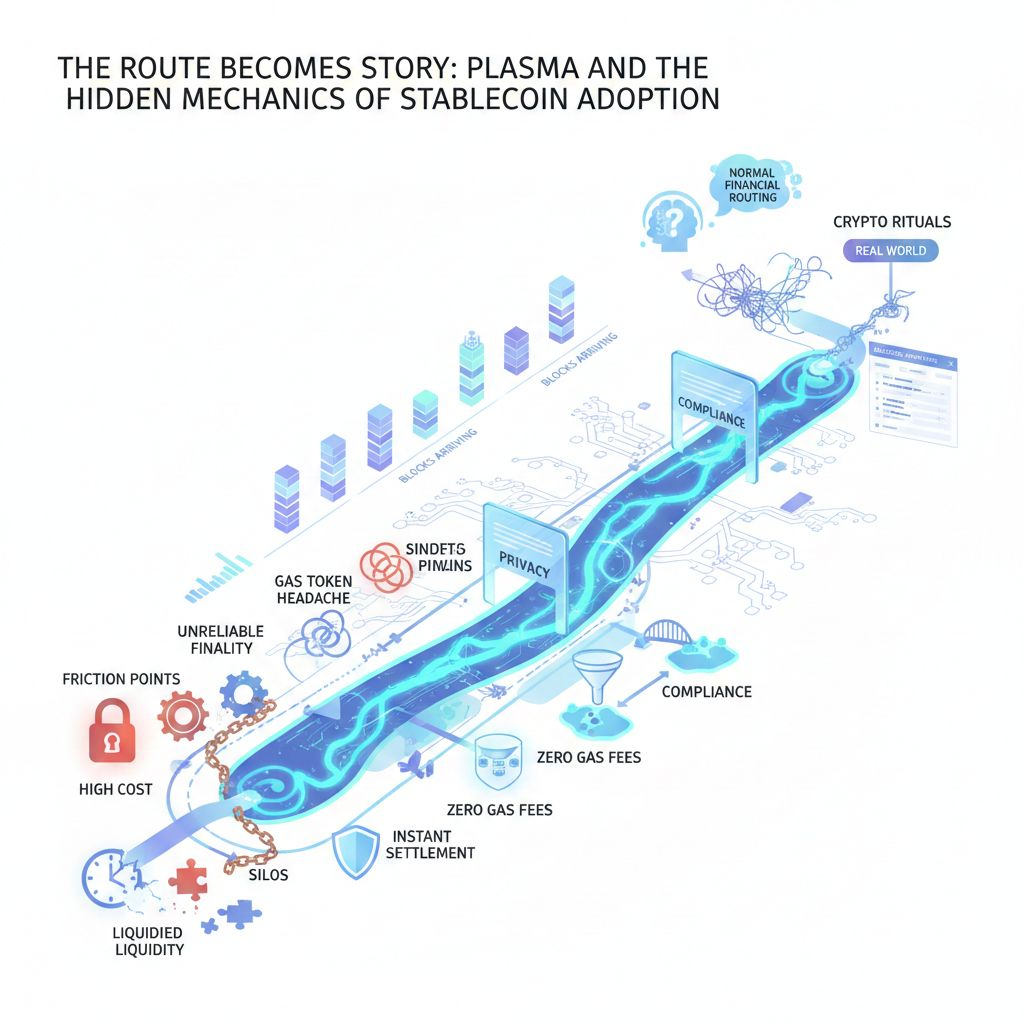
In payments, the thing that matters is rarely the thing people celebrate. The real work happens in the friction points: the cost of moving value, the reliability of finality, the operational headache of users needing a gas token, the messy reality of liquidity living on the “wrong” chain, the uncomfortable privacy tradeoffs businesses can’t ignore, and the compliance expectations that don’t disappear just because it’s on-chain. Most chains can claim they “support stablecoins.” Far fewer chains behave as if stablecoins are the actual product.
Plasma’s docs are blunt about what they’re building: a stablecoin settlement environment that’s optimized for throughput and cost, but also for how stablecoins behave in the real world—where people want to move dollars without thinking about chain mechanics. That’s why the design decisions are not just about speed. They’re about making the workflow disappear. The problem Plasma seems to be solving is not “how do we move tokens faster?” It’s “how do we make stablecoin settlement feel like it belongs in normal financial routing?”
The quickest way to see whether that’s real is to watch what chains usually get wrong.
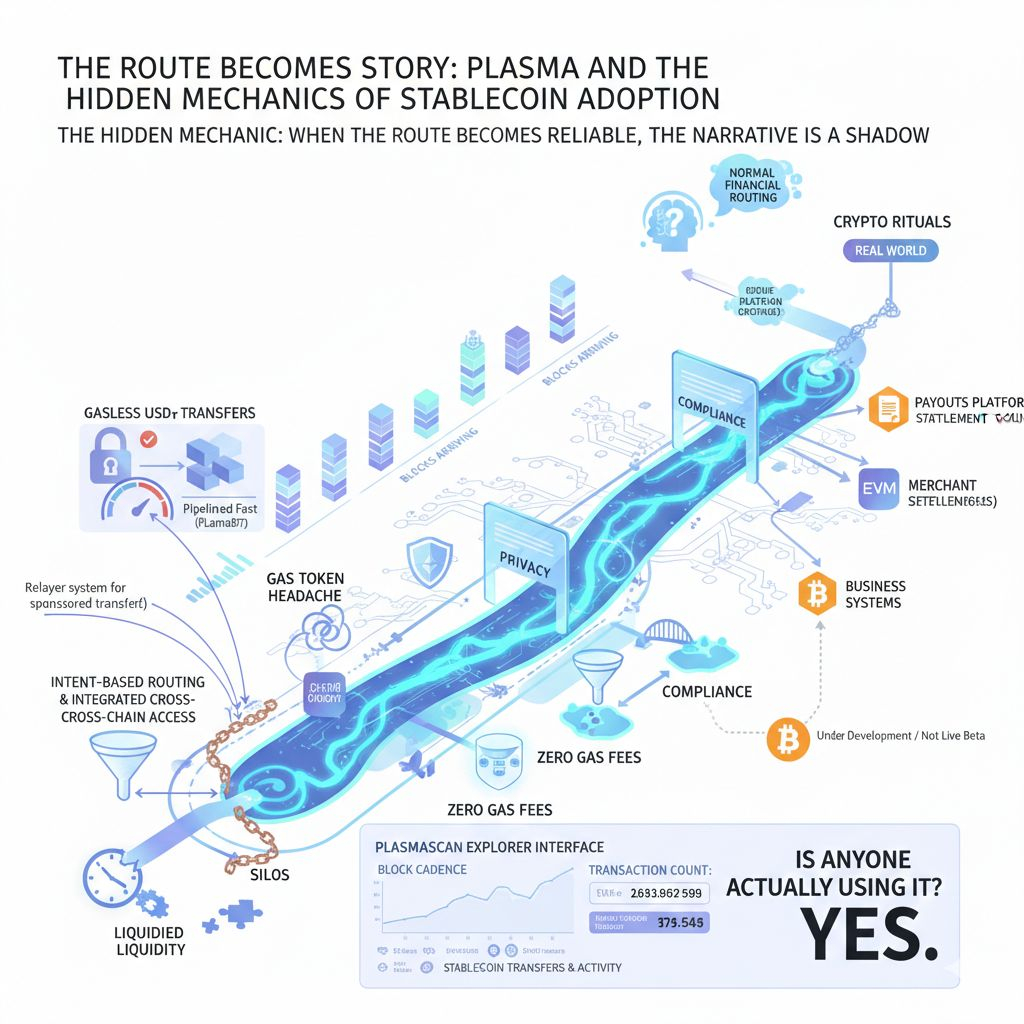
The first obvious failure mode is gas. You can’t call something a payment flow if the user has the money but can’t send it because they don’t have the right token for fees. Plasma documents a model for gasless USD₮ transfers using a relayer system that sponsors direct stablecoin transfers under controlled conditions—verification, rate limits, and abuse protections. It’s not magic and it’s not charity. It’s an attempt to turn “gas” into an infrastructure detail rather than a user-facing requirement. That sounds small until you’ve watched real users bounce off a product because their balance is technically there but practically unusable.
Right next to that is the idea of letting fees be paid in assets people already hold—stablecoins or BTC—through custom gas token mechanics. Again, this isn’t about winning points with builders. It’s about matching how payments actually work. In the real world, you don’t need a second currency to move your dollars. So Plasma is pushing the idea that stablecoin settlement should not force a second currency as a constant dependency.
Then there’s the liquidity problem, which is where “stablecoin adoption” usually becomes a maze. The user wants to send stablecoins. The recipient expects them somewhere else. The app has to bridge, route, swap, and sometimes fail mid-way. Plasma’s path here is to reduce that friction through intent-based routing and integrated cross-chain access, so liquidity movement can be abstracted behind a simpler action. If the chain is going to be a settlement route, it can’t just be fast when everything is already on the right network. It has to be reachable when it isn’t.
And this is where the story gets interesting, because what makes Plasma feel like it’s changing phase is the way these design choices are starting to show up through real integration narratives rather than purely internal documentation.
A payouts platform naming Plasma as part of its strategic integration path going into 2026 is a real-world anchor. Not because integrations are trophies, but because payout operators are the opposite of romantic. They care about reliability, support overhead, and compliance constraints. If Plasma can sit under a payouts product as a stablecoin settlement rail while keeping orchestration and controls intact, that matters more than most crypto marketing ever will. It suggests Plasma is being treated as a routing option—something that can be selected when it fits the flow.
Merchant-facing settlement tooling listing Plasma alongside major networks is a similar signal. This is not about Plasma being the only choice. It’s about Plasma being present as a choice inside products that need to behave predictably. A merchant settlement product can’t afford “interesting chaos.” It needs a rail that works and keeps working. Inclusion in that routing surface changes perception: it places Plasma closer to infrastructure than experimentation.
Underneath all of this is the technical backbone Plasma is leaning on to make settlement feel dependable. PlasmaBFT, described as a pipelined variant of Fast HotStuff, is positioned to deliver low-latency finality and higher throughput by overlapping consensus phases. The details matter because payments aren’t just about speed; they’re about finality you can trust operationally. If a chain is meant to settle stablecoins at scale, finality can’t be a philosophical claim. It has to be something you can build around.
On execution, Plasma is anchoring itself in EVM familiarity through Reth, emphasizing compatibility with Ethereum-like behavior so existing tooling and contracts can transfer without the weird edge cases that break production systems. That’s another quiet choice that points toward “route” thinking: keep the execution environment predictable so integrators don’t have to rewrite the world.
Plasma also documents a native Bitcoin bridge concept and a BTC-backed asset model, but importantly, the documentation is clear that the bridge work is under development and not live at mainnet beta. That honesty matters because it keeps the narrative grounded. The current “route” story isn’t hanging on future promises. It’s being built on what can be integrated and used now: stablecoin settlement mechanics, EVM accessibility, and the growing external surfaces that treat Plasma as a real rail.
And then there’s the part that feels almost too simple, but I keep coming back to it anyway: activity. Not vibes—activity. When you open Plasmascan, you see the chain moving. You see block cadence around a second. You see transaction counts that are hard to dismiss. You see stablecoin transfers and address activity that tells you this isn’t a dead showroom. None of that automatically proves “real commerce,” but it does remove the easiest doubt people throw at new payment networks: “Is anyone actually using it?”
This is where I think the phrase “stablecoin adoption” often misleads people. Adoption isn’t a cheering crowd. It’s a routing decision repeated enough times that it becomes invisible. The internet didn’t win because people loved TCP/IP. It won because it became the default path data took. Stablecoins won’t go mainstream because people become fans of settlement infrastructure. They’ll go mainstream because the settlement path becomes normal.
That’s why Plasma’s current direction matters. It’s less about building another chain people can talk about, and more about building a chain that can be used without becoming the subject. That’s the hidden mechanic: when the route becomes reliable, the narrative stops being the driver and starts being the shadow.
And honestly, that’s the part that keeps my attention. Not the hype cycle. Not the threads. The quiet stacking effect—payout rails acknowledging it, settlement platforms listing it, intent-based routing smoothing access, chain-level decisions trying to remove the dumbest friction in stablecoin UX, and an explorer that shows the chain isn’t just waiting for attention.
Because the real shift is rarely the day everyone notices. The real shift is when you look back and realize the route was already there—working, boring, dependable—while everyone else was still arguing about the story.


