

When I first started reading Dusk, I expected the familiar arc. Privacy tech up front, some consensus innovation underneath, and eventually a pitch about how this unlocks the next wave of DeFi primitives. That arc never really showed up. The deeper I went, the clearer it became that Dusk wasn’t trying to win the DeFi arms race at all. And that absence feels intentional.
Most chains design for optionality. They want to be everything at once: trading venue, liquidity hub, NFT layer, governance playground. Dusk goes the opposite direction. It narrows the surface area and builds for environments where optional behavior is actually a liability. That decision makes the protocol look quieter on the outside, but structurally stronger where it matters.
DeFi thrives on visibility. Positions are public. Strategies can be reverse-engineered. Liquidations are observable events. That transparency fuels composability, but it also creates fragility. The moment volatility spikes, incentives collide. Fees jump. Execution degrades. Systems optimized for experimentation suddenly become unpredictable. That’s acceptable for speculation. It’s unacceptable for regulated activity.
Dusk seems to have noticed that early. Instead of asking how to maximize composability, it asks how to minimize exposure without losing verifiability. That single shift ripples through everything else. Execution is designed to be provable without being legible. State transitions matter more than how they are achieved. Correctness beats expressiveness.
This has an interesting consequence. On Dusk, complexity lives inside proofs rather than on the surface. Applications don’t compete for attention through visible mechanics. They compete on reliability. If a contract does its job quietly and predictably, that’s success. There’s no incentive to make behavior observable for signaling purposes.
That’s not an accident. It’s a response to how real financial systems behave. In institutional environments, nobody wants cleverness. They want repetition. The same process, the same result, every time. Dusk’s architecture seems to internalize that expectation rather than fighting it.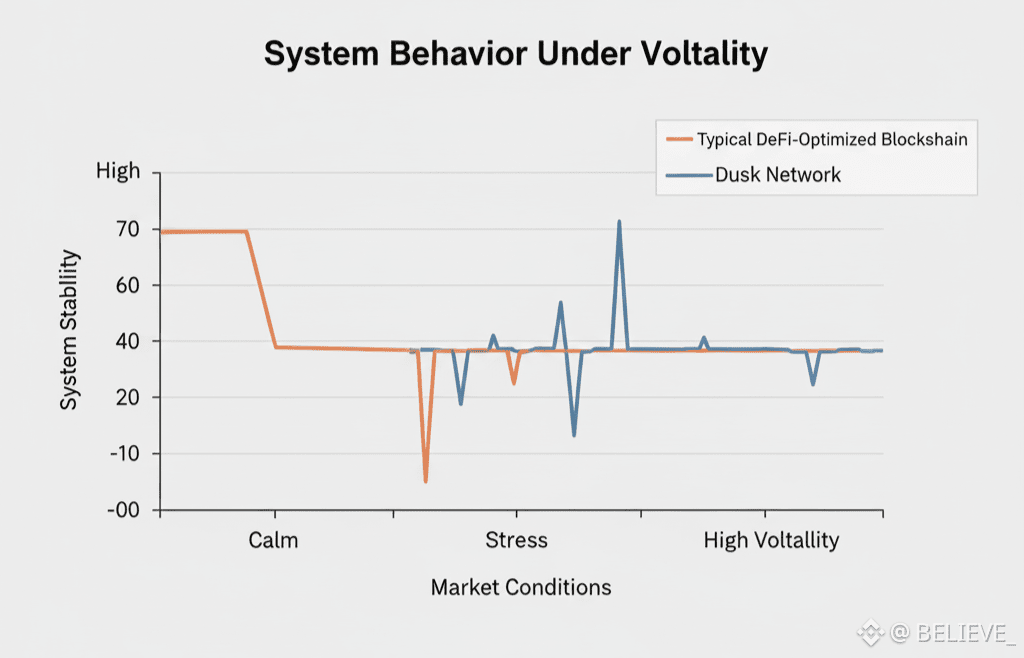
What stood out to me is how little Dusk tries to monetize unpredictability. Many protocols benefit when activity becomes chaotic. Volatility drives volume. Volume drives fees. Fees justify the system. Dusk flips that logic. It treats volatility as something to be insulated against, not harvested.
This shows up most clearly in how Dusk handles confidential assets. Ownership can change. Rules can be enforced. Audits can occur. But none of this requires broadcasting sensitive details to the network. The system verifies that rules were followed, not how internal decisions were made. That distinction matters when assets represent legal obligations rather than speculative positions.
There’s a broader pattern here. Systems optimized for traders rely on constant engagement. Systems optimized for institutions rely on absence of attention. If a process works, nobody should need to think about it. Dusk feels engineered for that kind of invisibility.
That invisibility is risky. Without visible activity, narratives are harder to build. Social traction grows slower. Speculators move on quickly. But invisibility is also where trust compounds. When something works repeatedly without incident, confidence becomes habitual rather than emotional.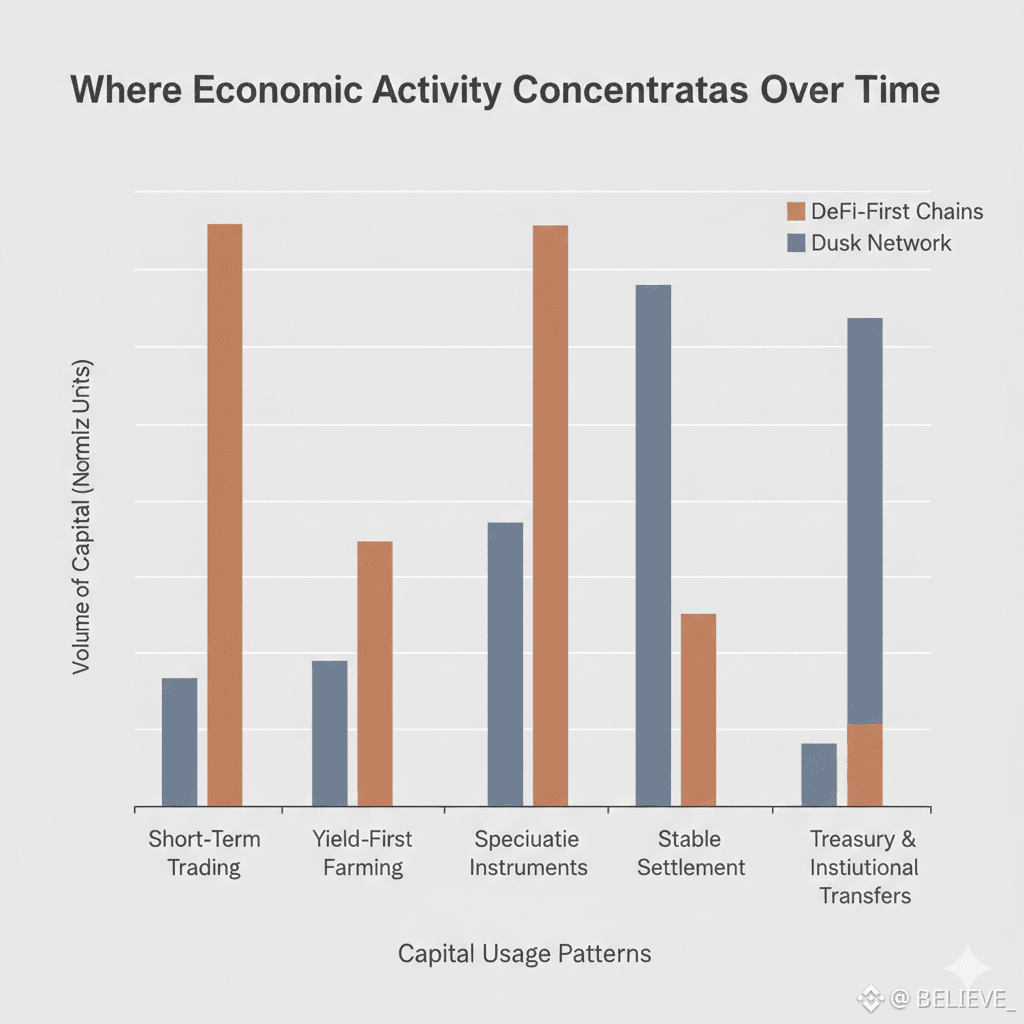
The data across markets supports this shift. Over the past few years, growth has concentrated in stablecoin settlement, treasury movement, and cross-border transfers rather than exotic financial instruments. These flows don’t care about yield. They care about predictability. A system that behaves the same during calm periods and stressed periods becomes valuable in ways charts don’t capture.
Dusk’s design aligns with that trajectory. Finality is decisive. Execution is bounded. Privacy is structural. None of these are exciting features in isolation. Together, they form a system that can sit underneath regulated workflows without constant supervision.
There’s also a subtle cultural effect. Because Dusk doesn’t reward aggressive optimization, participants are less incentivized to race each other. Infrastructure operators focus on uptime rather than strategy. Developers focus on correctness rather than cleverness. Over time, that shapes an ecosystem that feels closer to infrastructure than to a marketplace.
The DUSK token fits into this quietly. It doesn’t function as a casino chip designed to move quickly between hands. It acts more like a participation bond. It secures behavior rather than amplifying risk. That role won’t excite momentum traders, but it does matter for long-term stability.
Of course, there are tradeoffs. Narrow focus limits experimentation. Privacy complicates composability. Without visible liquidity, external developers hesitate. Dusk is not pretending these costs don’t exist. It’s choosing them deliberately.
What makes this interesting is timing. Regulatory pressure is increasing. Institutions are being pushed to demonstrate control, not creativity. In that environment, systems optimized for chaos struggle. Systems optimized for routine gain relevance.
Dusk feels like it was built for that moment before the moment fully arrived. It doesn’t market certainty loudly. It embeds it quietly. If adoption stalls, that restraint will look like a miscalculation. If adoption compounds, it will look obvious in hindsight.
The crypto space tends to reward spectacle first and durability later. Dusk is skipping the first phase. That’s uncomfortable to watch. It’s also how long-lived systems usually emerge.
If the next phase of blockchain adoption is less about discovery and more about repetition, the protocols that avoided the DeFi spotlight may end up carrying more weight than expected. Dusk doesn’t ask to be watched. It asks to be relied on.
And in infrastructure, that’s the harder position to earn.