

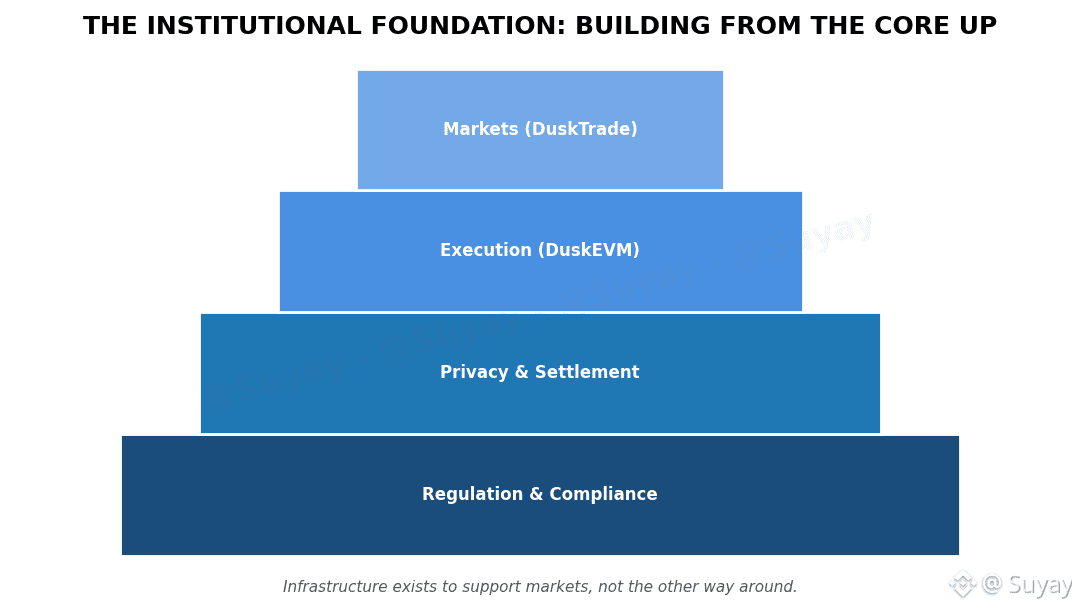
Most blockchain ecosystems grow by launching applications and hoping markets emerge around them. Finance has always evolved in the opposite direction. Markets appear only when infrastructure already exists: issuance frameworks, trading venues, settlement systems, legal integration, and operational control.
Dusk Foundation was created from this institutional perspective. Instead of competing in the race for applications, Dusk Network is being engineered as a regulated financial environment where real markets can operate on-chain.
This distinction explains why Dusk looks structurally different from most blockchains — and why its roadmap centers on infrastructure before products.
Markets are systems, not software
A financial market is not a website or a smart contract. It is a coordinated system involving issuers, brokers, trading venues, settlement layers, and regulators. Each component operates under legal and operational constraints that shape how the entire structure functions.
Most general-purpose blockchains were never designed to host such systems. They provide execution, but not market structure. Assets are generic. Transactions are public. Compliance logic lives outside the protocol.
Dusk starts where markets start: at settlement, confidentiality, and enforceable asset behavior. Its Layer 1 is designed to support regulated financial activity natively, rather than forcing institutions to rebuild their processes around open experimentation.
This is why Dusk does not frame its mission around decentralized apps. It frames it around on-chain capital markets.
The role of DuskTrade
DuskTrade represents the first concrete expression of this strategy. Built in collaboration with a regulated Dutch exchange, it is designed as a compliant trading and investment venue for tokenized securities.
This is not a marketplace built for crypto users. It is a financial platform built for issuers, operators, and professional participants. Its objective is not to showcase blockchain, but to run real financial workflows on-chain: issuance, trading, and settlement inside a regulatory framework.
DuskTrade grounds Dusk Network in real market needs. It ensures the protocol evolves around institutional requirements instead of speculative usage patterns.
It is the difference between building a product and building a market.
DuskEVM as an institutional bridge
Infrastructure alone does not create adoption. Integration matters.
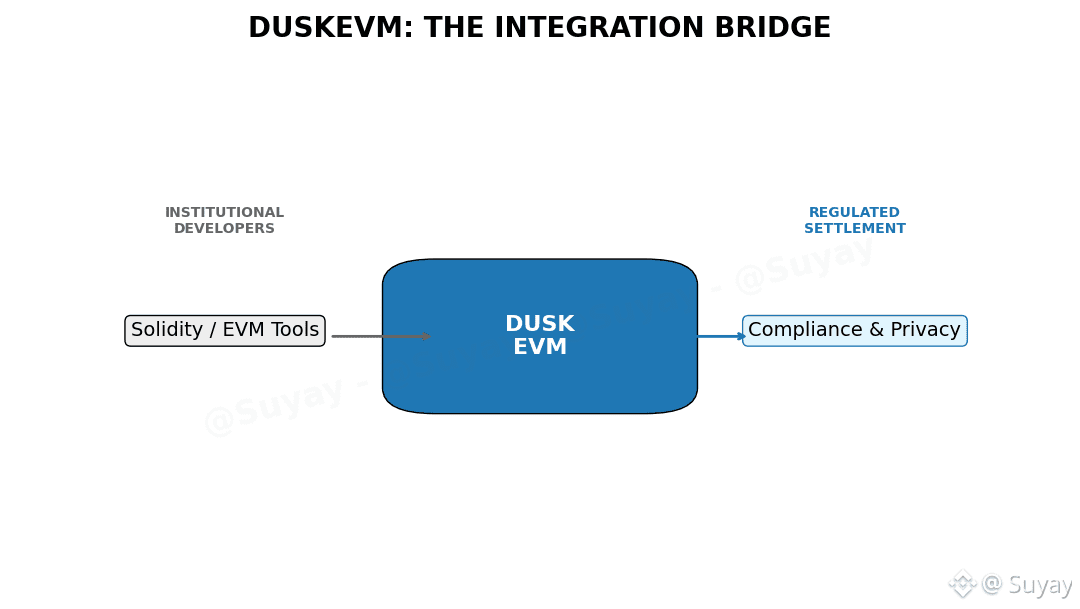
DuskEVM exists to connect financial developers and institutions to Dusk’s regulated settlement layer without forcing them to abandon existing tools. By providing Ethereum-compatible execution, it allows standard smart contracts to operate on top of an environment designed for compliant finance.
This removes one of the largest barriers to institutional blockchain deployment: incompatible development stacks.
Instead of asking markets to adapt to blockchain, Dusk adapts blockchain to the way markets already work.
DuskEVM is not a scaling feature. It is an integration layer.
Privacy designed for markets
Confidentiality is not optional in finance. Trading activity, positions, and counterparty relationships cannot exist on fully transparent ledgers.
Hedger addresses this at cryptographic level. It enables confidential transactions on DuskEVM while preserving auditability, control, and regulatory compatibility. This allows institutions to operate on-chain without exposing sensitive financial data, and regulators to retain visibility without breaking privacy.
This approach reframes privacy. It is not anonymity. It is financial-grade confidentiality.
And it is foundational to any infrastructure that claims to host real markets.
From blockchain platforms to financial environments
Together, Dusk Network, DuskEVM, Hedger, and DuskTrade form something most blockchains never attempt to build: a full financial environment.
Settlement is engineered for regulation. Execution is compatible with existing ecosystems. Privacy is structurally embedded. And real market venues are being constructed on top.
This positions Dusk not as a platform for applications, but as a base layer for financial systems.
If blockchain adoption in finance is to move beyond experimentation, it will require networks designed to host markets — not just code.
Dusk is being built for that transition.
Conclusion
The future of on-chain finance will not be defined by how many apps exist. It will be defined by which infrastructures institutions trust to run markets.
Dusk Foundation is not trying to win attention. It is engineering the conditions markets require to exist on-chain.
That is a slower strategy.
And it is the only one that scales to real finance.
