
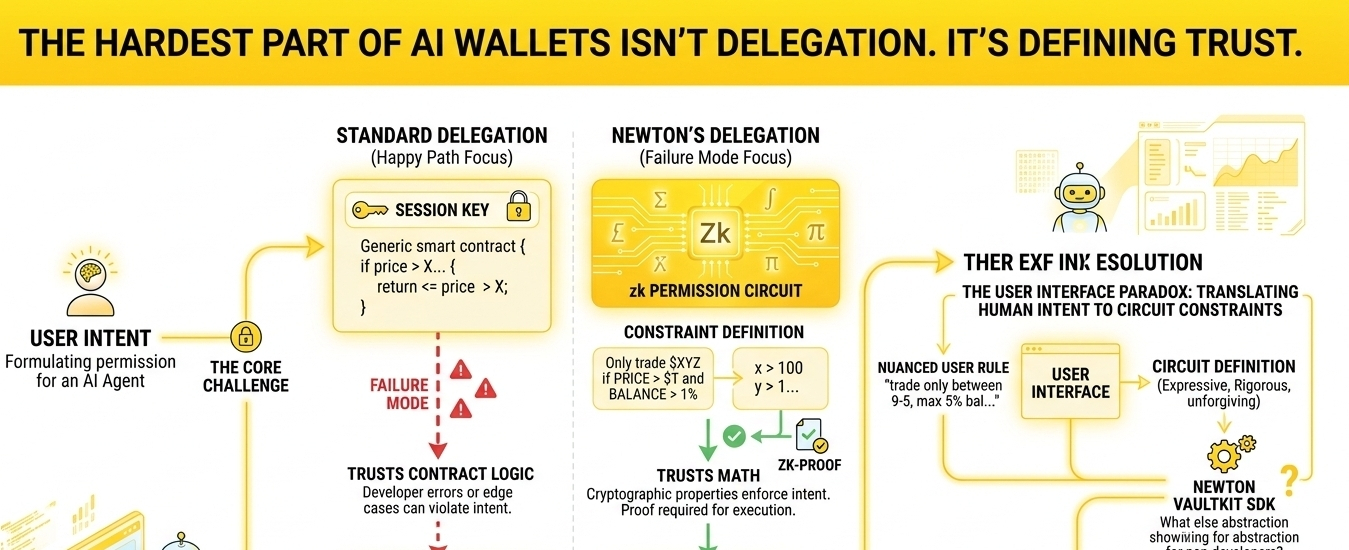

I was reading through some of the more recent Ethereum account abstraction discussions a few evenings ago, specifically around EIP-7702 shipping with the Pectra upgrade last year, and somewhere in the middle of that I found myself thinking about Newton Protocol again, not because anyone was mentioning it directly, but because a specific problem kept surfacing that Newton seems to have built around in a way I hadn't fully appreciated before. The core tension in any delegation model is deceptively simple: if you give another key permission to act on your behalf, how do you ensure it only does exactly what you intended and nothing beyond that? Most smart account implementations handle this through session keys, temporary credentials with bounded permissions attached, but the binding is typically enforced at the contract level on a single chain through whatever logic the wallet developer wrote. What Newton appears to be doing differently is embedding those boundaries inside a zero-knowledge circuit, a zkPermission, before the session key is ever issued, so the constraint isn't just a rule someone wrote in a contract somewhere, it's a cryptographic property of the key itself.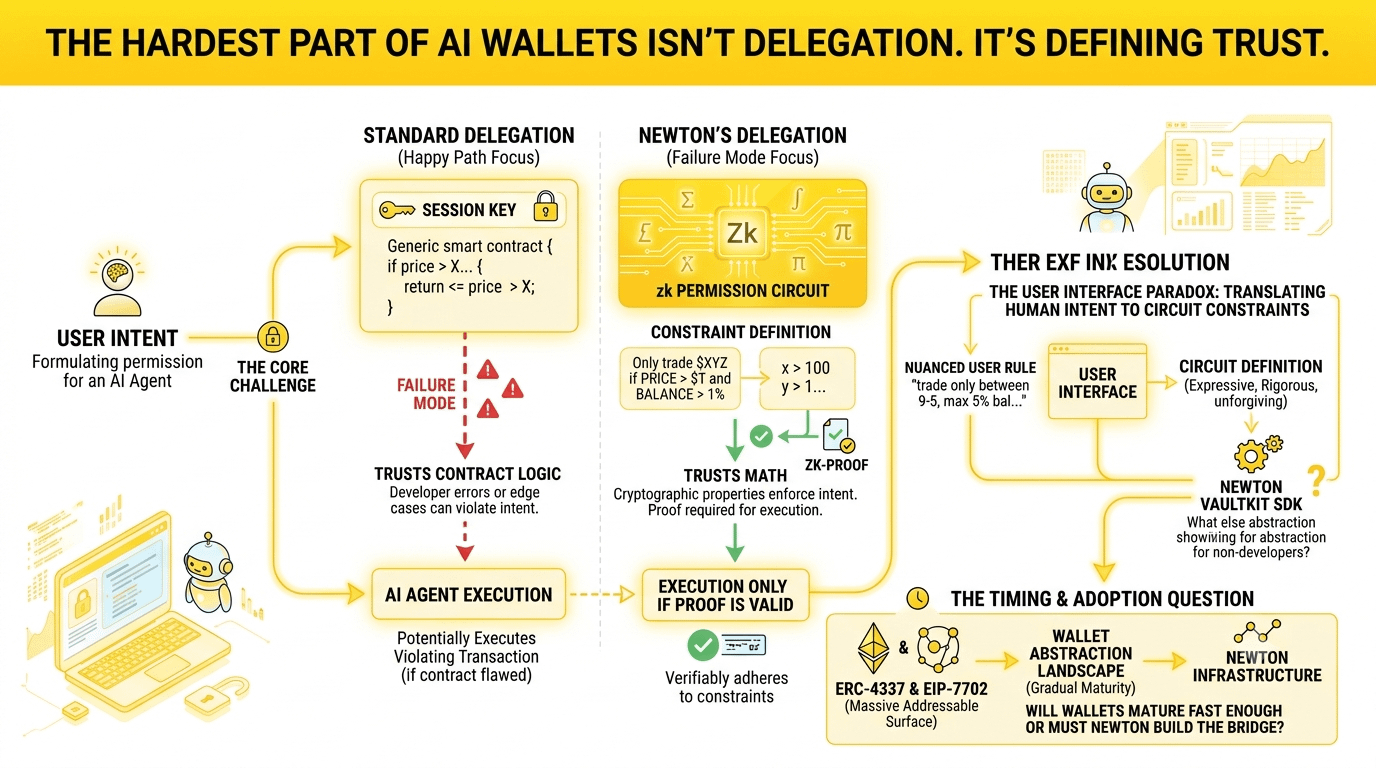
What seems interesting to me is how much that distinction matters in practice once you try to think through failure modes rather than happy paths. A standard session key approach is only as trustworthy as the implementation of the contract enforcing its scope. If the developer made an error in that logic, or if an edge case exists that wasn't anticipated when the permissions were defined, the key could potentially be used in ways that technically pass validation but violate what the user actually intended. A zkPermission circuit, by contrast, encodes the automation rule as a mathematical constraint and proves that any given action satisfies it before execution proceeds. I sometimes wonder if most people who talk about agent delegation in DeFi have really thought carefully about this distinction, because from a user trust perspective, those two models are meaningfully different, even if they look superficially similar when everything goes right. The difference shows up specifically when things go wrong or when someone is actively trying to exploit the boundaries of what an agent is allowed to do.
The part that I haven't fully resolved in my thinking is around the user experience of defining those zkPermission constraints in the first place. Zero-knowledge circuits are expressive and mathematically rigorous, but they're also notoriously unforgiving to work with at a specification level. The question that comes to mind is what actually happens when an ordinary user, not a developer, tries to express a nuanced permission like "only trade this asset if the price is above a certain threshold and only between these hours and never more than this percentage of my balance in a single transaction." Translating that kind of human intent into a circuit that captures it precisely, without accidentally being either too restrictive or too permissive, seems like a genuinely hard interface design problem that sits upstream of all the cryptographic elegance. Newton's VaultKit SDK is designed to abstract this for developers, but I'm not completely sure how far that abstraction extends toward end users who have no interest in thinking about circuit constraints.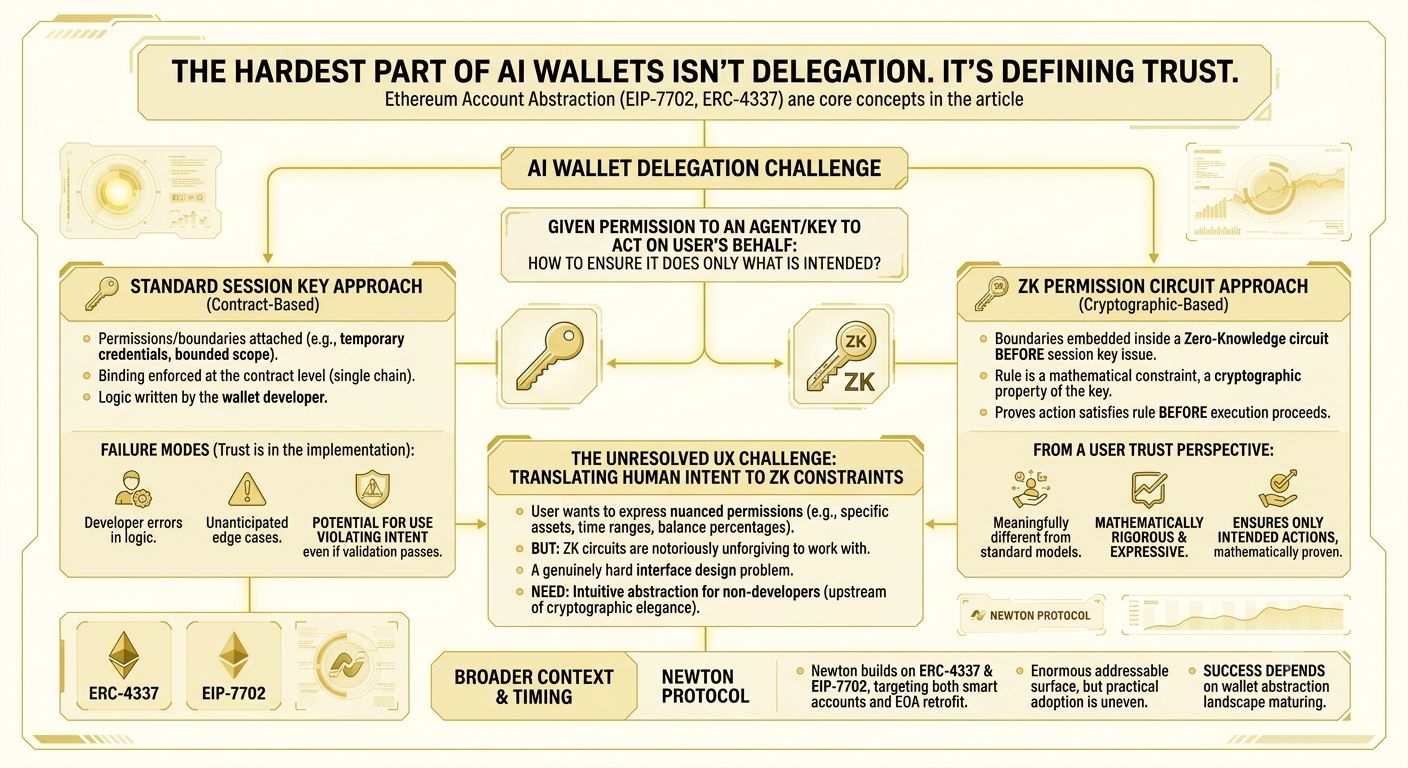
Looking from the outside, there's also a broader timing question here that I keep returning to. Newton is building on top of both ERC-4337 and EIP-7702, which together cover the landscape of both purpose-built smart accounts and the hundreds of millions of existing externally owned wallets that EIP-7702 can now retrofit with smart-account behavior without requiring migration. That's an enormous addressable surface in theory, but the practical adoption of these standards is still uneven across wallets, chains, and developer tooling. Newton's delegation and authorization model is most powerful when the wallet layer underneath it is already smart-account native, and that condition is still gradually becoming true rather than already being universally true. Whether the wallet abstraction landscape matures fast enough to meet Newton's infrastructure in the middle, or whether Newton ends up having to build more of that bridge itself, feels like one of those quiet dependencies that doesn't appear in the documentation but shapes the actual adoption trajectory more than almost anything else — anyway, time will tell💻