
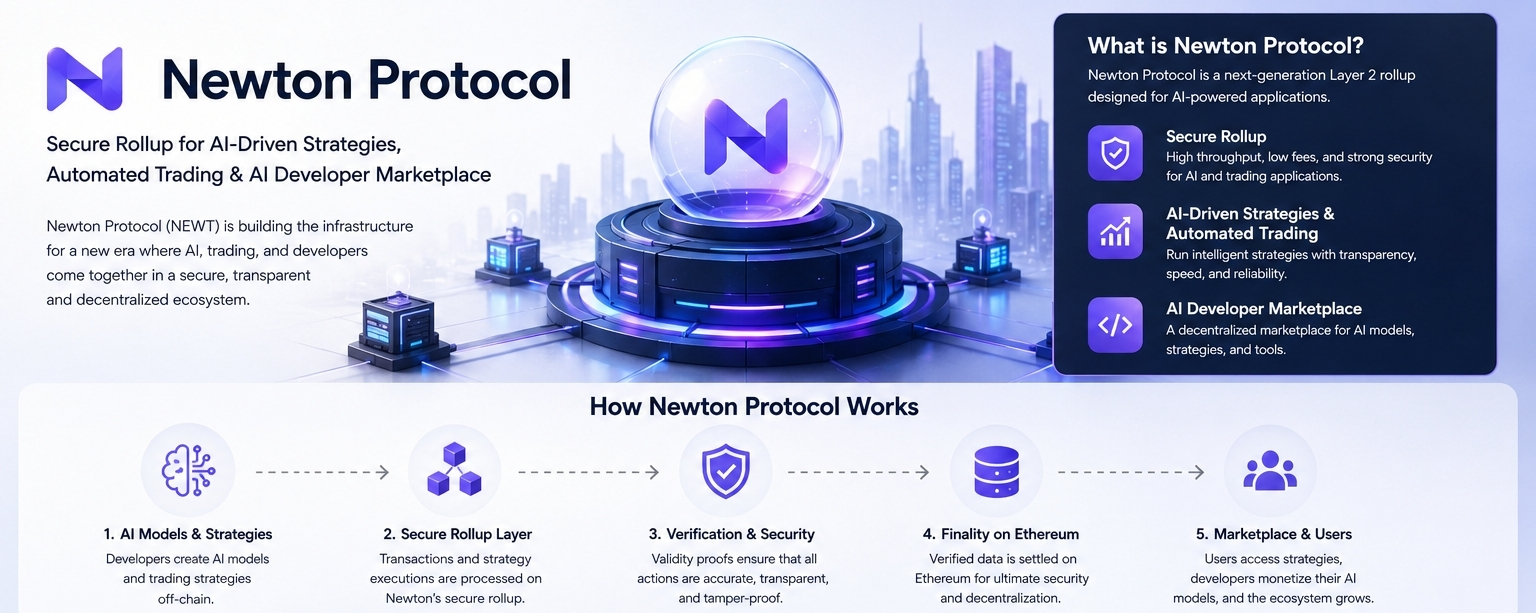
I've been following Newton Protocol for some time, and the more I watch it, the more I realize that the interesting part isn't the speed of its progress. It's the way everything seems to be developing quietly, without demanding constant attention. In a space where many projects compete to make the biggest announcement or promise the fastest growth, Newton Protocol gives me a different impression. It feels like something that is still finding its identity, allowing its ideas to mature instead of trying to prove everything immediately.
I've noticed that conversations around AI have changed a lot over the past few years. At first, most discussions were about what AI might achieve in the future. People were fascinated by possibilities, and almost every new project focused on potential rather than practical use. Recently, though, the conversation seems to have become more grounded. Instead of asking only what AI can do, people are beginning to ask how it should work, how its decisions can be trusted, and what kind of infrastructure is needed to support it. That shift feels gradual, but it also feels meaningful.
Newton Protocol appears to fit naturally into that changing mindset. Rather than treating AI as the entire story, it seems to pay equal attention to the environment where AI operates. That difference may not sound dramatic at first, but the longer I think about it, the more important it seems. Intelligent systems can become increasingly capable over time, but if the surrounding infrastructure isn't reliable, transparent, or secure, their usefulness eventually reaches a limit. Building the foundation may not attract as much attention as building the application, but foundations often determine whether something lasts.
The idea of a secure rollup is another part that has caught my attention, although not for the obvious reasons. It's easy to focus on technical terms, but I find myself thinking more about what they represent than the technology itself. As AI-driven strategies and automated trading continue to grow, the systems processing those actions become increasingly important. When decisions are made automatically, people naturally want confidence that the process remains consistent and verifiable. That confidence doesn't usually come from a single feature. It develops over time through reliability, transparency, and repeated experience.
I've also spent time thinking about the marketplace designed for AI developers. To me, this feels less like adding another feature and more like creating a place where different ideas can meet. Developers often build useful tools that remain isolated because there isn't a simple way for others to discover or integrate them. A shared marketplace has the potential to slowly change that dynamic. Instead of working independently, developers may begin contributing to a larger ecosystem where their work becomes part of something broader. Whether that happens on a large scale remains uncertain, but the possibility itself is interesting to observe.
One thing I've learned from watching blockchain projects is that communities rarely appear overnight. They grow through repeated interaction, small contributions, and shared experiences. The strongest ecosystems usually aren't created by one major event. They emerge because many individuals continue showing up, solving problems, improving ideas, and building trust over long periods of time. That's why I tend to pay attention to quieter signals rather than dramatic moments. Consistent progress often tells a more complete story than short bursts of excitement.
I've also noticed how incentives quietly shape the behavior of everyone involved. Developers want recognition for creating valuable tools. Users naturally look for systems they believe will remain dependable. Builders focus on improving performance, while participants search for opportunities that align with their interests. None of these motivations are unusual on their own, but when they begin influencing one another, they slowly create patterns that weren't visible at the beginning. Those patterns often define the direction of a project more than any roadmap ever could.
Another thought that keeps coming back to me is the relationship between automation and responsibility. As AI becomes capable of handling increasingly complex tasks, questions about oversight become more important instead of less. Automation can improve efficiency, but people still want to understand how decisions are made and whether those decisions can be trusted. That balance between independence and accountability feels like one of the biggest challenges for the next generation of blockchain infrastructure. It's not a challenge that can be solved instantly, and it probably won't be solved by technology alone.
What makes Newton Protocol interesting to me isn't that it claims to have every answer. It's that it seems to be exploring questions that many projects are only beginning to face. As AI continues becoming part of decentralized systems, the conversation naturally expands beyond performance. It starts including reliability, coordination, transparency, developer participation, and long-term sustainability. Those topics don't always generate the loudest discussions, but they often become the most important once a project begins attracting real users.
I've become more comfortable with uncertainty when looking at projects like this. Early-stage ecosystems rarely move in a straight line. Some ideas develop exactly as expected, while others change completely after real-world testing. New opportunities appear, unexpected challenges emerge, and communities adapt in ways that nobody could fully predict at the beginning. Watching those gradual adjustments tells me far more than trying to guess where everything will end.
For now, Newton Protocol feels less like a finished product and more like an evolving environment where different pieces are slowly learning to work together. The technology continues to develop, developers continue experimenting, and the broader AI landscape keeps changing alongside it. Whether those elements eventually create a lasting ecosystem is something only time will answer. Until then, the most interesting part isn't searching for certainty or expecting rapid transformation. It's simply observing how a collection of careful decisions, small improvements, changing incentives, and steady experimentation gradually shapes a system that is still writing its own story.
