
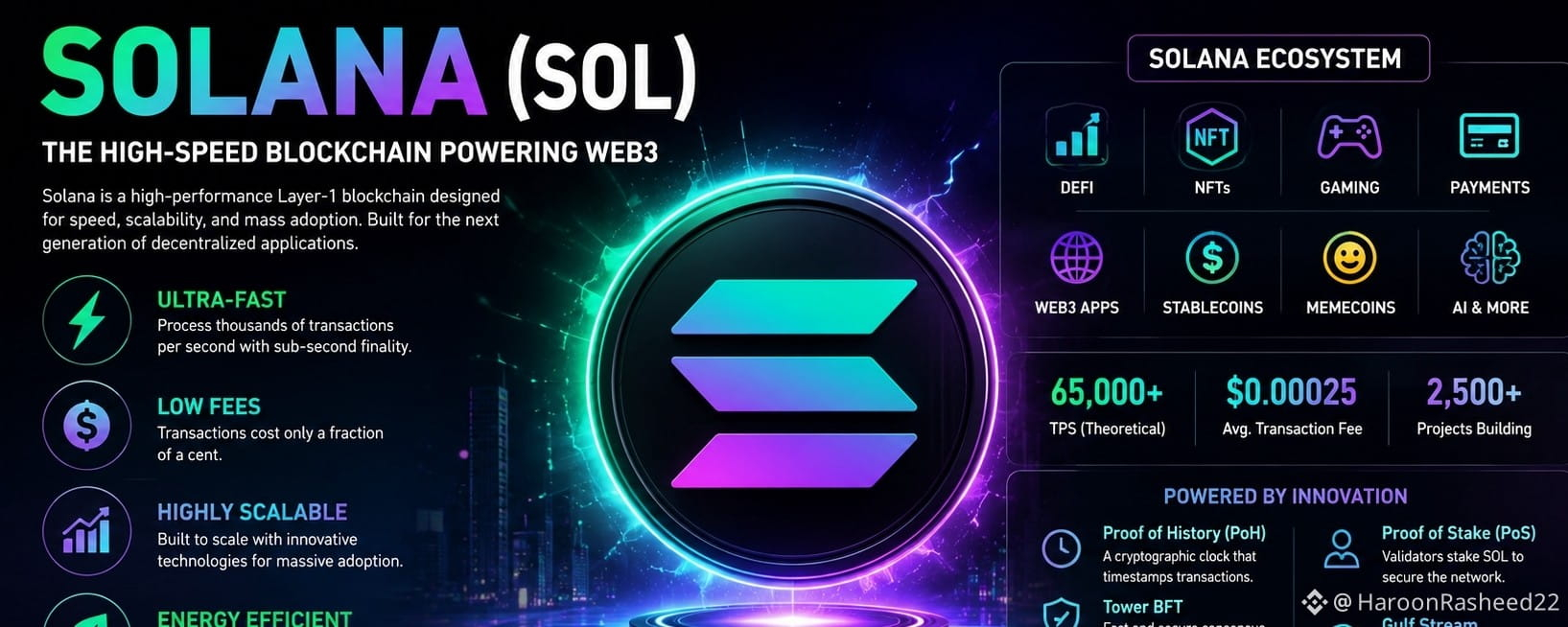
The cryptocurrency industry has evolved rapidly over the past few years, and among the many blockchain projects, Solana ($SOL ) has established itself as one of the fastest and most efficient networks in the world. Designed to solve the scalability problems faced by traditional blockchains, Solana offers lightning-fast transactions, low fees, and an ecosystem that continues to grow across decentralized finance (DeFi), NFTs, gaming, AI, and Web3 applications.
What is Solana?
Solana is a high-performance Layer-1 blockchain launched in 2020. It was created to provide developers and users with a blockchain capable of processing thousands of transactions per second while keeping transaction costs extremely low.
Unlike many blockchains that struggle with network congestion and expensive fees, Solana was built with scalability as its primary goal. This makes it an attractive platform for developers building decentralized applications (dApps).
The History of Solana
Solana was founded by Anatoly Yakovenko, a former Qualcomm engineer, who introduced a unique consensus mechanism called Proof of History (PoH). Together with Raj Gokal, he launched Solana Labs to develop a blockchain that could process transactions faster without sacrificing decentralization or security.
Since its launch, Solana has attracted thousands of developers, major investors, and millions of users worldwide.
How Solana Works
Solana combines multiple technologies to maximize performance:
- Proof of History (PoH): Creates a cryptographic clock that timestamps transactions before validation.
- Proof of Stake (PoS): Validators stake $SOL to secure the network.
- Tower BFT: A fast consensus protocol built on Proof of History.
- Gulf Stream: Reduces transaction confirmation delays.
- Sealevel: Allows smart contracts to execute in parallel, significantly increasing throughput.
Together, these innovations enable Solana to process thousands of transactions every second.
Key Features of Solana
1. Ultra-Fast Transactions
Solana can process thousands of transactions per second, making it one of the fastest public blockchains available today.
2. Extremely Low Fees
Transaction fees on Solana usually cost only a fraction of a cent, making it ideal for frequent trading, gaming, and micro-payments.
3. Scalable Infrastructure
The network is designed to handle increasing demand without major slowdowns.
4. Smart Contract Support
Developers can build decentralized applications, decentralized exchanges, NFT marketplaces, and blockchain games on Solana.
5. Energy Efficient
Thanks to Proof of Stake, Solana consumes significantly less energy than traditional Proof of Work blockchains.
The SOL Token
SOL is the native cryptocurrency of the Solana blockchain.
It is used for:
- Paying transaction fees
- Staking to secure the network
- Participating in governance (through ecosystem initiatives)
- Trading and investing
- Providing liquidity in DeFi protocols
Solana Ecosystem
The Solana ecosystem has expanded rapidly and now includes:
- Decentralized Exchanges (DEXs)
- Lending and Borrowing Platforms
- NFT Marketplaces
- Blockchain Games
- AI-powered Web3 applications
- Memecoins
- Stablecoins
- Payment solutions
Thousands of projects continue to build on Solana due to its speed and affordability.
Advantages of Solana
- Lightning-fast transaction speeds
- Very low transaction fees
- Large and active developer community
- Strong NFT ecosystem
- Rapidly growing DeFi sector
- Scalable blockchain architecture
- Eco-friendly consensus mechanism
Challenges
Despite its strengths, Solana also faces some challenges:
- Occasional network outages in the past
- Strong competition from Ethereum, BNB Chain, Sui, and Aptos
- High hardware requirements for validators
- Market volatility affecting SOL price
The Solana community continues working on upgrades to improve network stability and decentralization.
Why Investors Like Solana
Many investors view Solana as one of the most promising blockchain projects because it combines speed, scalability, and a thriving ecosystem. As more developers build decentralized applications and institutions show increasing interest in blockchain technology, Solana continues to strengthen its position in the crypto market.
Future Outlook
The future of Solana looks promising as adoption continues to grow across decentralized finance, NFTs, gaming, payments, artificial intelligence, and real-world asset tokenization. Continuous ecosystem development, increasing institutional attention, and regular network upgrades could further expand Solana's role in the global blockchain industry.
However, like all cryptocurrencies, SOL remains a volatile asset. Investors should always conduct their own research, understand the risks involved, and invest responsibly.
Conclusion
Solana has become one of the leading Layer-1 blockchain platforms by delivering exceptional speed, minimal transaction costs, and a rapidly expanding ecosystem. Whether you're a developer building Web3 applications, a trader exploring DeFi, or an investor looking at long-term blockchain innovation, Solana offers one of the most advanced infrastructures in the cryptocurrency space. As blockchain adoption accelerates worldwide, Solana is well-positioned to remain a major player in shaping the future of decentralized technology.$SOL
