
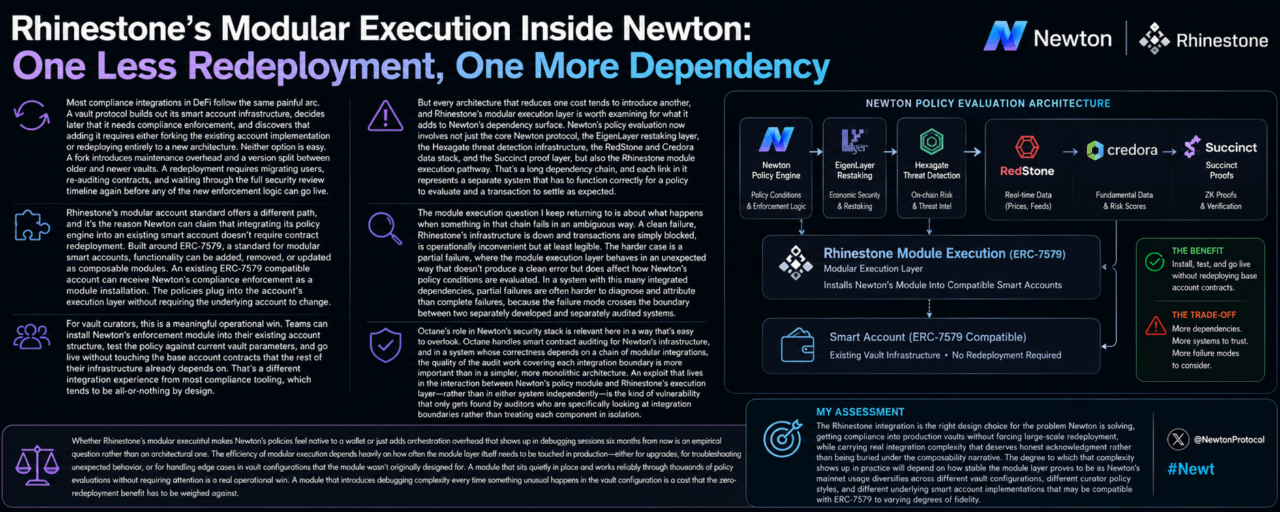
Most compliance integrations in DeFi follow the same painful arc. A vault protocol builds out its smart account infrastructure, decides later that it needs compliance enforcement, and discovers that adding it requires either forking the existing account implementation or redeploying entirely to a new architecture. Neither option is easy. A fork introduces maintenance overhead and a version split between older and newer vaults. A redeployment requires migrating users, re-auditing contracts, and waiting through the full security review timeline again before any of the new enforcement logic can go live.
Rhinestone's modular account standard offers a different path, and it's the reason Newton can claim that integrating its policy engine into an existing smart account doesn't require contract redeployment. Rhinestone's infrastructure is built around ERC-7579, a standard for modular smart accounts that allows functionality to be added, removed, or updated as composable modules rather than baked into the base account implementation. An existing smart account that's already ERC-7579 compatible can receive Newton's compliance enforcement as a module installation rather than a ground-up rebuild. The policies plug into the account's execution layer without requiring the underlying account to change.
For vault curators, this is a meaningful operational win. A team that's already running production vaults on a compatible smart account architecture doesn't have to choose between "ship compliance now and redeply everything" and "maintain the current setup and integrate compliance later after a long migration." They can install Newton's enforcement module into the existing account structure, test the policy against the current vault parameters, and go live without touching the base account contracts that the rest of their infrastructure already depends on. That's a different integration experience from most compliance tooling, which tends to be all-or-nothing by design.
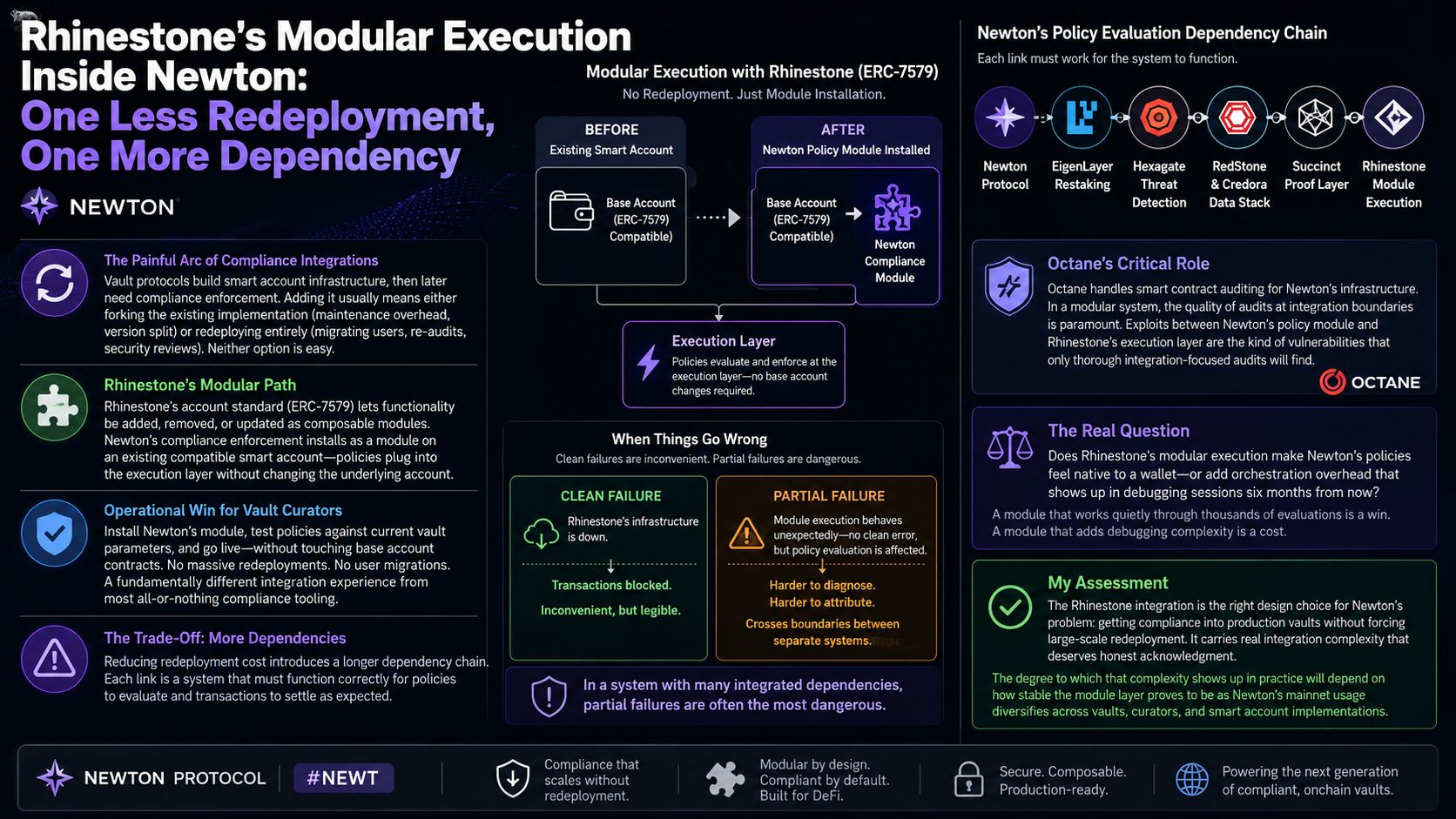
But every architecture that reduces one cost tends to introduce another, and Rhinestone's modular execution layer is worth examining for what it adds to Newton's dependency surface. Newton's policy evaluation now involves not just the core Newton protocol, the EigenLayer restaking layer, the Hexagate threat detection infrastructure, the RedStone and Credora data stack, and the Succinct proof layer, but also the Rhinestone module execution pathway. That's a long dependency chain, and each link in it represents a separate system that has to function correctly for a policy to evaluate and a transaction to settle as expected.
The module execution question I keep returning to is about what happens when something in that chain fails in an ambiguous way. A clean failure, Rhinestone's infrastructure is down and transactions are simply blocked, is operationally inconvenient but at least legible. The harder case is a partial failure, where the module execution layer behaves in an unexpected way that doesn't produce a clean error but does affect how Newton's policy conditions are evaluated. In a system with this many integrated dependencies, partial failures are often harder to diagnose and attribute than complete failures, because the failure mode crosses the boundary between two separately developed and separately audited systems.
Octane's role in Newton's security stack is relevant here in a way that's easy to overlook when reading about the more prominent integration partners. Octane handles smart contract auditing for Newton's infrastructure, and in a system whose correctness depends on a chain of modular integrations, the quality of the audit work covering each integration boundary is more important than in a simpler, more monolithic architecture. An exploit that lives in the interaction between Newton's policy module and Rhinestone's execution layer, rather than in either system independently, is the kind of vulnerability that only gets found by auditors who are specifically looking at integration boundaries rather than treating each component in isolation.
Whether Rhinestone's modular execution makes Newton's policies feel native to a wallet or just adds orchestration overhead that shows up in debugging sessions six months from now is an empirical question rather than an architectural one. The efficiency of modular execution depends heavily on how often the module layer itself needs to be touched in production, either for upgrades, for troubleshooting unexpected behavior, or for handling edge cases in vault configurations that the module wasn't originally designed for. A module that sits quietly in place and works reliably through thousands of policy evaluations without requiring attention is a real operational win. A module that introduces debugging complexity every time something unusual happens in the vault configuration is a cost that the zero-redeployment benefit has to be weighed against.
My assessment is that the Rhinestone integration is the right design choice for the problem Newton is solving, getting compliance into production vaults without forcing large-scale redeployment, while carrying real integration complexity that deserves honest acknowledgment rather than being buried under the composability narrative. The degree to which that complexity shows up in practice will depend on how stable the module layer proves to be as Newton's mainnet usage diversifies across different vault configurations, different curator policy styles, and different underlying smart account implementations that may be compatible with ERC-7579 to varying degrees of fidelity.