
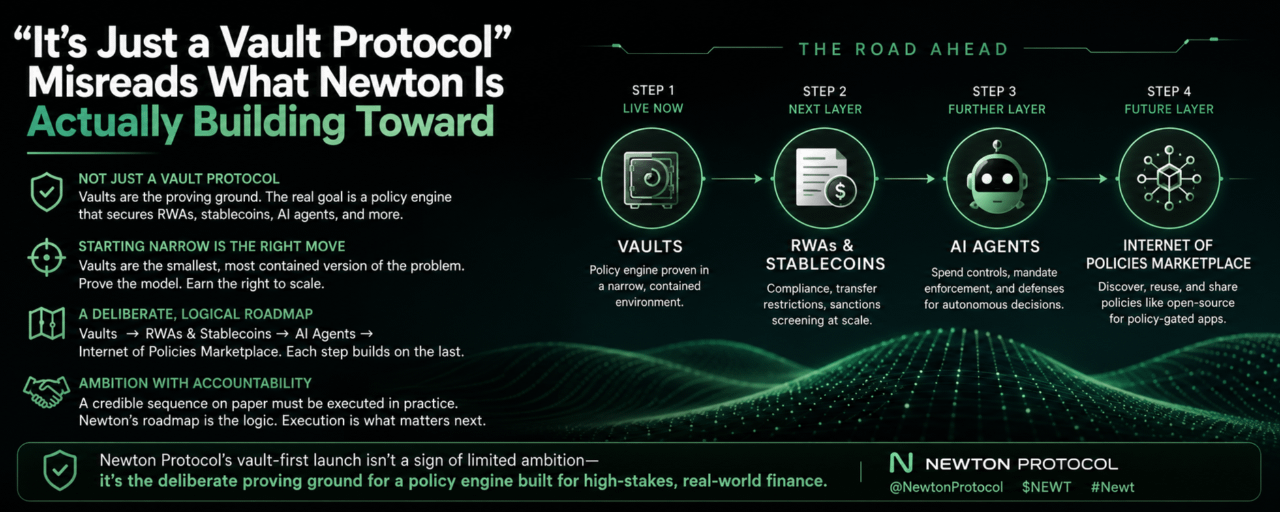
The fastest way to dismiss Newton right now is to call it a vault protocol with extra steps. Vaults are what shipped first, vaults are what the mainnet beta actually does today, and it's tempting to conclude that's the ceiling of the ambition rather than the floor. That conclusion is wrong, but it's wrong in an interesting way, because it's not wrong about the facts, it's wrong about what the facts mean.
The stereotype isn't baseless. A new protocol launching with a narrow use case and a roadmap full of bigger promises, RWAs, stablecoins, AI agents, an entire marketplace of reusable policies, is a pattern the industry has seen fail more often than it's seen succeed. Plenty of teams ship a working MVP and a sprawling vision document, and the vision document quietly becomes the thing investors remember while the actual product stalls at whatever it shipped on day one. Skepticism toward an ambitious roadmap attached to a narrow current product is a reasonable default, not paranoia.
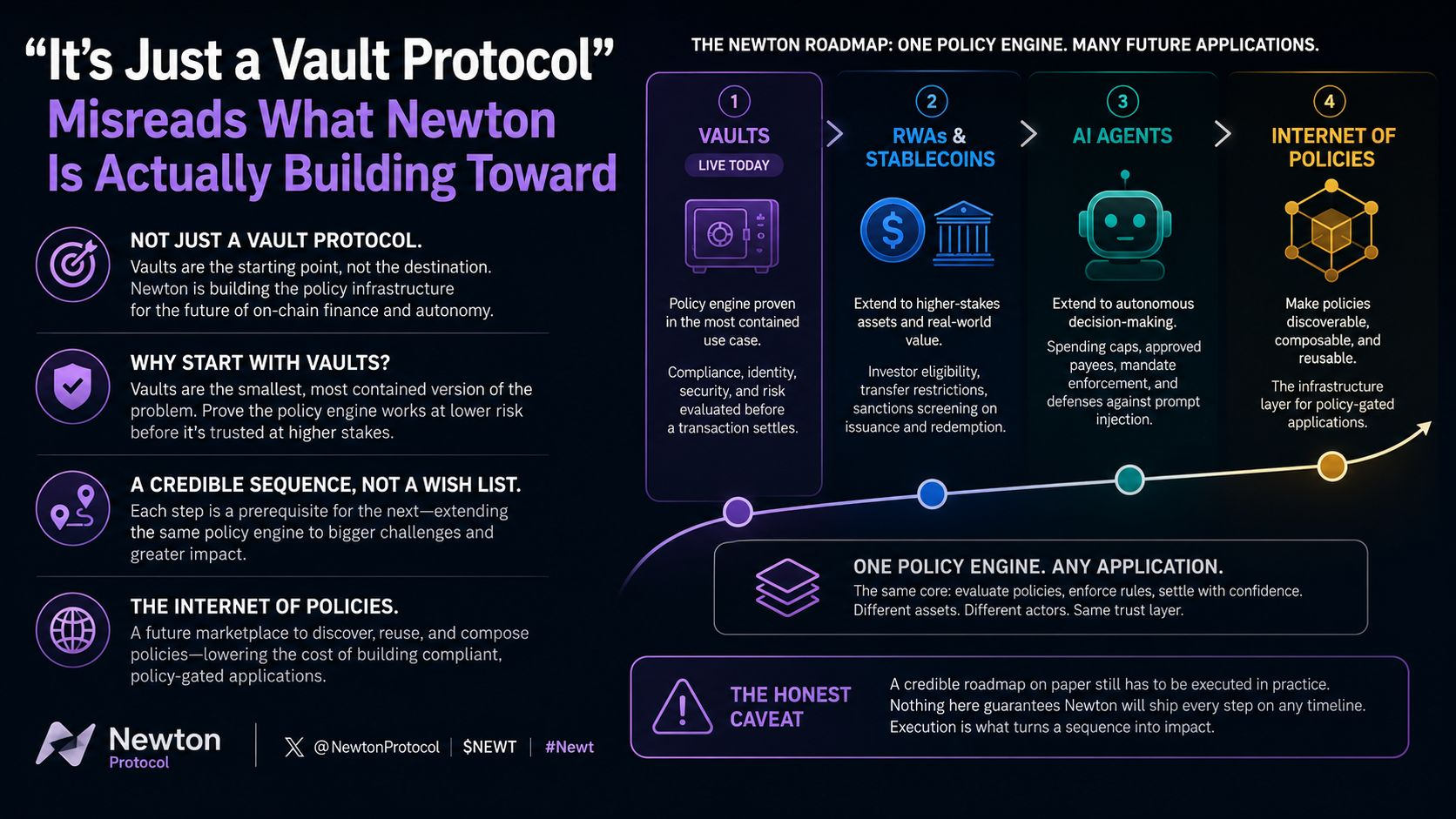
What the stereotype misses, in Newton's specific case, is the deliberate logic behind the sequencing rather than the sequencing being a sign of limited ambition. A policy engine that's going to eventually gate sanctions screening on a stablecoin moving billions in volume, or guardrails on an autonomous AI agent making spending decisions without a human reviewing each one, has no business being trusted with that responsibility before it's proven it can reliably enforce something smaller and more contained first. Vaults are the smallest, most contained version of the same underlying problem, compliance, identity, security, and risk evaluated before a transaction settles, just applied to a narrower scope where mistakes are more recoverable.
This is the part the "just a vault protocol" framing gets backward. Starting narrow isn't evidence the team lacks ambition for the rest of the roadmap, it's the only credible path toward earning the right to operate at the scale the rest of the roadmap describes. A team that shipped RWA compliance enforcement and AI agent guardrails on day one, with no track record proving the underlying policy engine actually works under real transaction volume, would be a much bigger red flag than a team that proved the model on vaults first.
The roadmap itself isn't vague about where this goes. RWAs and stablecoins represent the next layer, issuers needing investor eligibility enforcement, transfer restrictions, and sanctions screening on every issuance and redemption, the exact domains Newton's architecture already covers for vaults, applied to a different asset class. AI agents represent a further layer, spending caps, approved payee restrictions, mandate enforcement, and defenses against prompt injection, guardrails that become more urgent as autonomous agents handle more financial decision-making without direct human oversight on each individual action.
The Internet of Policies marketplace is the part of the roadmap that hasn't shipped yet and is hardest to evaluate in advance, a system where curators could presumably list, discover, and reuse policies the way developers reuse open-source packages today. If it works as described, it could meaningfully lower the cost of building new policy-gated applications, letting a stablecoin issuer adopt a proven sanctions-screening policy rather than building one from scratch. It's also the piece of the roadmap furthest from anything currently live, which means it deserves to be treated as a stated intention rather than a demonstrated capability until there's a working version to actually evaluate.
What separates "ambitious roadmap as marketing" from "ambitious roadmap as a credible sequence" is whether each step is actually a prerequisite for the next one, or just a list of unrelated features stacked together to sound impressive. Newton's roadmap reads like the former, vaults proving the policy engine works, RWAs and stablecoins extending it to higher-stakes asset classes, AI agents extending it to autonomous decision-making, and a policy marketplace eventually making all of it reusable rather than rebuilt from scratch each time.
Newton Protocol's vault-first launch isn't a sign the broader roadmap is aspirational marketing layered on top of a narrow product, it's the deliberate proving ground a policy engine needs before it has any business being trusted with RWA compliance or autonomous agent guardrails at meaningfully higher stakes. The honest caveat is that a credible sequence on paper still has to be executed in practice, and nothing about the logic of the roadmap guarantees Newton actually ships RWAs, stablecoins, or the Internet of Policies marketplace on a timeline anyone can currently verify.