

I've been thinking about a specific kind of problem lately. Not the kind you can solve by adding more compute or training on cleaner data. The kind that shows up quietly, spreads laterally, and only becomes visible once the damage is already structural. The kind of problem that AI infrastructure is about to run directly into whether the market is ready for it or not.
The problem is lineage collapse.
Most people in crypto still frame the AI conversation around model quality. Better reasoning, faster inference, multimodal capability, benchmark scores. That frame made sense when models were isolated products sitting inside company servers. It stops making sense once outputs start moving between systems, getting consumed by downstream agents, absorbed into ranking layers, used to train subsequent models, and treated as economic objects with real consequence attached to them. At that point, the question of where the output came from becomes structurally important in a way that benchmark scores never were.
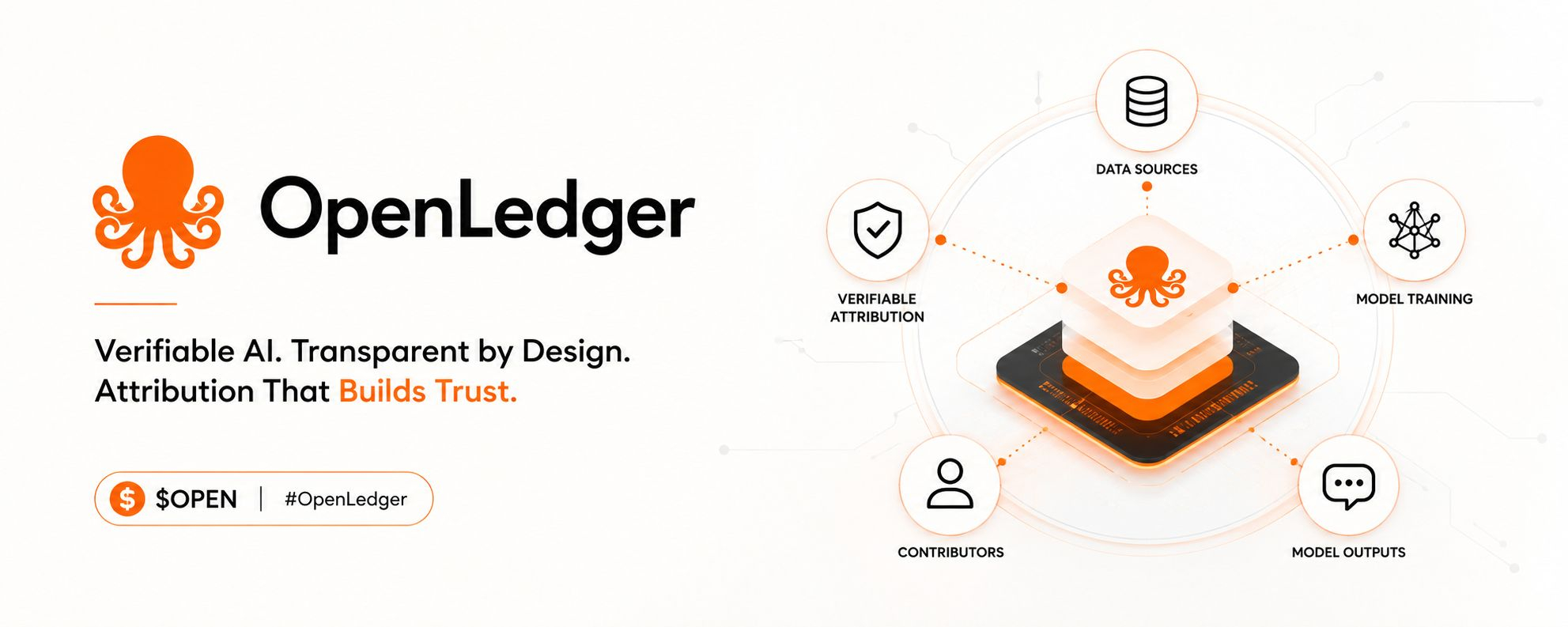
OpenLedger's Proof of Attribution is embedded at the protocol level, ensuring that data sources are cryptographically linked to model outputs, and contributors are rewarded proportionally to the influence of their data on actual inferences.
When I first read that, I filed it under "interesting tokenomics mechanism." The more I think about it, the more I think that's exactly the wrong frame for understanding what's being built.
Because this isn't primarily about fairness to contributors. That's the surface layer. The deeper structural point is that AI systems are increasingly operating inside environments where provenance isn't optional anymore. U.S. public trust in AI has fallen sharply over the past five years, and several pending lawsuits against companies like OpenAI and Google highlight the legal and structural gaps in data sourcing practices.
That isn't noise. That's the early signal of a market that's starting to price in accountability as an operational requirement rather than a reputational nice-to-have.
And once accountability becomes a hard requirement, the systems that preserved lineage from the beginning look completely different than the systems scrambling to retrofit it later.
Unlike general-purpose blockchains or AI projects that only focus on compute and storage, OpenLedger is AI-first at the protocol level. Its Proof of Attribution records every dataset, training step, and model inference on-chain, ensuring contributors are credited and rewarded. The language around this tends to emphasize contributor compensation, and I understand why. It's easier to market. But the architectural consequence is that every object produced inside this system carries its history with it. Not as an annotation. Not as metadata that can be stripped away. As verifiable chain state that persists across the system regardless of how many downstream environments the output passes through.
That is a fundamentally different thing than what current AI systems produce.
Right now, most AI outputs are historyless by design. They arrive as finished objects. Clean, confident, detached from the messy influence path that produced them. Downstream systems consume them as if that history never existed. And for a while that worked fine, because downstream systems weren't carrying real consequence. They were interfaces. They were chatbots. Nobody sued you because the response came from a training set scraped without consent if the response was just answering a trivia question.
But that calculus is changing fast. The OPEN Mainnet launch positions each AI output as traceable back to its source contributors, enabling verifiable credits and automated payouts based on actual usage. The economic mechanism is interesting. The structural implication is more interesting. Because once you build a system where every output carries verifiable lineage, you've also built a system where the output can be audited, challenged, defended, or rejected based on what's in that lineage. You've turned a disposable interaction into something closer to a legal document.
I'm not entirely sure the market has priced in how consequential that distinction becomes once AI outputs start touching things that actually matter. Hiring decisions. Medical recommendations. Financial analysis. Regulatory compliance. Legal research. Institutional systems consuming AI-generated content at scale without knowing whether the underlying data was ethically sourced, properly attributed, or contaminated by manipulated inputs somewhere upstream.
OpenLedger's Attribution Engine technical update in January 2026 was specifically designed to ensure that data-output links remain intact even as AI models are updated and fine-tuned. That detail stayed with me. Because model updates are exactly where lineage typically breaks in conventional systems. You fine-tune a model, the weights shift, the relationship between any given output and its original training inputs becomes increasingly opaque. OpenLedger seems to be treating that opacity as an engineering problem to solve rather than an acceptable limitation to document.
Whether the solution actually holds at scale is a real question. The Proof of Attribution whitepaper describes two approaches: influence-function approximations for smaller models, and suffix-array-based token attribution for LLMs that checks output tokens against training data. Both of those are computationally expensive relative to just generating outputs without tracking them. That cost doesn't disappear because the mechanism is elegant. And in a market that still heavily rewards speed over accountability, expensive provenance tracking faces real adoption friction.
That's the tension I keep sitting with. The infrastructure being built here seems correct in the direction it's pointing. Verifiable attribution, persistent lineage, contributor economics tied to actual influence on inference rather than just upload volume. The $5 million grants program with Cambridge University launched in November 2025 is funding research into transparent blockchain-AI systems. The institutional credibility is there. The technical architecture is coherent. But credibility and coherence don't guarantee adoption timing.
The uncomfortable part of the thesis is that lineage infrastructure only becomes obviously necessary once systems that lack it start visibly failing in accountable environments. And visible failure in AI tends to come in slow, distributed ways that are easy to attribute to other causes. A model that produces outputs from contaminated training data doesn't fail dramatically. It just produces subtly wrong outputs that drift through downstream systems, get cited, get trained on again, get embedded into institutional processes, and cause problems that take years to trace back to their origin.
By the time that pattern becomes undeniable, the window for building attribution infrastructure from scratch has already closed. You retrofit it on top of systems designed without it, and the lineage is incomplete everywhere that matters most.
OpenLedger is trying to make data, models, and agents transparent, traceable, and rewardable in real time, in a field where most systems still operate as black boxes where data origins remain hidden.
That framing sounds aspirational. Read it again and it sounds like exactly what institutional AI adoption will eventually demand before it extends real trust to AI-generated outputs.
I don't know if $OPEN is priced correctly for any of this. Token economics are a separate conversation from infrastructure thesis. But I find myself increasingly convinced that the infrastructure thesis itself is aimed at a real structural gap, even if the market hasn't fully felt the pressure yet.
The question isn't whether AI accountability becomes important. It's whether it becomes important fast enough for early infrastructure to matter economically before the window closes.
That's the bet. And honestly I'm not sure it resolves cleanly in either direction.